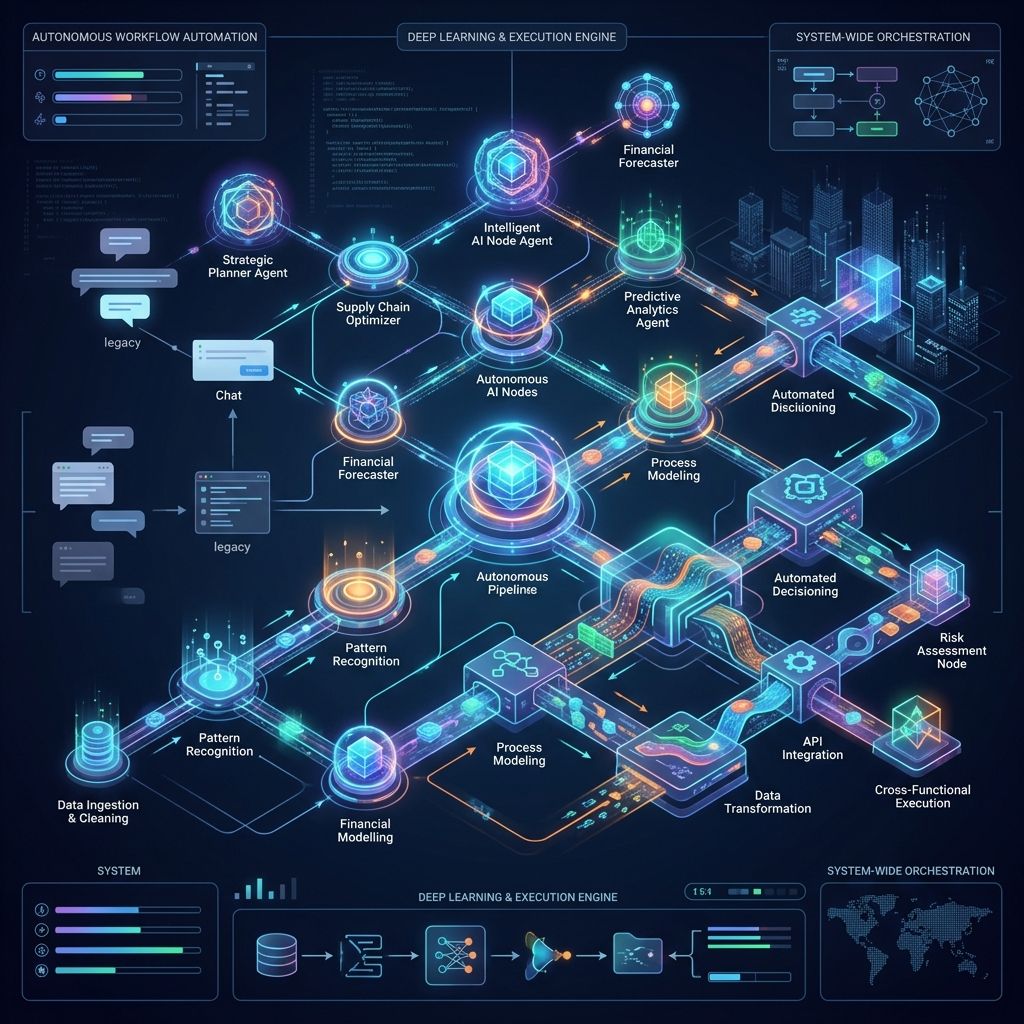
Global software leaders highlight a fundamental industry shift: the next phase of enterprise value creation is driven by autonomous agentic workflows rather than simple conversational chatbots.
Executive Key Takeaways
- Global software leaders highlight a fundamental industry shift: the next phase of enterprise value creation is driven by autonomous agentic workflows rather than simple conversational chatbots.
- Key Benchmark: **Primary Interface** — Text Chat Box / Prompt Window
- While 1st-generation enterprise AI focused primarily on conversational Q&A interfaces and text summarization, 2nd-generation enterprise AI deploys multi-agent orchestration frameworks capable of planning, executing, and auditing complex cross-departmental business workflows.
The global software ecosystem is undergoing a dramatic paradigm shift. Chief Information Officers (CIOs) and enterprise tech leaders report that the era of generic conversational chatbots is giving way to deep autonomous business automation.
While 1st-generation enterprise AI focused primarily on conversational Q&A interfaces and text summarization, 2nd-generation enterprise AI deploys multi-agent orchestration frameworks capable of planning, executing, and auditing complex cross-departmental business workflows.
Comparison: First-Gen Chatbots vs Second-Gen Autonomous Agentic Workflows
| Capability Dimension | 1st-Gen AI Chatbots (2023–2024) | 2nd-Gen Autonomous AI Agents (2026+) |
|---|---|---|
| Primary Interface | Text Chat Box / Prompt Window | Headless Background API Orchestration |
| Execution Horizon | Single-prompt, single-turn responses | Multi-step autonomous goals spanning days |
| System Integration | Read-only knowledge retrieval (RAG) | Full Read/Write API access to ERP, CRM, & DBs |
| Human Supervision | Human initiates and reviews every output | Human approves high-value checkpoints |
| Economic Value | Incremental employee convenience | Full end-to-end operational automation |
Core Pillars of Deep Business Automation
1. Multi-Agent Collaboration: Specialized AI agents (e.g., Finance Agent, Compliance Agent, Procurement Agent) communicate synchronously to complete vendor onboarding and contract reconciliation without human intervention.
2. Deterministic Guardrails & Audit Trails: Enterprise architectures enforce strict schema validation, role-based access control (RBAC), and transactional rollbacks to ensure complete compliance.
3. Self-Healing Process Pipelines: When API schemas change or external services experience downtime, modern autonomous agents dynamically reroute sub-tasks.
This evolution is echoed in recent earnings reports, including Fractal Analytics' 92% Profit Surge and VC Investment Patterns.