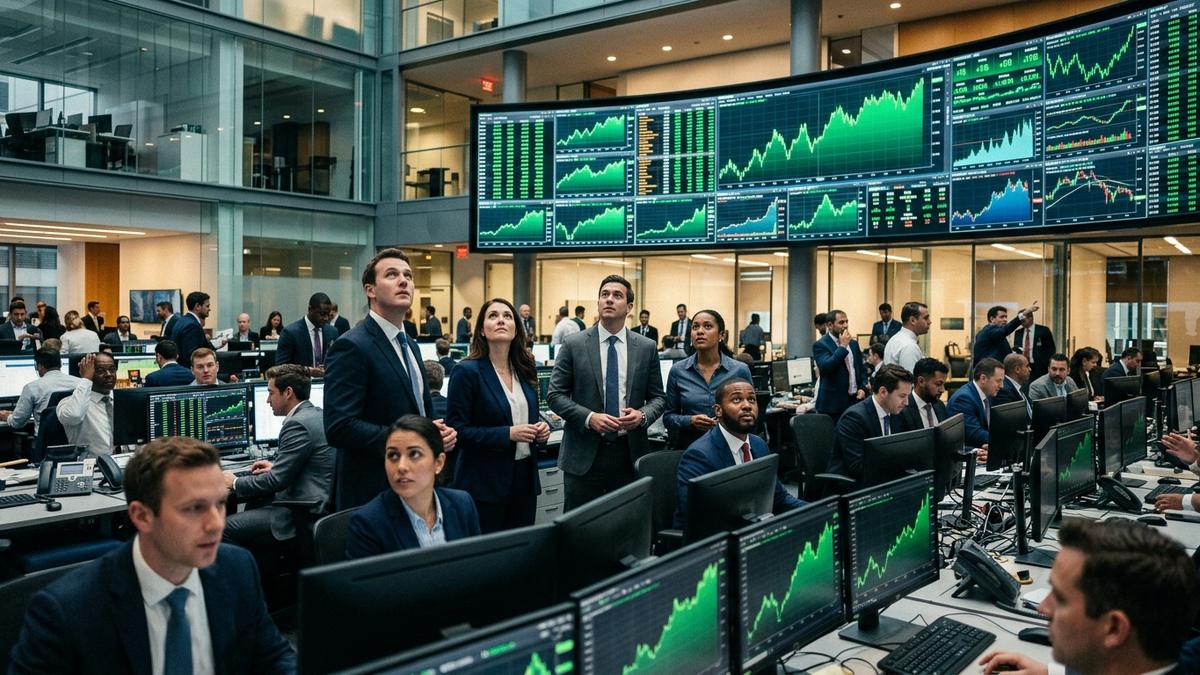
The Nifty IT index rallied over 16% as Indian tech majors TCS, Infosys, and HCLTech rebounded, buoyed by enterprise AI adoption and global capital rotation out of volatile tech trades.
Executive Key Takeaways
- The Nifty IT index staged a vigorous ~16% rebound, led by front-line tech majors TCS, Infosys, HCLTech, and Tech Mahindra rebounding from multi-month lows.
- Fears that generative AI would cannibalize traditional IT outsourcing have subsided as Indian system integrators secure large-scale enterprise GenAI consulting contracts.
- Global asset managers rotated institutional liquidity out of overextended US semiconductor stocks into cash-rich, defensive Indian IT service providers with stable balance sheets.
India's premier technology equities have staged a powerful and sustained recovery, with the benchmark Nifty IT index surging approximately 16% over recent trading sessions to break past key psychological resistance levels and reclaim multi-month highs. The sharp sector-wide rebound has been spearheaded by tier-1 global IT services bellwethers Tata Consultancy Services (TCS), Infosys, HCLTech, and Tech Mahindra, decisively reversing months of negative market sentiment triggered by global macroeconomic caution and fears of artificial intelligence disruption.
The resurgence in market confidence reflects a profound narrative shift among domestic and foreign institutional investors. After enduring more than a year of skepticism over whether automated code generation tools would cannibalize traditional outsourcing business models, Wall Street and Dalal Street are recognizing that enterprise generative AI adoption represents a multi-billion-dollar services tailwind rather than an existential threat.
Easing the Cannibalization Narrative: How Indian IT Monetizes Generative AI
When generative AI tools first emerged in late 2022, equity analysts warned of severe revenue deflation for Indian IT services. The prevailing bear thesis claimed that automated coding assistants would slash headcount requirements, compress billing rates, and allow enterprise clients to build custom software in-house without external systems integrators.
However, operational reality across global enterprise IT environments has dismantled this simplistic thesis:
- The Enterprise Data Bottleneck: Frontier AI models cannot generate meaningful corporate value when connected to fragmented, dirty legacy databases. Fortune 500 corporations are contracting Indian IT majors to execute massive data modernization, schema restructuring, and governance pipelines before AI models can even be deployed.
- Complex Multi-Vendor Integration: Enterprise software stacks do not operate in a vacuum. Integrating autonomous AI agents across legacy SAP mainframes, Salesforce CRMs, and hybrid cloud infrastructures requires deep domain architecture and custom middleware integration.
- Compliance, Guardrails, and Security: Enterprise CISOs refuse to deploy probabilistic AI models without deterministic audit logs, role-based access controls, and strict compliance monitoring—creating lucrative ongoing managed service contracts.
"The market dramatically misunderstood the reality of enterprise AI adoption,"noted institutional equities directors tracking Indian IT. "Writing code was never the primary value proposition of Indian IT majors—system architecture, complex enterprise integration, regulatory compliance, and 24/7 reliability were. Generative AI increases software complexity by an order of magnitude, and enterprises are turning to trusted partners like TCS and Infosys to manage that complexity."
This broader capital re-rating across enterprise technology aligns with strategic corporate finance moves such as /post/persistent-systems-approves-8000-crore-bond-issue-refinance-nagarro and the projected $100 billion public market expansion outlined in /post/goldman-sachs-forecasts-100-billion-india-ai-market-cap.
Global Capital Rotation: The Shift from Hardware Capex to Defensive Services
Beyond enterprise operational realities, a major macroeconomic rotation has redirected international capital flows. Over the past twelve months, global asset managers heavily concentrated portfolios in high-flying US semiconductor manufacturers and hardware hyperscalers. As valuations across these hardware names reached historically stretched price-to-earnings (P/E) multiples, institutional investors grew wary of near-term capex deceleration.
This valuation tension prompted institutional managers to rotate capital into attractively priced, cash-rich emerging market equities:
1. Compelling Free Cash Flow Yields: Indian IT front-liners maintain pristine, debt-free balance sheets, generating robust free cash flows with consistent dividend payout ratios exceeding 75%.
2. Defensive Currency Hedge: With revenues primarily billed in US Dollars and Euros while operating expenses remain in Indian Rupees, Indian IT majors offer natural currency depreciation protection.
3. Reasonable Valuation Multiples: Following the sector correction, front-line IT multiples had compressed to historical mean levels of 22x to 25x one-year forward earnings, providing an attractive margin of safety.
The table below highlights performance metrics and valuation parameters across leading Indian IT services firms during the recent rebound:
| IT Services Major | Recent Rebound Rally (%) | Total Contract Value (TCV) Pipeline | Operating Margin (EBIT %) | Trailing P/E Multiple | Key Strategic Growth Vector |
|---|---|---|---|---|---|
| Tata Consultancy Services (TCS) | +14.8% | $8.6 Billion | 24.1% | 27.2x | AI WisdomNext platform, sovereign cloud migrations |
| Infosys Limited | +17.2% | $7.2 Billion | 21.2% | 26.5x | Topaz GenAI suite, enterprise cognitive workflows |
| HCL Technologies | +15.4% | $4.5 Billion | 18.6% | 24.8x | Digital engineering, telecom 5G edge AI |
| Tech Mahindra | +18.6% | $2.8 Billion | 12.8% | 31.4x | Margin recovery turnaround, telecom AI routing |
| LTIMindtree | +16.1% | $1.9 Billion | 15.5% | 33.1x | Core banking transformation, cloud data fabrics |
Resilient Q2 Performance and High-Conviction Institutional Upgrades
Second-quarter corporate earnings reports across the sector acted as the primary operational catalyst for the stock rebound. While overall revenue growth remained moderate in constant currency terms, deal total contract value (TCV) was exceptionally robust. Furthermore, disciplined cost optimization and improved employee utilization rates allowed companies to expand operating margins despite ongoing wage increments.
Leading global investment brokerages, including Jefferies, Kotak Institutional Equities, and JPMorgan, responded by issuing selective rating upgrades, citing an asymmetric risk-reward profile and the potential for a sustained multi-year re-rating as discretionary tech spending recovers in key North American and European markets.
The infrastructure requirements for this enterprise software transition are accelerating demand at specialized providers, such as /post/simplismart-eyes-fresh-funding-ai-inference.
FY27 Growth Trajectory: Cloud Migration, Data Modernization, and Multi-Agent Systems
Looking ahead toward FY27 and FY28, industry leaders expect the nature of enterprise IT outsourcing to continue evolving rapidly. As corporations move beyond simple pilot programs into large-scale multi-agent orchestration, the demand for high-end systems integration, real-time security monitoring, and continuous model governance will expand substantially.
Having weathered the storm of global AI skepticism, India's flagship technology sector has once again demonstrated its remarkable structural resilience—reaffirming its role as the indispensable digital engineering engine of the global economy.
Frequently Asked Questions
What drove the sharp rebound in Indian IT stocks and the Nifty IT index?
The rebound was fueled by twin catalysts: first, resilient Q2 financial results and robust deal pipelines confirming that generative AI expands rather than diminishes enterprise IT service demand; second, a global equity rotation that directed capital away from overvalued semiconductor stocks into cash-generative, defensive Indian IT majors.
Which tech stocks led the market recovery?
The rally was led by industry bellwethers Tata Consultancy Services (TCS), Infosys, HCL Technologies, and Tech Mahindra, with mid-cap digital engineering specialists like LTIMindtree and Persistent Systems also recording strong institutional buying.
Why had Indian IT stocks faced heavy selling pressure in earlier months?
Earlier investor sentiment was depressed by fears that generative AI automated coding tools would cannibalize billable engineer hours and compress margins, coupled with elevated US interest rates that temporarily slowed corporate discretionary tech spending.
What is the forward outlook for Indian IT services in FY27?
Brokerages including Jefferies, Kotak Securities, and Goldman Sachs maintain an improving risk-reward outlook, highlighting that enterprise AI modernization requires extensive data cleaning, ERP cloud migration, and continuous security compliance—work that will sustain multi-year billing momentum.
Primary Sources & Official References
- National Stock Exchange of India (NSE): Nifty IT Index Performance and Sector Trading Metrics
- Tata Consultancy Services (TCS) & Infosys Limited: Second Quarter Financial Performance and Deal TCV Briefings
- Jefferies Equity Research: Indian IT Services Valuation and Generative AI Adoption Analysis
- Reserve Bank of India (RBI): Balance of Payments and Software Services Export Trends