Seed to Series A Valuation Normalization in 2026: The New Capital Efficiency Playbook for Indian Founders
By Priya Ramanathan | Published August 20, 2026 | 8 min read

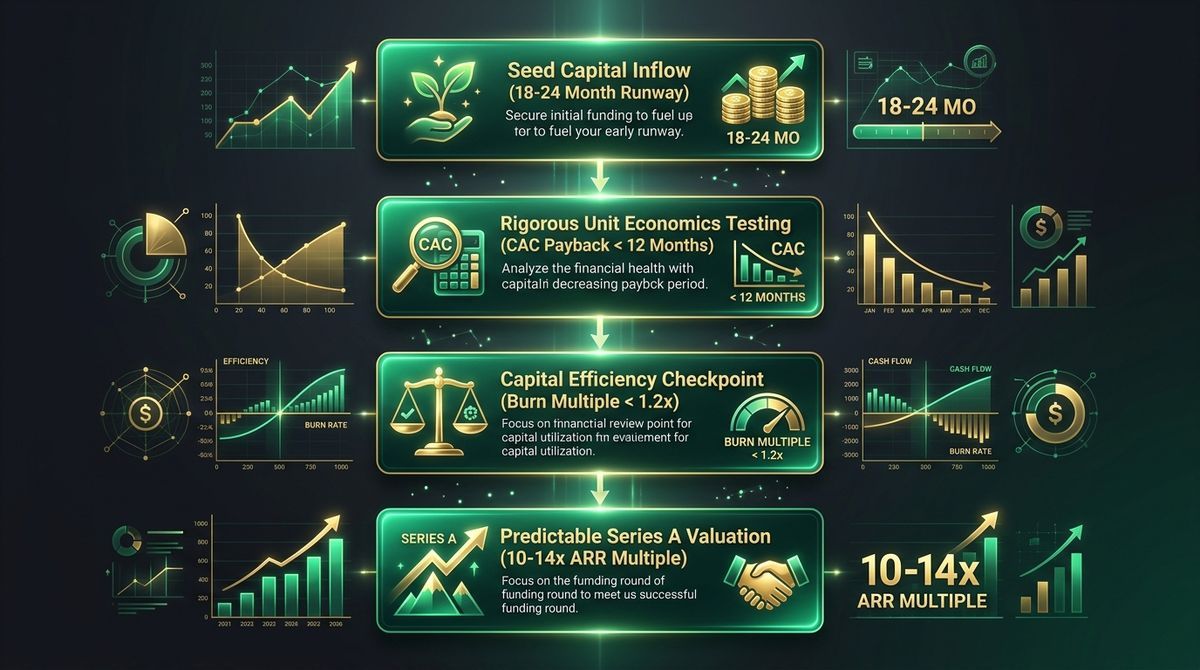
As venture capital shifts focus from blitzscaling to capital efficiency, early-stage Indian startups are operating on disciplined 24-month runways, sustainable burn multiples, and normalized 8-12x ARR multiples.
The Indian startup ecosystem has officially decoupled from the speculative exuberance of the 2021 funding cycle, establishing a mature, data-driven framework for early-stage capital allocation. Institutional venture funds, family offices, and cross-border investors have recalibrated due diligence metrics, placing premium valuation multiples on capital efficiency, sustainable gross margins, and verifiable customer retention over top-line growth at all costs.
For founders navigating Seed, Pre-Series A, and Series A rounds in 2026, this shift represents a fundamental return to first-principles economics. Rather than raising large, heavily dilutive rounds based on inflated ARR multiples, top-quartile founders are executing disciplined playbooks designed to maximize cash runway and reach default-investable status.
The Valuation Reset: 2021 vs. 2024 vs. 2026
The structural realignment of valuation multiples across Indian tech sectors reflects a healthier, more resilient fundraising environment:
| Round / Milestone | 2021 (Peak Exuberance) | 2024 (Market Correction) | 2026 (Normalized Baseline) |
|---|---|---|---|
| Seed Round Median | $2.5M – $3.5M at $12M–$18M post | $1.0M – $1.5M at $5M–$8M post | $1.5M – $2.2M at $7M–$10M post |
| Series A Median | $12M – $18M at $50M–$75M post | $5M – $8M at $22M–$30M post | $7M – $12M at $30M–$45M post |
| Median B2B SaaS ARR Multiple | 35x – 60x forward ARR | 6x – 10x trailing ARR | 10x – 14x trailing ARR (Quality Premium) |
| Expected Runway Buffer | 12 – 15 months | 24 – 30 months | 18 – 24 months with clear break-even path |
| Primary Dilution Per Round | 15% – 20% | 22% – 30% | 18% – 22% balanced equity structure |
The Capital Efficiency Scorecard: What VCs Audit in 2026
Institutional investment committees have replaced vanity metrics like Gross Merchandise Value (GMV) and registered user signups with rigorous operational health ratios:
1. The Burn Multiple (Net Burn / Net New ARR):
- Best-in-Class: < 1.0x (generating $1.00+ in ARR for every $1.00 burned).
- Acceptable: 1.0x – 1.5x.
- Red Flag: > 2.0x (indicates unsustainable customer acquisition or product-market churn).
2. Net Revenue Retention (NRR):
- For enterprise SaaS, VCs expect NRR > 115%, proving that expansion revenue from existing accounts outpaces gross churn.
3. Magic Number (Net New ARR * 4 / Sales & Marketing Expense):
- A Magic Number above 0.75x – 1.0x demonstrates efficient go-to-market channels, justifying accelerated capital deployment.
Strategic Tactics for Founders Navigating Series A
To optimize term sheets and avoid toxic liquidation preferences or ratchets, founders are adopting three structural funding strategies:
- Right-Sizing the Round Size: Instead of raising maximum available capital at aggressive valuations, founders are targeting exact 24-month operational requirements with a 20% contingency buffer, preventing painful down-rounds in subsequent growth cycles.
- Blending Venture Debt with Equity: As detailed in our venture finance guides, founders are complementing equity rounds with 15–20% non-dilutive venture debt to finance working capital, equipment, and GTM expansion without sacrificing founder control.
- Targeting Deep-Tech & Sovereign Programs: Startups in semiconductors, aerospace, and energy are leveraging non-dilutive government grants and corporate incubation pipelines (such as the MC² Foundation Energy Deep-Tech Accelerator) to achieve technology readiness milestones before institutional Series A rounds.
"A founder who builds a $2M ARR business burning $50k a month is far more valuable and resilient than one who bought $5M in ARR by burning $500k a month."
By anchoring fundraising narratives around capital efficiency and predictable customer payback periods, Indian entrepreneurs are building enduring companies capable of compounding value across all economic cycles.
Model your company's ownership distribution with our Cap Table Simulator or calculate current funding metrics using the Valuation Calculator.