Zepto Plans Fresh ₹1,000 Crore Pre-IPO Fundraise to Strengthen Balance Sheet and Expand Quick Commerce Footprint
By Aditi Sharma | Published August 2, 2026 | 8 min read
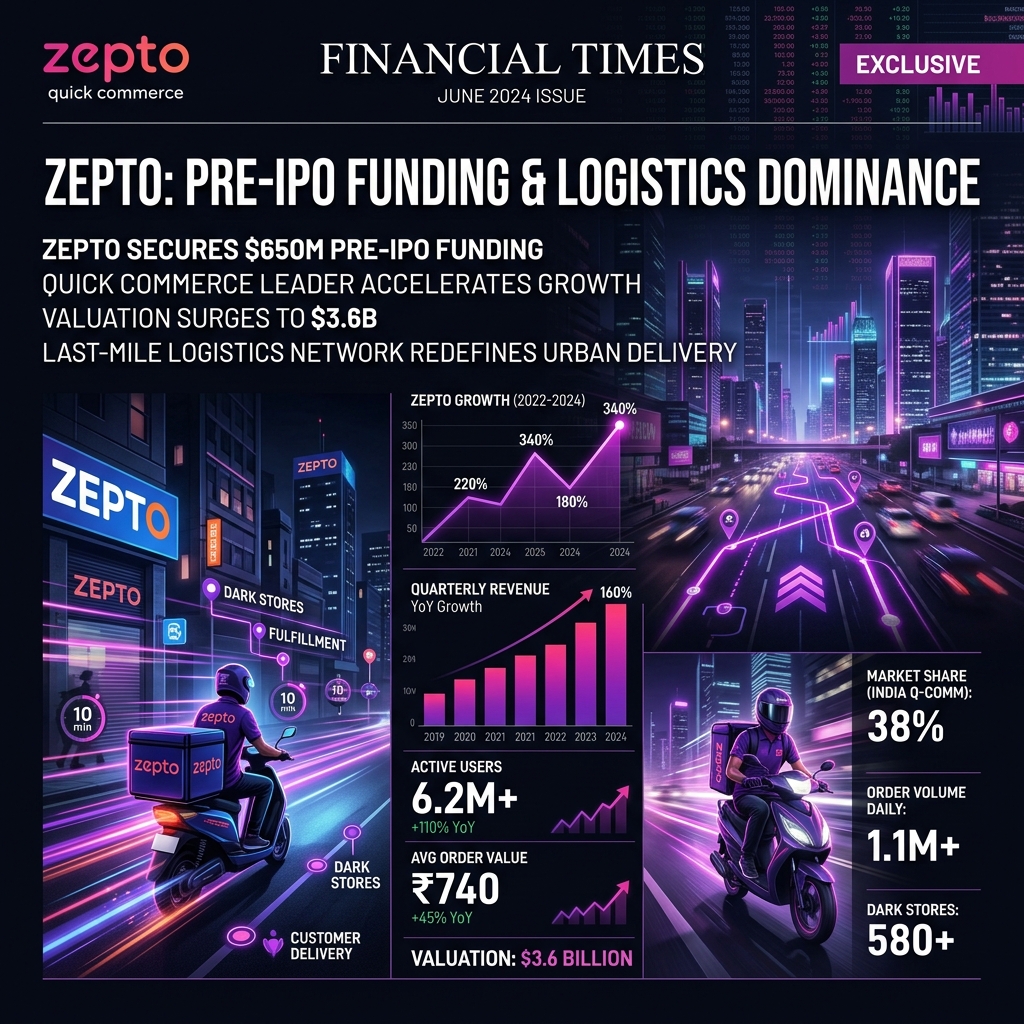
Quick-commerce leader Zepto pursues a fresh ₹1,000 crore funding round, delaying public listing plans to build balance sheet resilience and expand dark store footprint.
In a strategic pivot aimed at solidifying capital reserves, quick-commerce unicorn Zepto is preparing to secure a fresh pre-IPO capital injection of approximately ₹1,000 crore ($120 million). By prioritizing financial resilience and operational expansion over a rushed public debut, the Mumbai-headquartered venture is taking a measured approach to long-term sustainable growth.
The decision to raise capital ahead of its anticipated initial public offering (IPO) comes as competition in India's 10-minute delivery landscape intensifies. Rather than navigating public market volatility under tight listing timelines, Zepto is choosing to fortify its balance sheet, optimize unit economics, expand its dark store density across Tier-1 and Tier-2 urban hubs, and upgrade its core supply chain technology infrastructure.
Strategic Rationale Behind Pre-IPO Capital Infusion
The upcoming fundraise represents a calculated effort by Zepto's leadership team to enter the public equity markets with undeniable fundamentals, robust cash flow buffers, and expanding profit margins across mature fulfillment hubs. While market conditions for Indian tech listings have shown positive momentum, institutional investors increasingly demand clear paths to profitability and sustained operational moats.
By securing ₹1,000 crore in private growth capital, Zepto mitigates the short-term market pressures associated with quarterly public reporting while executing capital-intensive expansion plans.
Dark Store Footprint Expansion and Capacity Building
A major allocation of the incoming capital will be directed toward expanding Zepto's micro-fulfillment network:
- Dark Store Density: Scaling active dark store locations from 500+ to over 750 across metros and high-growth Tier-2 markets.
- Category Diversification: Expanding beyond groceries and daily essentials into high-margin consumer electronics, beauty, fashion, and quick-delivery home goods.
- Cold-Chain Automation: Upgrading temperature-controlled storage infrastructure to optimize perishable handling and reduce shrinkage rates.
Furthermore, as seen in market shifts across construction and specialized quick commerce such as Fixxly's recent funding round, ultra-fast delivery models are expanding rapidly beyond consumer groceries into broader retail segments.
Quick Commerce Unit Economics & Capital Allocation Matrix
Zepto's financial strategy centers around driving store-level EBITDA positivity while expanding average order value (AOV) and customer order frequency. The matrix below outlines key operational targets tied to the ₹1,000 crore pre-IPO fundraising round.
| Operational Focus Area | Key Target / Benchmark | Strategic Execution Vector |
|---|---|---|
| Total Pre-IPO Capital | ₹1,000 Crore (~$120 Million) | Balance sheet fortification & working capital runway |
| Dark Store Network | Expansion to 750+ Micro-Hubs | Increasing urban density in Tier-1 & Tier-2 cities |
| Order Delivery Target | 10–15 Minutes average fulfillment | Micro-logistics AI & predictive inventory routing |
| Target EBITDA Margin | Store-level positivity across 80% hubs | High-margin SKU mix & private label penetration |
| Tech Infrastructure | Advanced algorithmic dispatch | Reducing rider wait times & route optimization |
Advanced Micro-Logistics & AI Technology Infrastructure
Beyond physical store expansion, Zepto is doubling down on its proprietary technological architecture. The company relies heavily on real-time spatial algorithms, automated inventory picking, and machine learning models that forecast demand down to specific neighborhood blocks.
1. Predictive Stock Positioning: Machine learning engines analyze localized buying patterns to pre-stock fast-moving inventory before demand spikes.
2. Automated Order Dispatch: Dynamic routing algorithms pair delivery partners with incoming orders within seconds of checkout, minimizing idle time.
3. Inventory Loss Prevention: Computer vision systems monitor dark store shelves to eliminate stockouts and inaccuracies.
"Prioritizing balance sheet resilience over a hasty public listing ensures that Zepto enters public markets with robust fundamentals, strong EBITDA visibility, and unmatched operational depth,"noted a senior venture capital analyst familiar with Indian consumer tech trends.
Public Market Dynamics & Indian Tech IPO Pipeline
Zepto's decision to delay its public listing and build private runway mirrors a broader trend among Indian tech unicorns. As detailed in our coverage of India's August IPO pipeline featuring Shiprocket, high-profile ventures are choosing carefully calibrated launch windows to maximize valuation and investor confidence. Additionally, this move builds directly upon earlier developments around Zepto's strategic IPO deferral strategy.
Key Takeaways for the Quick Commerce Sector
- Investor Confidence: Raising capital prior to listing demonstrates strong private backer conviction and protects early shareholders from market swings.
- Competitive Advantage: Additional capital runway enables Zepto to defend its market share against legacy e-commerce players and rival quick-commerce operators.
- Long-Term Sustainability: Focus on unit economics ensures that public equity investors inherit a resilient business model poised for long-term compounding.
As Zepto finalizes the terms of its ₹1,000 crore raise, the quick-commerce leader is positioning itself not only to dominate India's instant delivery landscape, but to set a gold standard for tech listings on Dalal Street.