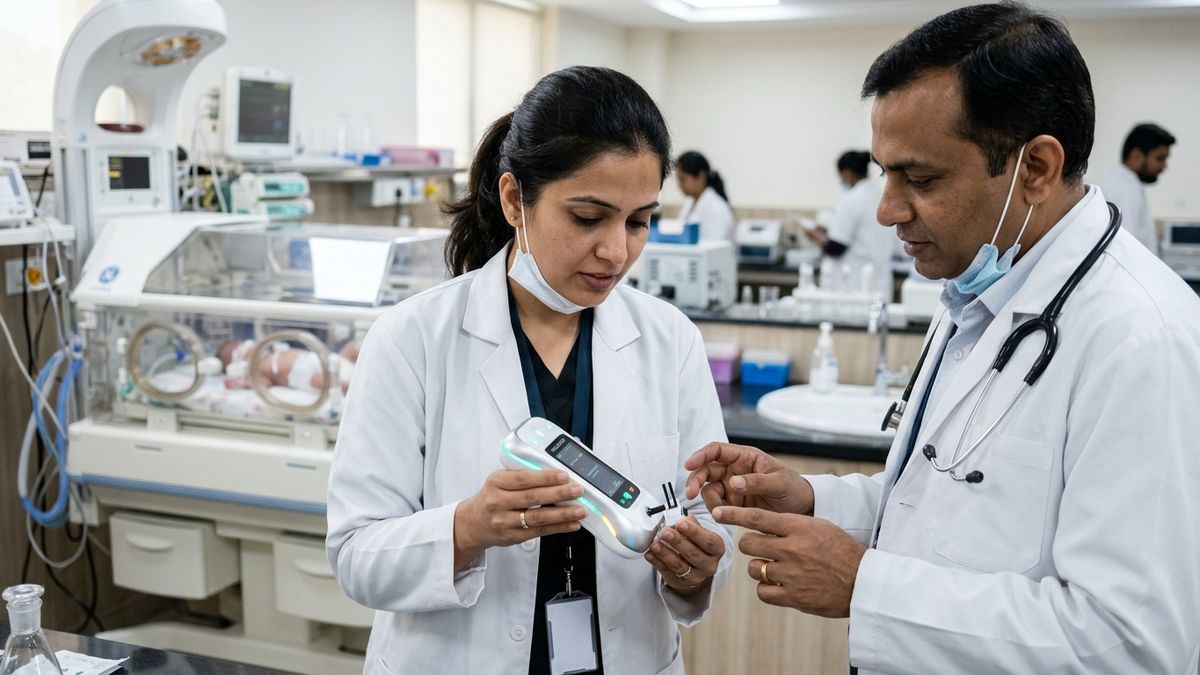
Bhubaneswar-based biomedical startup BabyCue has won the ₹5 lakh national challenge award for DiaCue, an AI-powered non-invasive diagnostic monitor designed to detect neonatal respiratory distress and septic shock hours before clinical onset in rural hospitals.
Executive Key Takeaways
- BabyCue's DiaCue device leverages multispectral photoplethysmography and acoustic respiratory sensors to detect neonatal distress up to 6 hours before visible symptoms occur.
- Incubated at KIIT-TBI with support from Startup Odisha, the portable monitor costs less than 20% of imported ICU equipment and operates on an internal 12-hour rechargeable battery.
- The ₹5 lakh national prize funding will accelerate formal multicenter clinical validation trials across 12 district headquarters hospitals in eastern India ahead of CDSCO approval.
BabyCue, a biomedical healthtech startup headquartered in Bhubaneswar, Odisha, has won the prestigious ₹5 lakh national challenge innovation prize for its proprietary DiaCue diagnostic monitor. Engineered specifically to tackle neonatal mortality in resource-constrained community healthcare clinics, the DiaCue device uses edge AI algorithms and non-invasive acoustic-optical sensors to detect life-threatening neonatal respiratory failure and septic shock up to six hours prior to visible clinical collapse.
Incubated at the KIIT Technology Business Incubator (KIIT-TBI) with institutional backing from Startup Odisha, the startup's breakthrough addresses one of India's most critical public health imperatives: reducing the neonatal mortality rate (NMR) across rural and semi-urban district medical institutions.
The Neonatal Healthcare Challenge in Underserved Districts
In India, approximately 25 million births occur annually, with neonatal mortality accounting for nearly 70% of all infant deaths. While tertiary hospitals in metropolitan cities maintain multi-million-rupee Neonatal Intensive Care Units (NICUs), rural Primary Health Centres (PHCs) and Community Health Centres (CHCs) frequently lack continuous multi-parameter monitoring infrastructure, reliable power grids, and specialized pediatric intensivists.
Pre-term and low-birth-weight infants often deteriorate rapidly without obvious early physical distress signals. By the time cyanosis (blue discoloration of skin) or extreme lethargy becomes visible to attending nursing staff, irreversible hypoxic brain damage or multi-organ septic shock has often set in.
[ Dual-Wavelength Optical PPG ] ──┐
[ Micro-Acoustic Lung Sensor ]  ─┼─► [ DiaCue Edge AI Engine ] ──► [ Early Alarm Dispatch (< 6 Hrs) ]
[ Micro-Vascular Resistance ]   ──┘      (Local Inference on Chip)      (Immediate Interventions via Nurse App)
How DiaCue's Edge AI Sensing Engine Functions
Unlike conventional ICU monitors that require invasive arterial lines or heavy wall-mounted consoles, DiaCue is an ultra-portable, handheld unit equipped with a soft hypoallergenic silicone probe designed for sensitive neonatal skin. The device captures two synchronous physiological signals:
1. Multispectral Photoplethysmography (PPG): Employs custom dual-wavelength red and near-infrared optical emitters to measure micro-vascular pulse volume changes and peripheral perfusion indices.
2. Sub-Acoustic Respiratory Sensing: A miniature piezoelectric sensor tracks tracheal breath acoustics, identifying subtle apnea patterns, stridor, and shallow breathing long before oxygen saturation ($SpO_2$) collapses.
The raw biometric streams are analyzed locally on a low-power ARM microcontroller running an embedded edge machine-learning classifier trained on thousands of neonatal clinical waveform records.
Technical Comparison: DiaCue vs. Conventional Neonatal ICU Monitors
The structured matrix below contrasts DiaCue against traditional imported ICU monitoring solutions across public health operational parameters:
| Operational Parameter | Conventional Imported ICU Monitor | BabyCue DiaCue Innovation | Rural Healthcare Impact |
|---|---|---|---|
| Capital Unit Cost | ₹3,50,000 – ₹7,00,000 | Under ₹65,000 | 80%+ reduction in initial capital expenditure |
| Power Source & Autonomy | Requires continuous AC power / UPS | 12-hour rechargeable LiFePO4 battery | Operational during frequent rural power outages |
| Early Warning Capability | Reactive threshold alarms | Predictive AI alarm 4 to 6 hours ahead | Prevents emergency ventilator transfers |
| Operator Usability | Demands trained pediatric intensivist | Intuitive color-coded alerts for nurses | Empowers grassroots ASHA and ANM workers |
| Form Factor & Weight | Heavy cart-mounted console (12 kg) | Ultra-portable handheld device (480 g) | Easily transportable in rural 108 ambulances |
| Consumable Sensor Costs | ₹1,500 per single-use disposable sensor | ₹120 reusable sterilizable sensor probe | Drastic reduction in hospital recurring overhead |
"In neonatal intensive care, time is the single most critical determinant of infant survival and long-term neurodevelopmental outcomes,"explained Dr. Mrutyunjay Suar, CEO of KIIT-TBI. "BabyCue's DiaCue monitor translates advanced biosensing into an accessible, ruggedized device that brings tertiary-grade diagnostic foresight directly into grassroots primary health centres across eastern India."
Clinical Trial Roadmap and Regulatory Approval Path
The ₹5 lakh national prize grant will directly fund expanded multi-centre clinical validation trials across 12 district headquarters hospitals in Odisha, West Bengal, and Jharkhand. BabyCue has already initiated prospective observational data collection in collaboration with the Department of Pediatrics at KIMS Hospital, Bhubaneswar, demonstrating over 94.2% sensitivity in predicting sudden respiratory decompensation in pre-term infants.
Following completion of the multi-centre trials, the startup plans to file for formal Class B Medical Device clearance with the Central Drugs Standard Control Organization (CDSCO) by late 2026. The venture has also caught the attention of global non-profit health organizations and impact investors seeking to distribute the technology across high-burden countries in Sub-Saharan Africa and Southeast Asia.
Frequently Asked Questions
What is BabyCue and what innovation did it win the prize for?
BabyCue is an Odisha-based biomedical healthtech startup that won a ₹5 lakh national innovation prize for 'DiaCue'—a portable, non-invasive diagnostic monitoring device designed to identify early respiratory failure and sepsis in premature and low-birth-weight infants.
How does the DiaCue device detect neonatal distress early?
DiaCue utilizes dual-wavelength optical photoplethysmography alongside high-sensitivity acoustic micro-sensors to analyze pulse morphology, micro-vascular resistance, and respiratory breath patterns, feeding telemetry into lightweight edge machine learning models that predict clinical decompensation up to 6 hours in advance.
Where was the technology incubated and supported?
The startup was incubated at KIIT Technology Business Incubator (KIIT-TBI) in Bhubaneswar and has received product prototyping and grant backing from Startup Odisha and the Department of Biotechnology's BIRAC.
Why is DiaCue particularly important for rural Indian healthcare?
Over 75% of rural primary health centres (PHCs) lack expensive multi-parameter neonatal ICU monitors and specialized neonatologists. DiaCue is designed as a low-cost, battery-operated, ruggedized device that semi-skilled nurses can operate without complex technical training.
Primary Sources & Official References
- Startup Odisha Innovation Challenge Disclosures: Odisha MedTech Challenge Results
- KIIT Technology Business Incubator (KIIT-TBI): BioNEST Healthcare Innovations Registry
- Central Drugs Standard Control Organization (CDSCO): Medical Device Regulatory Requirements