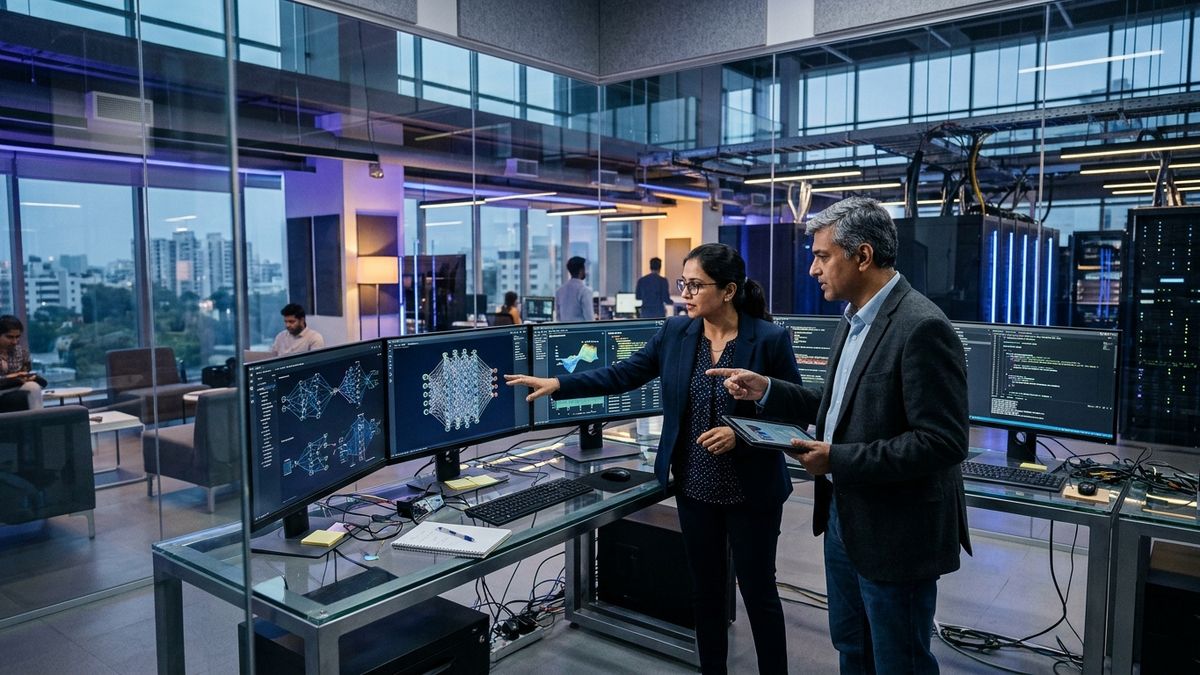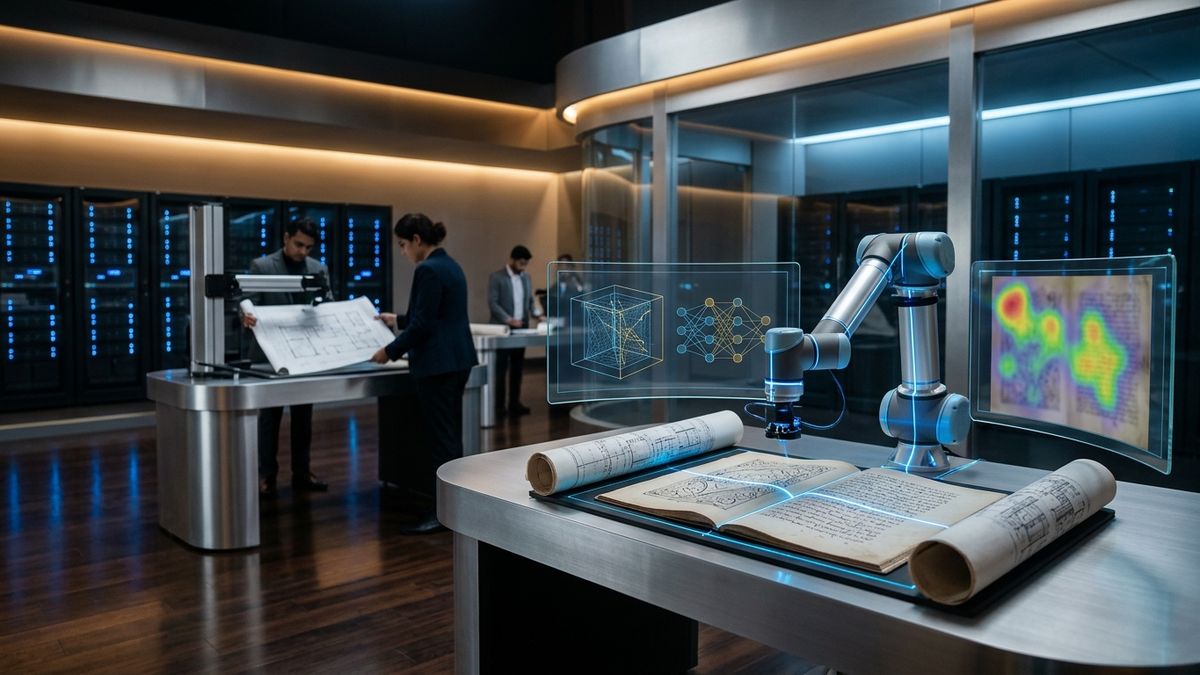
BharatGen has released Patram 1.5, an open-weight 7B vision-language model built in India for OCR 3.0 visual document understanding across English and Indian scripts.
Executive Key Takeaways
- BharatGen has released Patram 1.5, an Apache 2.0 open-weight 7-billion-parameter vision-language model (VLM) built from scratch with IIIT Hyderabad.
- Positioned as OCR 3.0, Patram 1.5 processes full document pages as images in a single pass—interpreting tables, stamps, seals, signatures, and mixed-script Indic text.
- Trained with built-in abstention to avoid hallucinating blank or illegible fields, it outputs structured JSON, HTML, or Markdown and was evaluated across 49 benchmarks including PatramBench.
BharatGen, India's government-backed generative AI initiative anchored at IIT Bombay and supported by the Department of Science and Technology (DST) and the IndiaAI Mission, has launched Patram 1.5, a homegrown 7-billion-parameter open-weight vision-language model (VLM) built specifically for enterprise and public-sector document intelligence. Developed in collaboration with the vision research team at IIIT Hyderabad, Patram 1.5 introduces what BharatGen calls OCR 3.0—processing complex, multi-script Indian documents in a single visual pass.
Released under the permissive Apache 2.0 license on Hugging Face and accessible through the BharatGen Playground, Patram 1.5 joins a growing wave of sovereign Indian AI infrastructure alongside Chariot's multilingual Chariot-1 launch and Sarvam AI's open-weight Indic LLM initiatives.
Why Single-Pass OCR 3.0 Matters for Indian Paperwork
Legacy document automation pipelines split Optical Character Recognition (OCR) from downstream Large Language Models (LLMs). While that two-stage approach works on clean English PDFs, it routinely breaks on Indian banking, healthcare, legal, and government paperwork—where multi-column tables, rubber stamps, official seals, handwritten marginalia, and mixed English-Indic scripts coexist on a single scanned page.
Patram 1.5 eliminates the intermediate plain-text bottleneck by ingesting entire document pages as images and combining visual perception with structured reasoning:
- Complex Visual Elements: Accurately interprets dense tables, charts, diagrams, photographs, official seals, rubber stamps, signatures, and handwritten corrections.
- Natural-Language Querying: Users can prompt the model in plain language to extract targeted fields—such as specific customer IDs or branch codes from cluttered bank statements—rather than dumping raw unformatted text.
- Structured Schema Outputs: Emits clean JSON, HTML, or Markdown ready for direct ingestion into ERP, core banking, and e-governance workflows.
"By uniting visual layout comprehension with domain-tuned Indic reasoning in a 7B open-weight checkpoint, enterprises can run high-stakes document workflows on private infrastructure without sending sensitive records to external APIs,"noted sovereign AI researchers following the release.
Hallucination-Safe Abstention and PatramBench Results
In regulated sectors such as banking KYC, insurance claims, and public records, a fabricated digit is far worse than a missed field. BharatGen trained Patram 1.5 with built-in abstention, teaching the model to recognize the limits of its visual certainty and flag blank, blurred, or illegible fields rather than guessing.
| Evaluation Dimension | Legacy Two-Stage OCR + LLM | BharatGen Patram 1.5 (OCR 3.0) |
|---|---|---|
| Model Architecture | Separate OCR engine + external text LLM | Unified 7B Vision-Language Model |
| Layout & Visual Cues | Often loses tables, stamps, and marginalia | Single-pass reading of tables, seals, signatures |
| Blank / Blurry Fields | Prone to silent text hallucination | Trained abstention flags illegible fields |
| Deployment & Licensing | Often proprietary cloud APIs | Apache 2.0 open weights for on-prem or private cloud |
Built in India Across 49 Benchmarks
Trained from scratch with computer vision and document-analysis researchers at IIIT Hyderabad, Patram 1.5 was evaluated across 49 distinct tests, comprising 34 public document-AI benchmarks and 15 specialized tasks from BharatGen's custom PatramBench suite. With Apache 2.0 open weights, Indian banks, fintechs, and state agencies—alongside enterprise cloud partners highlighted in Minfy and AWS's global AI expansion—can deploy Patram 1.5 inside air-gapped or local data centers with full data sovereignty.
Frequently Asked Questions
What is BharatGen's Patram 1.5 model?
Patram 1.5 is an open-weight 7-billion-parameter vision-language model developed by BharatGen and IIIT Hyderabad under India's DST and IndiaAI Mission, designed for visual document understanding and structured data extraction.
How does OCR 3.0 in Patram 1.5 differ from legacy OCR?
Traditional pipelines separate OCR text extraction from LLM reasoning, often breaking table layouts and visual context. Patram 1.5 reads entire document pages as images in a single pass, understanding tables, diagrams, rubber stamps, signatures, and handwritten edits.
How does Patram 1.5 prevent hallucinations on unclear documents?
Patram 1.5 is explicitly trained with built-in abstention: when a field is blank, blurred, or illegible, the model flags the uncertainty instead of fabricating values.
Under what license is Patram 1.5 available?
Patram 1.5 is released with open weights under the permissive Apache 2.0 license on Hugging Face and can also be tested via the BharatGen Playground.
Primary Sources & Official References
- Patram 1.5 Open-Weight Vision-Language Model Release & PatramBench Evaluation: BharatGen / IIIT Hyderabad, 2026 (bharatgen.com)
- IndiaAI Mission Sovereign Multimodal Foundation Model Framework: Ministry of Electronics and Information Technology (MeitY) & DST, 2026