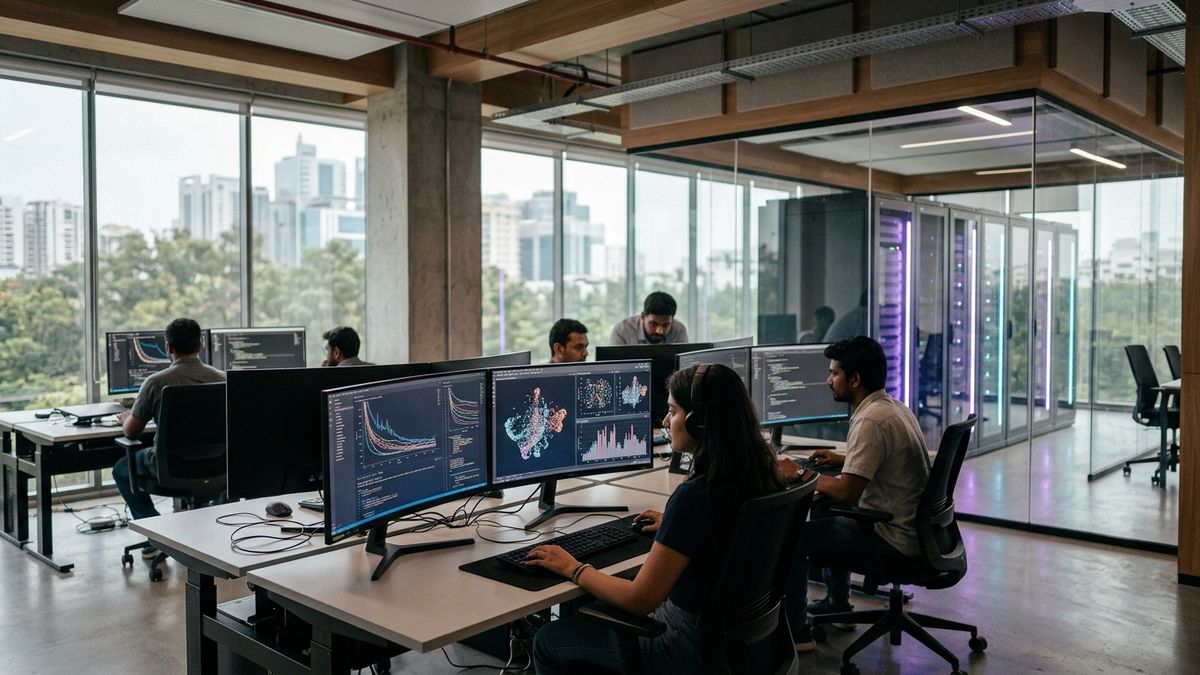
Sarvam AI accelerates India's sovereign AI roadmap with high-parameter bilingual foundation models, multimodal speech pipelines, and regional public utility deployments.
Executive Key Takeaways
- Sarvam AI expands its sovereign AI footprint, deploying the 105-billion parameter Indus foundation model and high-throughput speech pipelines across 22 scheduled Indian languages.
- The startup commands over 85% of domestic language-AI venture funding, supported by foundational compute allocation under the Ministry of Electronics and Information Technology (MeitY) IndiaAI Mission.
- State-level public infrastructure partnerships, including a planned 50MW AI-optimized facility in Odisha, establish dedicated sovereign intelligence rails for public governance, legal documentation, and industrial safety compliance.
Bengaluru-headquartered artificial intelligence research lab Sarvam AI has accelerated its sovereign foundation model roadmap, deploying scalable Mixture-of-Experts (MoE) language architectures, multimodal vernacular speech engines, and strategic public-sector infrastructure partnerships. Supported by compute allocation under the Ministry of Electronics and Information Technology (MeitY) IndiaAI Mission, Sarvam AI is systematically building an indigenous digital public infrastructure (DPI) designed to ensure that India's critical enterprise, financial, and civic data systems operate on domestically trained and verified neural models.
The sovereign push comes amid a broader national realignment toward technological autonomy. As generative AI becomes integrated into banking, judicial administration, defense logistics, and citizen welfare distribution, national planners have warned against technological dependency on foreign proprietary API endpoints. By engineering foundational models natively pre-trained on India's 22 scheduled languages and tokenized specifically for vernacular syntactic nuances, Sarvam AI is proving that localized foundation models can outperform generalized Western models on regional reasoning while dramatically reducing inference costs.
"Sovereign AI is not merely about hosting foreign weights in domestic data centers; it requires complete architectural ownership of tokenization, pre-training corpora, and domain reasoning. India cannot build its next digital decade on leased cognitive infrastructure."
"— Dr. Vivek Raghavan, Co-Founder, Sarvam AI"
Architectural Breakthrough: From Fine-Tuning to Ground-Up Indus MoE
While early-stage Indian AI initiatives relied heavily on instruction-tuning open-source models like Llama or Mistral, Sarvam AI has transitioned into end-to-end foundation pre-training. The company's flagship release—Sarvam-105B, operating in enterprise beta under the architectural codename Indus—utilizes a sparse Mixture-of-Experts (MoE) framework designed to optimize parameter activation during vernacular generation.
Traditional LLM tokenizers severely penalize Indic scripts like Devanagari, Tamil, Telugu, and Bengali, frequently requiring 4 to 8 tokens to represent a single Hindi word compared to 1 to 2 tokens for an English equivalent. This 'tokenization tax' results in quadrupled inference costs and sluggish generation latencies. Sarvam AI overcame this architectural bottleneck by developing a bespoke custom tokenizer trained across trillions of high-quality multilingual tokens, achieving near-parity token efficiency across Indian languages.
Recent market reports show that domestic language-AI startups have seen surging investor momentum, with Indian AI startups raising $1.6 billion in funding over the past nine months alone. Within this generative ecosystem, Sarvam AI commands over 85% of total capital allocated to foundational Indic language modeling.
Sovereign Model Suite & Technical Benchmarks
The table below outlines Sarvam AI's core architectural releases, compute parameters, context capacity, and enterprise deployment applications across the Indian digital economy:
| Model / Pipeline | Architecture Parameters | Context Window | Core Modality | Primary Enterprise & Civic Applications |
|---|---|---|---|---|
| Sarvam-105B (Indus) | 105B MoE (21B active) | 128,000 tokens | Bilingual / Multilingual Text | Legal reasoning, policy drafting, corporate audit, judicial summarization |
| Sarvam-30B | 30B Dense Transformer | 32,000 tokens | Indic Vernacular Text | High-throughput enterprise customer support, banking advisory, regional search |
| Saaras V3 | Multi-speaker Conformer ASR/TTS | Continuous stream | Audio & Speech | Voice commerce, call center automation, rural citizen welfare interfaces |
| Sarvam Vision | Hybrid Vision-Language Model | 16,000 tokens | Document Image & OCR | Sovereign digitisation of land records, vernacular invoices, KYC validation |
High-Throughput Speech: Unlocking Voice as India's Primary OS
In a country where hundreds of millions of smartphone users prefer voice over text inputs, Sarvam's speech intelligence stack represents its most immediate commercial moat. The Saaras V3 pipeline provides real-time speech-to-text (ASR) and expressive text-to-speech (TTS) across 10 major Indian languages, operating with word-error-rate (WER) metrics superior to global proprietary engines on accented, mixed-language (e.g., Hinglish, Tanglish) audio.
By compressing audio latent representations, Sarvam enables low-latency voice bots capable of handling banking transactions, insurance claims, and agricultural advisory through ordinary phone calls and WhatsApp audio notes. This capability integrates seamlessly with existing public digital rails, complementing OpenAI's localized data processing initiatives by providing native vernacular understanding that foreign hyperscalers struggle to duplicate.
State-Level Sovereign AI Hubs & Industrial Deployments
Sarvam AI is translating research into public utility through institutional agreements with provincial state governments. In Odisha, the startup partnered with state industrial authorities to architect a dedicated 50MW AI-optimized high-performance computing facility. This infrastructure serves dual mandates:
- Heavy Industry Safety Automation: Deploying vision models across steel mills, ports, and mining concessions to track thermal hazards, worker compliance, and automated machinery safety in real time.
- Civic Governance & Citizen Grievance Redressal: Automating the ingestion, translation, and triaging of public grievances submitted in regional dialects across block-level administrative offices.
Similar public-sector deployments in Tamil Nadu and Karnataka are exploring automated vernacular land registry title verification and multilingual citizen chatbots for healthcare triage. These deployments validate reports by international strategy consultancies that recognize India as an AI rising contender possessing structural scale, software depth, and sovereign policy determination.
The Digital Public Infrastructure (DPI) Paradigm
India's strategy for artificial intelligence diverges sharply from the private walled gardens of Silicon Valley or China's state-directed monoliths. Mirroring the architectural success of the Unified Payments Interface (UPI) and Aadhaar, national policymakers view sovereign foundation models as public utility layers upon which private startups, banking institutions, and healthcare providers can innovate freely.
By establishing foundational APIs that provide guaranteed data confidentiality and zero data egress to overseas cloud servers, Sarvam AI shields Indian banks, NBFCs, and healthcare networks from cross-border regulatory vulnerabilities under the Digital Personal Data Protection Act (DPDPA). As national AI infrastructure continues to scale with dedicated semiconductor fabs and GPU clusters, Sarvam's sovereign stack positions India not merely as a consumer of global algorithms, but as an exporter of frugal, multilingual cognitive systems for the Global South.
Frequently Asked Questions
What is Sarvam AI and what is its role in India's sovereign AI strategy?
Sarvam AI is an Indian foundational artificial intelligence research lab co-founded by Dr. Vivek Raghavan and Dr. Pratyush Kumar. The company builds ground-up bilingual and multilingual language models, enterprise voice intelligence platforms, and domain-specific vision architectures tailored to India's 22 scheduled languages, acting as a sovereign alternative to foreign proprietary AI infrastructure.
What are the primary models in Sarvam AI's foundation suite?
Sarvam's suite features Sarvam-30B and the flagship Sarvam-105B (Indus) Mixture-of-Experts (MoE) foundation model, featuring a 128,000-token context window. These models are accompanied by the Saaras V3 high-throughput speech recognition and synthesis engine and Sarvam Vision for complex vernacular document parsing.
How is the Government of India supporting Sarvam AI?
Under the ₹10,372 crore IndiaAI Mission managed by MeitY, Sarvam AI was selected under the Innovation Centre pillar, receiving priority subsidized GPU compute access from the national GPU cluster alongside institutional deployment contracts across central and state public administration.
How does sovereign AI differ from standard enterprise AI deployments?
Sovereign AI ensures that data residency, model weights, training datasets, and inference compute infrastructure remain entirely under domestic regulatory jurisdiction. This prevents algorithmic bias, protects sensitive citizen records, and hedges critical national systems against geopolitical export controls or foreign API revocations.
Primary Sources & Official References
- Ministry of Electronics and Information Technology (MeitY): IndiaAI Mission Technical Architecture, Compute Capacity Allocation, and Indigenous Foundational Model Guidelines. MeitY Portal
- Sarvam AI Technical Communications: Scaled Mixture-of-Experts and Vernacular Tokenization for Indic Languages Whitepaper. Sarvam AI Research Desk
- NITI Aayog: Frontier Technology Framework: Building National Digital Public Infrastructure (DPI) for Sovereign Artificial Intelligence. NITI Aayog Official
- Indian Semiconductor & Compute Initiative: Sovereign Datacenter Infrastructure and GPU Cluster Deployment Review. India Semiconductor Mission