Forward-Deployed Engineers Become a Hot IT Role
By Rohan Varma | Published September 26, 2026 | 8 min read

Indian IT service giants and AI scale-ups aggressively recruit Forward-Deployed Engineers (FDEs) to bridge the gap between AI code and client production systems.
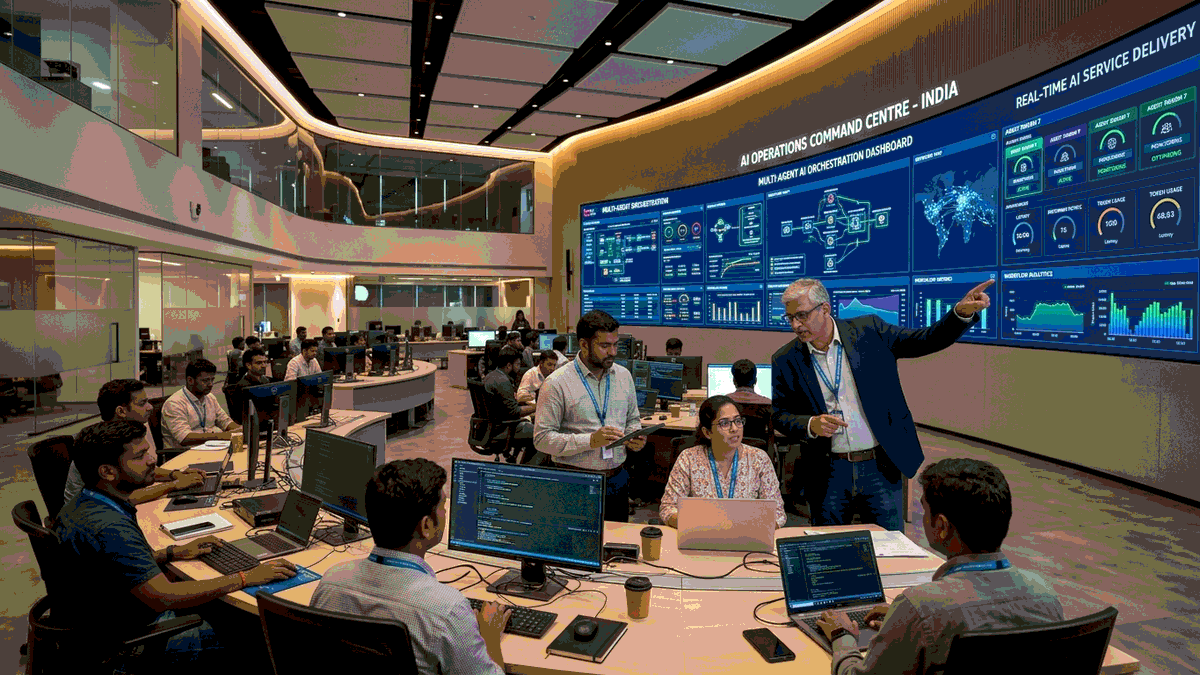
The Forward-Deployed Engineer (FDE)—an elite technical hybrid who pairs deep systems engineering expertise with on-site corporate problem-solving—has rapidly emerged as the most sought-after and lucrative technical role across India's technology ecosystem. As Indian IT services giants (TCS, Infosys, Wipro, LTI-Mindtree) and venture-backed AI startups transition from selling commoditized offshore developer hours to delivering mission-critical artificial intelligence integrations, the traditional separation between corporate strategy consultants and offshore coding teams has collapsed.
Enterprise customers are no longer satisfied receiving a software library or an API endpoint developed thousands of kilometers away. Confronted with labyrinthine legacy mainframes, unformatted proprietary databases, strict data privacy mandates, and organizational inertia, Fortune 500 enterprises require engineers who physically embed within their operations, diagnose root business problems, and write production-grade integration code on-site.
Origins of the FDE: From Palantir to the Indian IT Mainstream
The Forward-Deployed Engineer title was pioneered by data intelligence titan Palantir Technologies in the early 2000s. Rather than hiring sales representatives and business analysts who pitched slide decks, Palantir dispatched top-tier software engineers directly to defense commands, intelligence agencies, and Wall Street trading floors to configure its data ontology engines in real time.
Today, Indian IT majors and AI scale-ups have adapted this methodology at unprecedented scale.
With over 85% of enterprise generative AI pilots historically stalling before reaching full production due to data integration bottlenecks, Indian IT services leaders realized that closing the "pilot-to-production gap" required technical talent capable of sitting between client executives and core engineering teams.
"A PowerPoint deck explaining how AI can optimize supply chain logistics is worthless to a manufacturing CEO whose factory floor runs on an unpatched 2012 SCADA system,"explained an engineering director at a leading Bengaluru enterprise AI consultancy. "Our Forward-Deployed Engineers don't advise; they write code, clean database schemas, connect real-time sensor streams, and demonstrate working automation within hours."
This embedded technical deployment model directly powers the commercialization of specialized platforms, such as Dextr AI's autonomous hospitality agents and complex industrial implementations across global enterprise corridors.
The Anatomy of an Elite Forward-Deployed Engineer
What makes an FDE so rare—and so well-compensated—is the extreme breadth of skills required. Unlike specialized backend engineers who may work in isolation for weeks on a specific microservice, an FDE operates in high-pressure, unstructured client environments:
- Technical Execution: Mastery of distributed data pipelines, cloud architecture (AWS, Azure, GCP), SQL/NoSQL databases, API design, and container orchestration (Kubernetes, Docker).
- Applied AI Architecture: Practical expertise in fine-tuning Small Language Models, implementing Retrieval-Augmented Generation (RAG) vector pipelines, and setting up guardrails against model hallucination.
- Executive Communication: The poise and business acumen to present technical trade-offs directly to Chief Information Officers (CIOs) and Chief Technology Officers (CTOs) without technical jargon.
- Rapid Prototyping & Empathy: The psychological resilience to sit with factory floor managers, hospital administrators, or trading desk heads, understanding their day-to-day pain points and building tailored tools on the fly.
Traditional Software Roles vs. The Forward-Deployed Engineer
The structured matrix below contrasts the operational responsibilities, skill distributions, and commercial value of traditional software roles against the modern Forward-Deployed Engineer:
| Role Dimension | Traditional Backend Developer | Enterprise Management Consultant | Forward-Deployed Engineer (FDE) |
|---|---|---|---|
| Physical Work Location | Offshore development center / Remote | Client executive boardroom | Client operations floor & data center |
| Primary Work Deliverable | Pull requests & unit tests | PowerPoint presentations & strategy memos | Working production code & live integrations |
| Client Interaction | Minimal / Screened by project managers | High / Executive stakeholders | Direct collaboration with end-users & C-suite |
| Problem Definition | Pre-written Jira tickets & specs | Abstract business strategy | Ambiguous, unstructured business bottlenecks |
| Compensation Trend | Standard industry benchmarks | High base + performance bonuses | Premium base + equity / ARR revenue share (+40-65%) |
The Compensation Surge and Talent Scramble
The scarcity of engineers possessing both hardcore systems architecture abilities and high emotional intelligence has triggered an aggressive bidding war.
In Bengaluru, Hyderabad, and Pune, compensation packages for mid-to-senior FDEs with 4 to 8 years of experience now range from ₹45 lakh to over ₹1.2 crore, representing a 40% to 65% premium over traditional software engineering roles at the same experience tier. Furthermore, enterprise AI startups are offering substantial equity grants, recognizing that an effective FDE can single-handedly secure and retain multi-million-dollar annual recurring revenue (ARR) accounts.
Academic institutions and corporate training academies are scrambling to adapt. Leading universities and internal corporate learning academies are creating specialized curricula combining systems engineering, cloud deployment, and business negotiation to prepare the next generation of engineers for this hybrid reality.
Redefining India's Global IT Identity
For nearly three decades, India's IT sector was characterized globally as an offshore cost-arbitrage center—the world's back-office coding workshop. The rise of the Forward-Deployed Engineer marks a fundamental elevation in that relationship.
By sending thousands of elite, business-fluent systems engineers into the core operational centers of global enterprises, Indian technology firms are no longer merely maintaining existing applications; they are orchestrating the AI-driven reinvention of global commerce from the inside out.
Frequently Asked Questions
What is a Forward-Deployed Engineer (FDE)?
A Forward-Deployed Engineer is a hybrid role originally popularized by Silicon Valley companies like Palantir. FDEs are elite full-stack engineers who embed directly at client headquarters or industrial sites, diagnosing business bottlenecks, writing custom integration code, and deploying AI models into live enterprise systems.
Why are Indian IT companies adopting the FDE model now?
Traditional offshore delivery models struggle with enterprise AI deployments, which fail due to messy proprietary data, complex regulatory constraints, and legacy software incompatibilities. FDEs work directly alongside client domain experts on-premise, dramatically reducing AI project failure rates.
What specific skills are required to become an effective Forward-Deployed Engineer?
FDEs require advanced systems engineering skills (distributed systems, low-latency APIs, SQL, cloud infrastructure), hands-on AI deployment expertise (RAG, agent orchestration, fine-tuning), and executive consulting capabilities (business translation, stakeholder negotiation, and product ownership).
How does FDE compensation compare to standard software engineering roles?
Due to their direct influence on enterprise software contract renewals and high-margin ARR, FDE compensation packages in India command a 40% to 65% premium over standard backend or full-stack software engineering positions, frequently including substantial equity or performance incentives.
Primary Sources & Official References
- NASSCOM Tech Talent & Workforce Evolution Survey: The Rise of Forward-Deployed Engineering in India
- IEEE Spectrum: Software Engineering Careers & The Transition from Offshore Dev to Embedded Systems Consulting
- Palantir Technologies Engineering Methodology Whitepaper: Principles of the Forward-Deployed Engineer
- Harvard Business Review: Why Enterprise AI Deployments Fail and How Embedded Engineering Solves Implementation Gaps