Global IT services major DXC Technology leverages its 40,000-strong Indian workforce to pivot from headcount-based billing to enterprise-scale AI deployment, co-innovation, and automated service delivery.
Executive Key Takeaways
- Global IT services major DXC Technology leverages its 40,000-strong Indian workforce to pivot from headcount-based billing to enterprise-scale AI deployment, co-innovation, and automated service delivery.
- The conversation with global enterprise clients has fundamentally transformed, observed senior DXC delivery leaders in Bengaluru. Clients do not want 200 developers to manually triage application tickets over six months; they want an autonomous agentic mesh that resolves 80% of IT incidents in seconds and frees human architects to focus exclusively on product innovation and revenue-generating digital transformation.
- Key Benchmark: **Commercial Contract Structure** — Time & Material / Man-hour billing
BENGALURU — In what is emerging as the definitive structural experiment for the global technology services sector, DXC Technology is aggressively deploying enterprise-scale artificial intelligence across its Indian operations, testing whether the industry can transcend its multi-decade reliance on headcount-driven labour arbitrage.
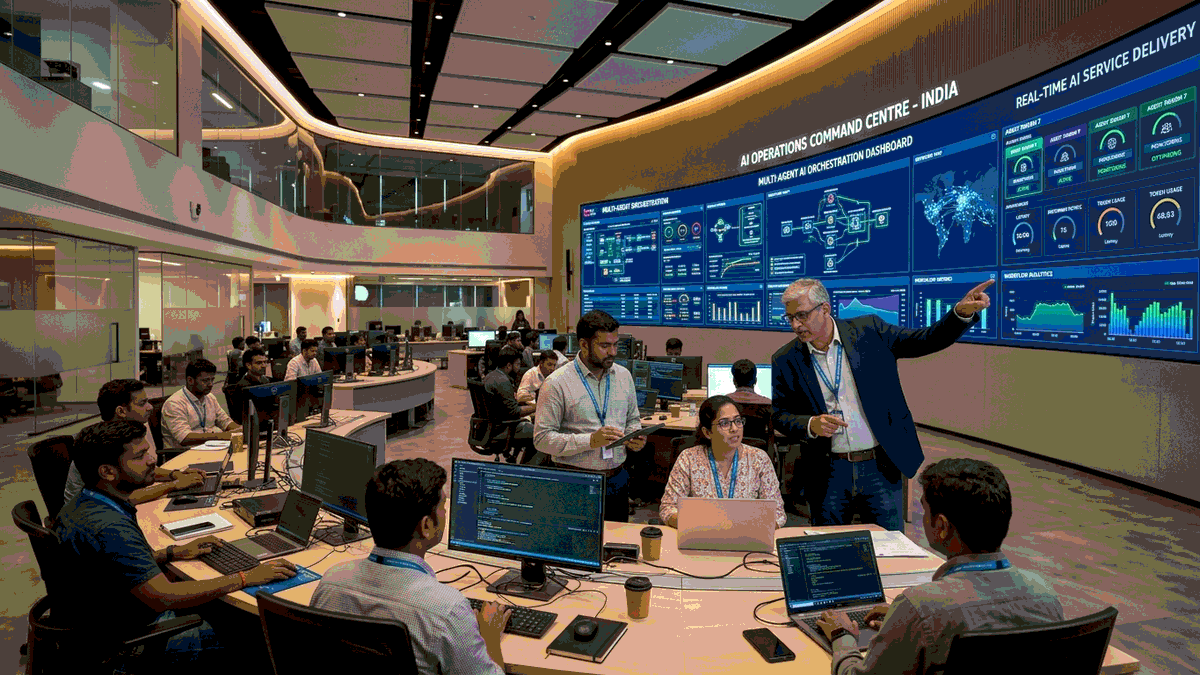
With an Indian workforce numbering over 40,000 engineers and solution architects—representing the multinational’s single largest talent base globally—DXC is moving past peripheral proof-of-concept experiments. The company is re-architecting its core delivery model around autonomous software agents, predictive IT operations, and immersive customer co-innovation hubs located in Bengaluru.
The transformation reflects the broader enterprise modernization thesis examined in IBM CEO Arvind Krishna Champions Smaller, Smarter AI Models: Why Specialized Architectures Outperform Trillion-Parameter LLMs and mirrors enterprise spend patterns documented in Infosys Bets on AI Startup Aerchain to Transform Enterprise Procurement.
The Sunset of the 'Man-Hour' Model: Why IT Services Must Reinvent Themselves
For more than thirty years, the Indian IT services sector flourished on a predictable economic engine: time-and-materials billing. Global enterprises outsourced legacy software maintenance, database migration, and enterprise resource planning (ERP) support to India, capitalizing on wage arbitrage between Western corporate headquarters and Indian engineering centers.
However, the explosive advent of generative AI, autonomous coding agents, and self-healing cloud infrastructure has made routine IT maintenance susceptible to radical automation. Enterprise CIOs no longer evaluate IT vendors based on how many billable junior developers can be assigned to an account; they demand fixed-price outcomes, guaranteed delivery acceleration, and continuous productivity gains.
"The conversation with global enterprise clients has fundamentally transformed,"observed senior DXC delivery leaders in Bengaluru. "Clients do not want 200 developers to manually triage application tickets over six months; they want an autonomous agentic mesh that resolves 80% of IT incidents in seconds and frees human architects to focus exclusively on product innovation and revenue-generating digital transformation."
Inside the Bengaluru AI Innovation Center: The 'AI Impact' Engine
Central to DXC's operational pivot is its newly inaugurated 200,000-square-foot Customer Experience and AI Innovation Center in Bengaluru. The campus operates as an industrial-grade engineering foundry designed to validate and operationalize AI pipelines before broad customer deployment.
The delivery architecture relies on three interrelated pillars:
1. The 'AI Impact' Orchestration Blueprint: A standardized operational framework that combines enterprise strategy, proprietary workflow automation engines, and managed cybersecurity governance to ensure that client data remains strictly siloed within compliance boundaries.
2. Anthropic Model Certification & Claude Integration: A multi-year enterprise alliance that trains thousands of Indian engineers as certified practitioners capable of embedding frontier Claude models into legacy banking mainframes, healthcare record systems, and supply chain ERPs.
3. Cyber Range and Real-Time Forensics: Integrating defensive AI directly into network operations centers (NOCs) to automatically detect and quarantine anomalous network behaviors before ransomware or unauthorized data exfiltration occurs.
The comparative matrix below delineates the profound shift from traditional IT services delivery to DXC’s agentic AI-driven delivery paradigm:
| Operational Metric | Legacy IT Services Paradigm | DXC Scaled AI-Led Delivery Model | Commercial Impact |
|---|---|---|---|
| Commercial Contract Structure | Time & Material / Man-hour billing | Outcome-based / Value-indexed SLAs | Aligns IT vendor incentives with client business velocity |
| Ticket Resolution Lifecycle | 4 to 24 hours (manual triage by L1/L2 engineers) | Sub-60 seconds (autonomous agent remediation) | 85% reduction in enterprise downtime and support latency |
| Code Refactoring Cadence | Months of manual line-by-line code translation | Agentic decompilation & synthetic unit testing | 60% faster migration from legacy COBOL to modern cloud stacks |
| Talent Composition | Heavy pyramid of entry-level commoditized coders | Diamond structure of senior architects & prompt engineers | Substantially higher revenue yield per employee |
| Client Engagement Model | Remote offsite execution against fixed specs | Onsite/Offshore collaborative co-innovation labs | Higher client retention and multi-year strategic advisory value |
Reskilling 40,000 Technologists: The Largest Upskilling Exercise in IT
Transitioning an enterprise services giant toward an AI-first footing requires massive human capital reinvestment. DXC has introduced comprehensive internal academies where software developers, system administrators, and quality analysts undergo mandatory training across prompt engineering, vector database indexing, and responsible AI governance.
By turning its Indian operations into the testing ground for this new operating model, DXC is proving that artificial intelligence does not spell the demise of India’s technology services sector. Instead, it provides the catalyst to elevate Indian engineering from low-cost operational support to the undisputed strategic architects of global enterprise intelligence.