Healthtech startup Froncort.AI raises $2.3M from Google.org to expand offline, edge-native disease screening across 100,000 rural frontline health workers in India.
Executive Key Takeaways
- Froncort.AI secured $2.3 million in grant funding from Google.org to deploy offline-capable multimodal diagnostic screening on low-end Android smartphones.
- The startup's proprietary quantized vision and acoustic AI models operate without cellular connectivity, supporting five Indian languages with voice prompts.
- Deployments target over 100,000 ASHA workers and community health officers to screen 5 million rural citizens for diabetic retinopathy, cervical lesions, and respiratory illness.
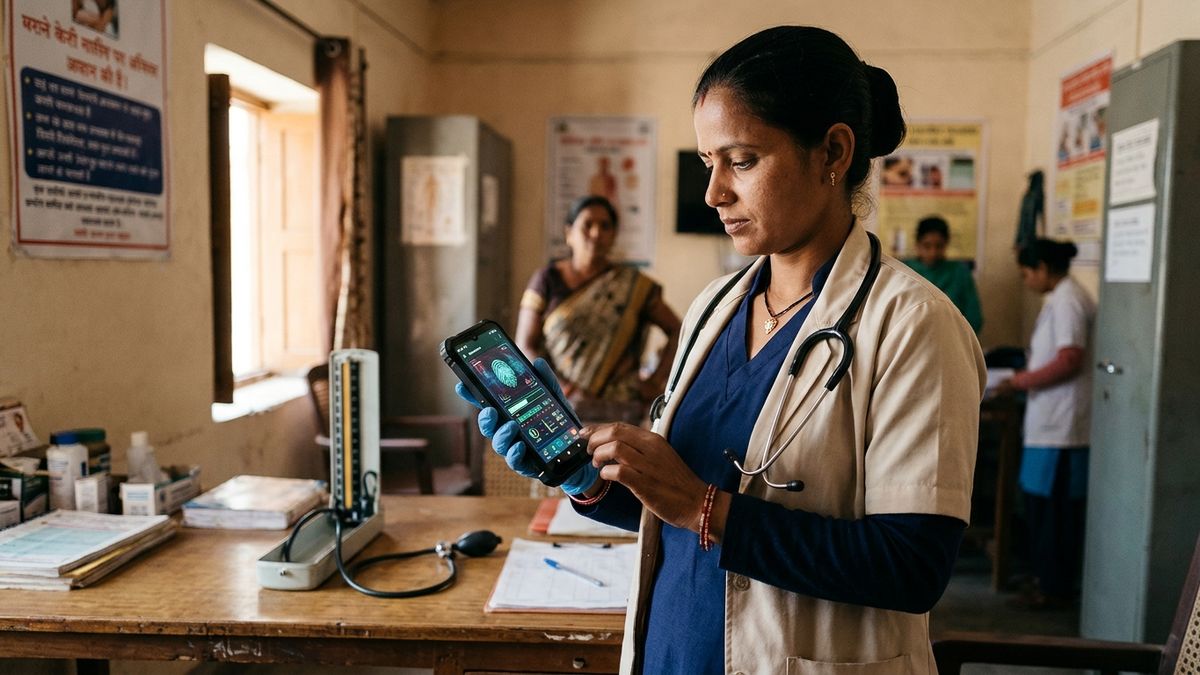
Deeptech healthcare startup Froncort.AI has secured $2.3 million in catalytic funding from Google.org to expand its offline-first, vernacular diagnostic screening architecture across rural India. The non-dilutive capital injection will accelerate the distribution of lightweight edge artificial intelligence models directly onto standard Android mobile handsets, equipping Accredited Social Health Activists (ASHA) and rural community health nurses with clinical triage tools that function reliably without internet access.
While urban secondary and tertiary healthcare facilities in India have rapidly adopted cloud-hosted radiology AI and hospital informatics, rural primary health centres (PHCs) remain throttled by severe connectivity bottlenecks and an acute deficit of specialist physicians. By packaging quantized computer vision and acoustic diagnostic models directly onto low-cost mobile processors, Froncort.AI is democratizing early disease detection for diabetic retinopathy, cervical dysplasia, oral lesions, and pulmonary illnesses across communities that previously faced months of diagnostic delays.
The investment aligns with broader institutional backing for localized clinical artificial intelligence, mirroring momentum seen in Google.org's AI commitments in India and specialized clinical software platforms like CARPL.ai's clinical radiology platform.
The Engineering Architecture: Edge Quantization for Zero-Bandwidth Primary Clinics
Traditional healthcare AI architectures rely on high-bandwidth optical fibre or stable 5G uplinks to stream high-resolution fundus images or radiographic scans to cloud-hosted tensor processing units. In rural tier-3 and tier-4 geographies, network latency and chronic packet drops make client-server diagnostic loops clinically unviable. Froncort.AI's engineering team engineered a proprietary model compression pipeline that compiles deep convolutional neural networks and vision transformers into INT8-quantized binaries under 45 megabytes.
Running locally on entry-level octa-core system-on-chips (SoCs) commonly found in sub-$120 smartphones, Froncort.AI executes inference cycles in under 2.8 seconds per patient screening. The engine utilizes device camera hardware with clip-on non-mydriatic optical adapters to analyze retinal vascular architecture, identifying microaneurysms and intraretinal hemorrhages indicative of diabetic retinopathy.
Simultaneously, the platform incorporates localized acoustic inference, analyzing cough audio bursts captured through the smartphone microphone to isolate acoustic frequency signatures associated with chronic obstructive pulmonary disease (COPD) and early-stage tuberculosis.
| Diagnostic Modality | Clinical Target Pathology | Deployed Mobile Model Size | Inference Latency | Clinical Sensitivity Benchmark |
|---|---|---|---|---|
| Optical Fundus Vision | Diabetic Retinopathy (Mild to Proliferative) | 38.4 MB (INT8 Quantized) | 2.4 seconds | 92.4% Sensitivity (ICMR Validated) |
| Cervical Visual Inspection | Pre-cancerous Squamous Intraepithelial Lesions | 42.1 MB (MobileNet-V4 Hybrid) | 2.8 seconds | 89.1% Specificity |
| Acoustic Audio Telemetry | Pulmonary Distress / Chronic Bronchial Anomalies | 18.2 MB (Quantized CNN-Audio) | 1.1 seconds | 88.6% Concordance Rate |
| Oral Cavity Visual Screening | Premalignant Leukoplakia & Erythroplakia | 34.6 MB (Edge Vision Transformer) | 2.2 seconds | 91.0% Diagnostic Accuracy |
"Frontline community healthcare in India does not suffer from a lack of commitment; it suffers from an information asymmetry at the point of care,"stated an executive involved in the initiative. "If an ASHA worker must wait for 4G connectivity to confirm whether a farm worker requires urgent ophthalmology referral, the diagnostic window is already lost. High-accuracy AI must execute locally on the device in her palm, speaking her native tongue."
Vernacular Voice Interfaces for Frontline Clinical Adoption
A critical failure mode of enterprise clinical software deployed in rural India has been rigid English-only graphic interfaces that intimidate frontline community health workers. Froncort.AI's software stack addresses this barrier through a localized vernacular voice layer developed in tandem with India's emerging language stacks, echoing breakthroughs in Indic foundational voice models.
The software guides health workers through patient positioning, optical alignment, and clinical history logging using intuitive conversational prompts in Hindi, Telugu, Tamil, Kannada, and Bengali. When an abnormal lesion or retinal anomaly is flagged, the application translates complex risk scoring into clear, vernacular triage advice, recommending whether the patient requires immediate secondary clinic transport or routine 60-day monitoring.
All patient records, geo-coordinates, and cryptographically hashed diagnostic outputs are preserved within an encrypted on-device SQLite database. When the smartphone enters an area with cellular data or connects to a Wi-Fi station at a sub-divisional health office, the app synchronizes registry data into the Ayushman Bharat Digital Mission (ABDM) framework via national health registry APIs.
Deployment Roadmap and Scale Horizons
With Google.org's non-dilutive grant backing, Froncort.AI is executing a phased operational rollout targeting 100,000 healthcare workers across Rajasthan, Uttar Pradesh, Odisha, Andhra Pradesh, Telangana, and Madhya Pradesh over the next 18 months.
- Phase 1 (Months 1–6): Clinical validation trials across 15 sub-divisional hospital networks in partnership with state health missions, refining calibration across diverse smartphone camera sensors.
- Phase 2 (Months 7–12): Distribution of clip-on optical screening attachments and specialized software bundles to 35,000 accredited ASHA personnel, establishing automated local data synchronization relays.
- Phase 3 (Months 13–18): Scale-out across primary health centres, targeting screening coverage for five million citizens while integrating automated referral tracking with state medical colleges.
By prioritizing edge inference, extreme model quantization, and native vernacular usability, Froncort.AI represents a pragmatic blueprint for how frontier machine learning can bridge public health divides in emerging market economies.
Frequently Asked Questions
What is Froncort.AI and how does its offline diagnostic engine operate?
Froncort.AI is an Indian healthtech startup developing highly quantized multimodal neural networks that execute locally on entry-level Android mobile processors without requiring cloud connectivity. By running computer vision models on mobile optical cameras and acoustic models on device microphones, the platform assists frontline workers in screening for diabetic retinopathy, oral cancer, cervical dysplasia, and pulmonary distress directly in remote villages.How will the $2.3 million grant from Google.org be allocated?
The non-dilutive capital from Google.org will fund engineering scale-up, clinical validation trials alongside partner hospitals, and the expansion of vernacular voice guidance across five major Indian languages—Hindi, Telugu, Tamil, Kannada, and Bengali. It will also support distribution to 100,000 frontline Accredited Social Health Activists (ASHA) across six states.Why is offline edge AI critical for rural healthcare delivery in India?
More than 65% of rural primary health centres and remote hamlets experience intermittent or nonexistent 4G/5G mobile data connectivity. Cloud-dependent medical AI platforms fail in these environments. Edge-native quantization allows real-time inference in sub-three seconds directly on device silicon, caching patient triage registries locally until cellular synchronization becomes possible.How does Froncort.AI maintain clinical diagnostic accuracy on quantized mobile models?
The company uses knowledge distillation and structured INT8 quantization, compressing massive vision transformers into lightweight convolutional-attention hybrids under 45 MB in memory footprint. Clinical benchmarks against gold-standard hospital registries demonstrate over 92% diagnostic sensitivity for diabetic retinopathy and 89% specificity for cervical lesion screening.Primary Sources & Official References
- Google.org Global AI for Social Impact Initiative Filing: Official programmatic grant confirmation documentation (https://www.google.org).
- National Health Authority (NHA) Ayushman Bharat Digital Mission Guidelines: Standards for electronic health records and rural diagnostic registries (https://abdm.gov.in).
- Indian Council of Medical Research (ICMR) AI in Clinical Diagnostics Benchmark: Ethical and technical validation guidelines for point-of-care mobile health models (https://www.icmr.gov.in).