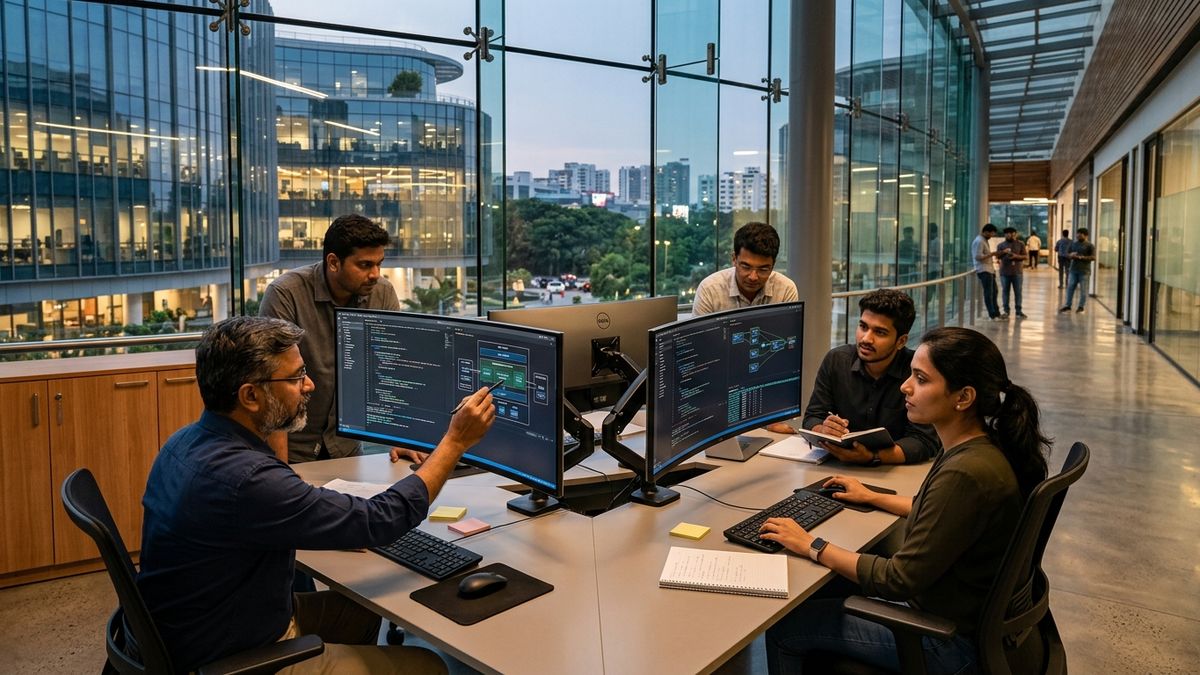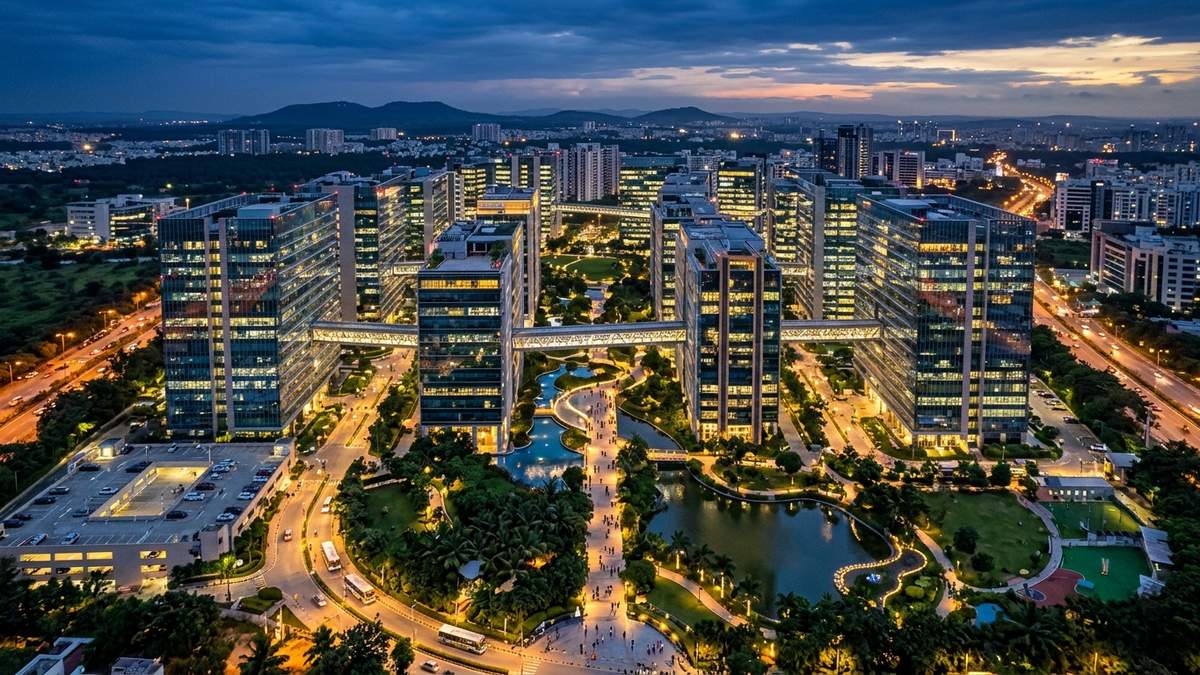
India's Global Capability Centres are projected to expand their workforce to 3.7 million by 2031, adding over 1 million net new jobs while driving 170M sq ft of prime office absorption.
Executive Key Takeaways
- India's GCC workforce is projected to expand from 2.3 million to 3.3–3.7 million by 2031, generating 1.0 to 1.4 million net new high-skilled jobs.
- AI automation will moderate routine tasks by 400,000–500,000 jobs, but will be offset by 300,000 specialized AI positions and deep functional engineering mandates.
- Workforce growth will stimulate 150 to 170 million square feet of prime commercial office absorption across Tier-1 and emerging Tier-2 Indian tech clusters.
India's network of Global Capability Centres (GCCs)—the strategic offshore engineering and operations hubs operated by multinational corporations—is on track to expand its workforce to between 3.3 million and 3.7 million professionals by 2031. The exhaustive forecast, published in a research benchmark by advisory firm Embark titled 'India GCCs in the AI Era: Implications for Workforce Growth and Office Demand', projects that the sector will add between 1.0 million and 1.4 million net new high-skilled jobs over the next seven years.
The findings decisively refute fears that artificial intelligence would trigger widespread retrenchment across India's technology export economy. Instead, the report documents a profound structural evolution: as multinational enterprises transition their Indian centres from back-office support hubs into sovereign product engineering and global P&L centres, the demand for high-tier technical talent is accelerating.
The AI Rebalancing: Net Job Creation Outpaces Routine Automation
A central insight of the Embark study is the dynamic rebalancing between routine operational displacement and advanced deep-tech job creation:
- Routine Task Displacement: AI automation, robotic process automation (RPA), and generative workflow tools are projected to compress routine transactional, administrative, and basic maintenance roles by 400,000 to 500,000 positions by 2031 through natural attrition and slower replacement hiring.
- Specialized AI Creation: Simultaneously, multinational corporations are establishing dedicated AI development units in India, which will create over 300,000 net new roles directly focused on model development, data pipeline engineering, AI governance, and cybersecurity.
- Functional Ownership Expansion: The remainder of the 1.0M to 1.4M net job expansion stems from global corporations shifting entire corporate engineering functions—such as core silicon design, automotive powertrain software, and algorithmic financial trading—directly to India.
By 2031, India's dedicated pool of AI specialists within GCCs is projected to expand from current estimates to an astounding 800,000 to 900,000 professionals.
"The global capability centre narrative in India has permanently outgrown the labor arbitrage phase,"noted institutional research analysts. "Multinationals are not coming to India simply to reduce payroll; they are coming because they cannot find 500 AI model engineers or microelectronics architects in Frankfurt, London, or Chicago. India is now the world's innovation engine."
Strategic Projections: India GCC Ecosystem Metrics (2024 Baseline vs. 2031 Forecast)
The table below provides comparative metrics detailing the scale, workforce composition, and economic footprint of India's GCC ecosystem over the projection horizon:
| Strategic Dimension | 2024 Current Baseline | 2031 Industry Projection | Net Strategic Impact |
|---|---|---|---|
| Total GCC Headcount | ~2.30 Million Employees | 3.30 to 3.70 Million Employees | 1.0 to 1.4 Million Net High-Skilled Jobs |
| Specialized AI Talent Pool | ~180,000 Specialists | 800,000 to 900,000 Specialists | 4.5x Growth in Deep-Tech Engineering |
| Routine Task Headcount Share | ~32% of Total Workforce | Under 14% of Total Workforce | Significant Shift Toward High-Value P&L Mandates |
| Incremental Office Space Demand | Pre-Pandemic Baseline | 150 to 170 Million Square Feet | Massive Commercial Real Estate Expansion |
| Primary Hub Concentration | Tier-1 (Bengaluru, Hyderabad) | Tier-1 + Tier-2 (Pune, Ahmedabad, Kochi) | Decentralized Geographic Talent Distribution |
Macro Real Estate Impact: 170 Million Square Feet of Office Absorption
The projected addition of more than a million high-earning tech professionals carries immense ramifications for commercial infrastructure. Embark estimates that GCC expansion will drive an incremental 150 to 170 million square feet of Grade-A office space absorption across Indian commercial centers between now and 2031.
While primary tech capitals like Bengaluru, Hyderabad, and Chennai will capture the majority of large-campus requirements, increasing infrastructure congestion and rising living costs are prompting multinationals to open secondary engineering hubs in Tier-2 ecosystems:
- Pune and Ahmedabad: Emerging as leading centers for automotive software, aerospace engineering, and optoelectronics design.
- Kochi and Coimbatore: Gaining prominence for hardware engineering, embedded firmware, and sustainable cloud operations.
- Lucknow and Bhubaneswar: Attracting significant state government incentives under programs aligned with the MeitY IndiaAI Mission and university technical centres.
Synergies with Domestic IT Services and Public Market Expansion
The robust growth of multinational GCCs operates in tandem with the broader Indian technology landscape. As documented in our recent analysis of Indian IT bellwethers rebounding on enterprise GenAI contracts, global enterprises frequently contract tier-1 Indian systems integrators to build and modernize the data architectures that multinational GCC teams subsequently operate.
Furthermore, the concentration of elite engineering talent within Indian GCCs is catalyzing a new wave of deep-tech spinouts and founder networks, directly fueling the Goldman Sachs forecast of $100 billion in public tech market expansion over the coming decade.
Frequently Asked Questions
What is the projected headcount growth for Indian GCCs through 2031?
According to the Embark research study, India's GCC workforce will expand from its current base of approximately 2.3 million employees to between 3.3 million and 3.7 million by 2031, delivering 1.0 to 1.4 million net new jobs.
How will artificial intelligence impact routine roles versus high-skilled jobs in GCCs?
AI automation, workflow consolidation, and slower replacement hiring will contract routine and repetitive operational tasks by 400,000 to 500,000 jobs. However, this will be heavily counterbalanced by 300,000 new AI-specialist positions and the transfer of core global product mandates to Indian teams.
How large will India's specialized AI talent pool become by 2031?
The study forecasts that India's dedicated AI talent pool will scale dramatically, reaching between 800,000 and 900,000 specialized engineers, data scientists, and machine learning researchers by 2031.
What are the commercial real estate implications of this GCC expansion?
The influx of over one million net new professionals will drive incremental office absorption of 150 to 170 million square feet across primary metropolitan corridors like Bengaluru, Hyderabad, and Pune, as well as emerging hubs like Ahmedabad and Kochi.
Primary Sources & Official References
- Embark Strategic Advisory: India GCCs in the AI Era - Workforce Growth and Office Demand Report
- NASSCOM & Zinnov: India Global Capability Centres Annual Industry Review
- Reserve Bank of India (RBI): Balance of Payments and Computer Software Services Export Statistics
- CBRE & JLL India: Commercial Real Estate Absorption and GCC Workplace Footprint