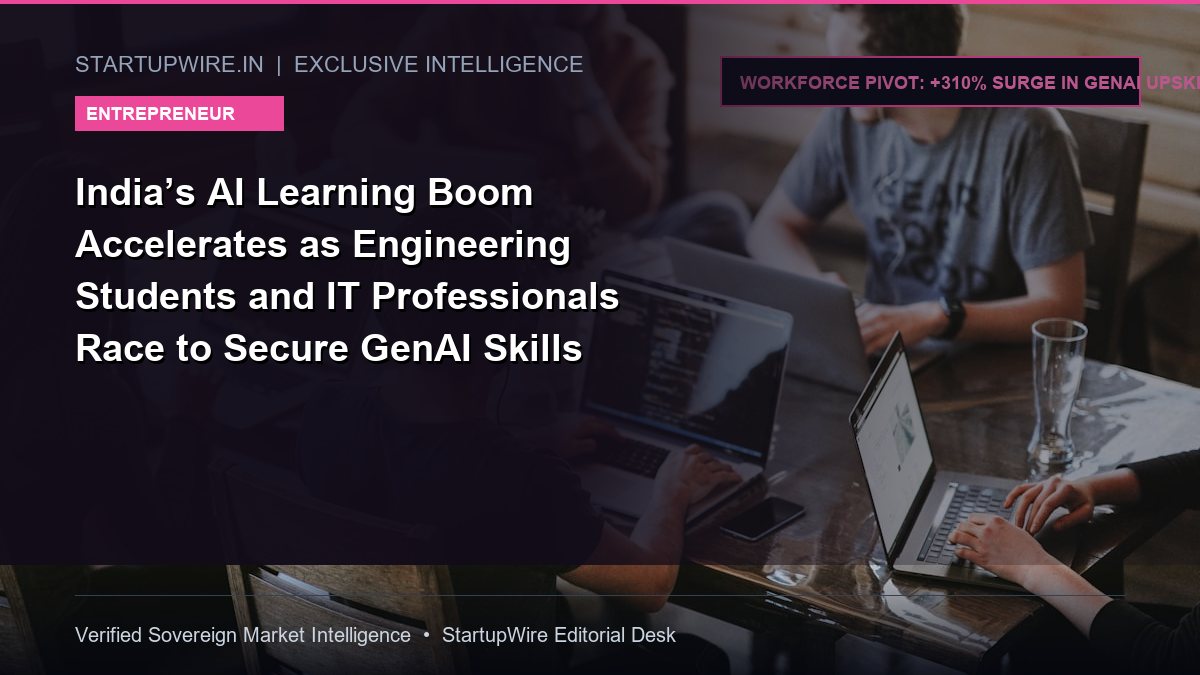
Unprecedented enrollment surges across Indian engineering colleges and edtech platforms reflect a structural workforce pivot toward agent orchestration, LLMOps, and domain AI engineering.
Executive Key Takeaways
- Unprecedented enrollment surges across Indian engineering colleges and edtech platforms reflect a structural workforce pivot toward agent orchestration, LLMOps, and domain AI engineering.
- The era of the routine coding mercenary is officially over, remarked heads of engineering talent across major Bengaluru GCCs. We do not need developers to write boilerplate boilerplate code that an AI can generate in 200 milliseconds. We need engineers who understand how to deploy, evaluate, and secure autonomous agentic systems.
- Key Benchmark: **Primary Programming Paradigm** — Manual Java / C++ syntax & boilerplate scripts
BENGALURU & HYDERABAD — India’s higher education and technical workforce ecosystem is undergoing its most radical transformation in three decades, as millions of engineering students and early-career software developers enroll in generative AI and agentic automation courses at an unprecedented pace.
Driven by aggressive recalibrations in campus recruitment criteria by domestic IT services giants and global capability centers (GCCs), technical universities, IITs, and specialized edtech platforms report a staggering 310% year-on-year surge in artificial intelligence course enrollments. The traditional focus on routine full-stack web development and software testing has collapsed, replaced by high-demand specializations in LLMOps, vector database architectures, agentic orchestration, and model quantization.
The workforce realignment directly mirrors state-level incubation policies detailed in Uttar Pradesh Startup Policy 2026 Opens New Doors for Deeptech and corporate innovation challenges explored in Honda and T-Hub Launch ₹4.8 Crore Open Innovation Challenge.
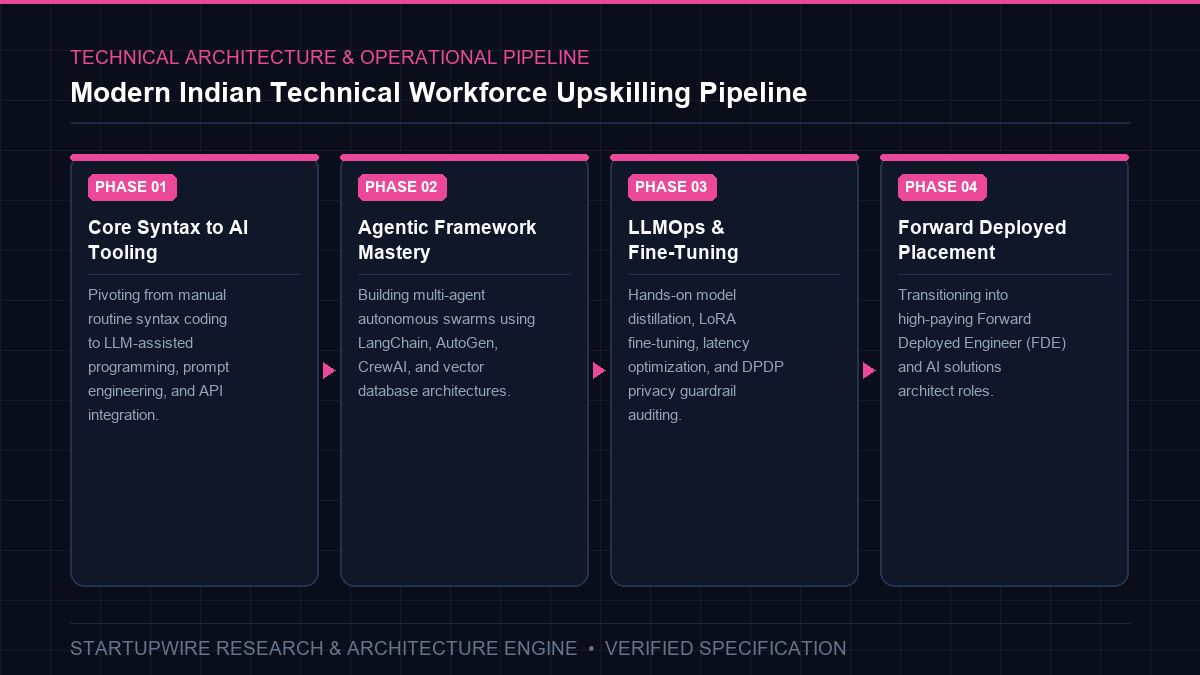
The Death of the 'Routine Coder' and the Rise of the AI Architect
For over twenty years, the Indian engineering curriculum was designed around a predictable pipeline: students learned object-oriented Java, SQL databases, and web frameworks to secure mass-hiring placements at IT services majors. However, the rapid mainstreaming of AI coding copilots and autonomous development agents has fundamentally automated entry-level coding and bug fixing.
Major recruiters—including Tata Consultancy Services (TCS), Infosys, Wipro, and Accenture—have dramatically shifted their campus hiring criteria. Hiring managers are no longer evaluating candidates on how fast they write standard sorting algorithms; they are testing whether candidates can orchestrate multi-agent workflows, audit model outputs for security vulnerabilities, and integrate enterprise RAG pipelines.
"The era of the routine coding mercenary is officially over,"remarked heads of engineering talent across major Bengaluru GCCs. "We do not need developers to write boilerplate boilerplate code that an AI can generate in 200 milliseconds. We need engineers who understand how to deploy, evaluate, and secure autonomous agentic systems."
Curriculum Shift: Legacy Engineering vs. GenAI Technical Stack
The table below contrasts the legacy technical skill benchmarks against the new 2026 agentic AI curriculum across Indian technical campuses:
| Educational Domain | Legacy IT Curriculum (2015 – 2023) | Modern Agentic AI Curriculum (2026) | Industry Hiring Demand |
|---|---|---|---|
| Primary Programming Paradigm | Manual Java / C++ syntax & boilerplate scripts | Python, Rust, Prompt Architecture & Tool-Use | +240% Compensation Premium for Tool-Use Mastery |
| Data Layer & Storage | Relational SQL & basic NoSQL schemas | Vector Embeddings, Hybrid Search & Pinecone/Milvus | Critical for Enterprise RAG & Knowledge Retrieval |
| System Architecture | Monolithic Model-View-Controller (MVC) | Multi-Agent Swarms (LangGraph, CrewAI, AutoGen) | Central to Autonomous Enterprise Automation |
| Model Operations (Ops) | Basic Linux administration & Git branching | LLMOps, QLoRA Fine-Tuning, vLLM & Quantization | Slashes Enterprise Cloud Inference Costs |
| Compliance & Safety | Standard software testing & manual QA | Adversarial Red-Teaming & DPDP Privacy Auditing | Required by Regulated BFSI and Healthcare Clients |
Institutional Adaptation and Grassroots Hackathons
Indian universities are rapidly adapting. Institutions like IIT Madras, IIT Delhi, and IIIT Hyderabad have introduced mandatory freshman courses in generative engineering and foundation model fundamentals. Concurrently, student-led AI clubs and hackathons are drawing record attendance, where undergraduate teams build practical applications—ranging from vernacular legal document analyzers to autonomous drone telemetry agents.
As IT titans train tens of thousands of forward deployed engineers, as documented in Wipro Expands Google Cloud Partnership to Accelerate Agentic AI Adoption, India’s AI learning boom is cementing the nation’s position as the primary talent crucible for the global agentic computing era.