Campus Hiring Turns Skills-First as Indian Universities Overhaul Curricula: How AI, Data Engineering, and Cybersecurity Are Replacing Generic Degrees
By Priya Sundaram | Published August 24, 2026 | 8 min read
Indian engineering institutes revamp course syllabi to mandate hands-on AI model deployment, cloud infrastructure, and cybersecurity as tech employers eliminate degree-based screening.
NEW DELHI / CHENNAI — In the most sweeping reform of technical higher education in decades, engineering universities and institutes across India are undergoing a comprehensive curriculum overhaul. Driven by a decisive shift among top tech employers toward skills-first, portfolio-grounded hiring, higher education institutions are replacing generic academic syllabi with mandatory, industry-vetted specializations in Applied AI Engineering, Cloud-Native Systems, Data Engineering, and Full-Stack Cybersecurity.
The transformation comes as premier global technology corporations, domestic unicorns, and Global Capability Centers (GCCs) dismantle legacy degree-centric hiring filters. In their place, recruiters are deploying automated, real-world coding sandboxes and GitHub portfolio audits to evaluate candidates strictly on their demonstrated ability to design, build, and deploy production-ready software.
#
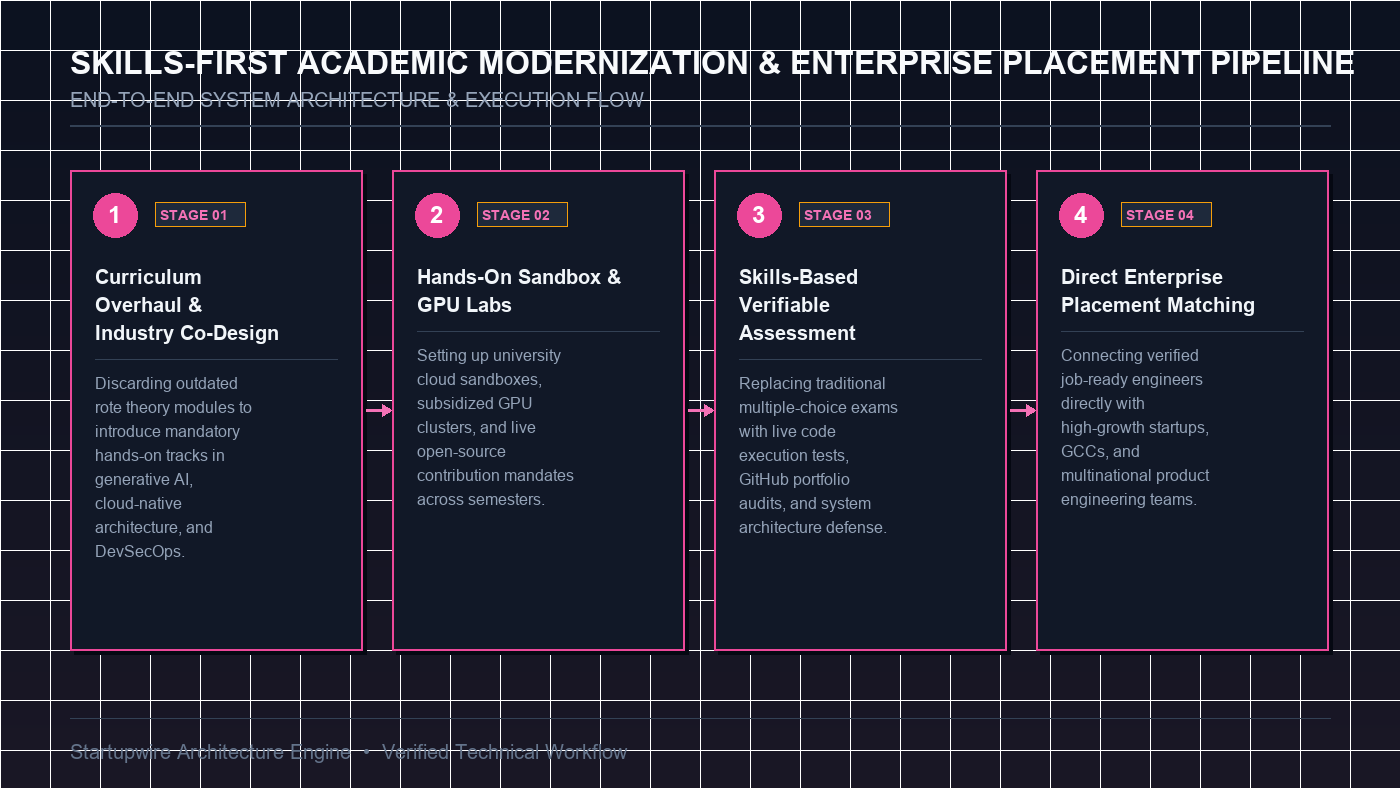
Figure 1.0: End-to-end framework transforming academic computer science education into project-grounded, verifiable industry readiness.
The Death of Rote Theory in Computer Science Education
For years, computer science curricula across thousands of Indian engineering colleges were criticized for being hopelessly disconnected from modern industry practices. Students frequently spent semesters studying legacy software development lifecycles, obsolete database management systems, and abstract theory without ever deploying a containerized application to the cloud.
The rapid rise of AI coding agents and automated development frameworks exposed this divide. To ensure their graduates remain competitive, institutions like the IITs, IIITs, NITs, and leading private universities have joined forces with industry bodies and tech giants to mandate hands-on, project-based learning.
"A candidate’s degree title or GPA is no longer an accurate indicator of whether they can contribute to a modern software engineering team on day one,"noted Dr. K. Radhakrishnan, Dean of Engineering at a leading technical university. "By redesigning our curriculum around real-world code repositories, cloud-native architectures, and ethical AI deployment, we are transforming students from passive exam-takers into self-sufficient software builders."
Academic Curriculum Transformation: Legacy vs Modern Skills-First
The structured comparison table below highlights the radical modernization sweeping computer science and engineering coursework across Indian universities:
| Academic Domain | Legacy Rote Curriculum (Phase Out) | Modern Skills-First Curriculum (Active) | Practical Lab Mandate | Industry Alignment Target |
|---|---|---|---|---|
| Artificial Intelligence & ML | Abstract mathematical theorems & static linear regression models | Applied LLM Engineering, RAG Architectures, & SLM Fine-Tuning | Building end-to-end multi-agent applications using PyTorch & vLLM | Direct readiness for AI product startups and enterprise labs |
| Software Development & QA | Textbook waterfall models & basic desktop application coding | Cloud-Native Full-Stack Development & Automated CI/CD Pipelines | Deploying microservices on Docker & Kubernetes clusters | Sub-30 day onboarding in Tier-1 software engineering teams |
| Data & Database Systems | Relational SQL schema design on standalone local servers | Distributed Data Engineering, Vector Databases, & Kafka Streams | Managing real-time data pipelines on cloud object storage | Instant eligibility for Data Engineer & Analytics roles |
| Information Security | Basic cryptography theory & DES/AES algorithm memorization | Full-Stack Cybersecurity, Zero-Trust Architecture, & Red-Teaming | Live capture-the-flag (CTF) exercises & penetration testing | Filling critical national cybersecurity talent shortages |
| Hardware & Embedded Tech | Outdated 8051 microcontroller assembly language | RISC-V System-on-Chip (SoC) Design & IoT Edge AI Firmware | Designing custom silicon blocks in Verilog/Chisel on FPGA boards | Aligning with India Semiconductor Mission (ISM) design needs |
Industry Ecosystem & Sovereign Computing Synergies
The push to democratize hands-on technical education aligns with major sovereign computing initiatives across India. Academic institutions are partnering with state initiatives, such as the low-cost offline computing hardware detailed in Karnataka Launches KEO AI-Ready Computing Initiative.
Similarly, AI-driven learning tools and syllabus-grounded academic assistants are helping students master advanced concepts faster, as examined in Google Brings AI-Powered JEE & NEET Prep Tools to India.
This rapid upskilling is also providing the essential engineering fuel that enables Indian startups to dominate regional rankings, such as the landmark achievements analyzed in India Leads Forbes Asia’s 100 to Watch List with 19 Startups.
The New Benchmark: GitHub Over Grades
As campus hiring season accelerates, the evaluation criteria for engineering candidates have transformed:
- Verified GitHub Portfolios: Recruiters prioritize candidates who have contributed to active open-source projects, built working SaaS products, or participated in global hackathons.
- System Design Defenses: Traditional multiple-choice aptitude tests have been replaced by interactive system design interviews where candidates explain architectural tradeoffs for high-traffic platforms.
- Continuous Lifelong Upskilling: Universities are embedding micro-credentials and industry certifications directly into graduation requirements, ensuring students continuously master evolving frameworks.
By putting skills, real code, and practical problem-solving at the center of education, India is preparing the next generation of engineers to lead the global software and deeptech revolution.