India's Digital Public Infrastructure Goes Global: 25 Countries Pilot DPI Framework
By Vikramaditya Sen | Published July 27, 2026 | 9 min read
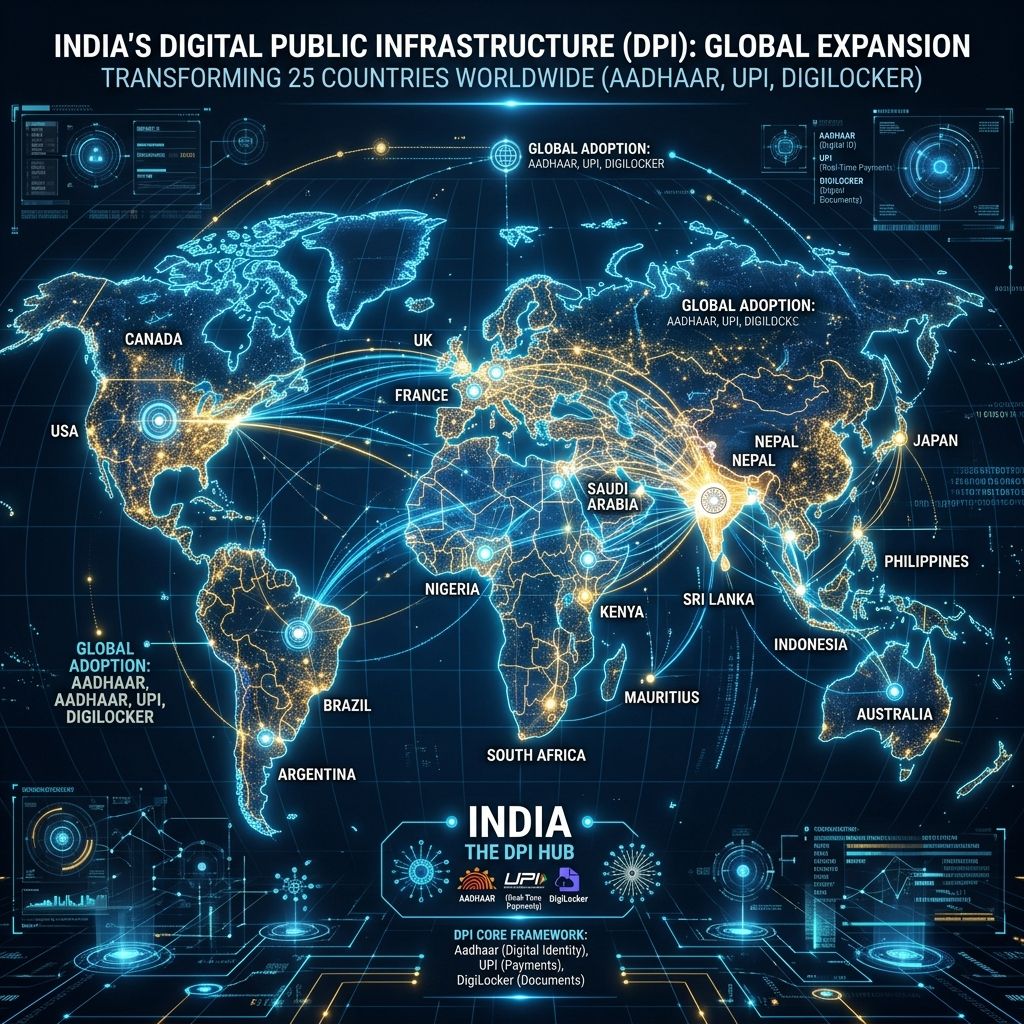
Twenty-five nations across Asia, Africa, and Latin America are actively piloting India's Digital Public Infrastructure framework, exporting modular digital identity, instant payments, and open data exchange.
In a historic milestone for global technology diplomacy and digital governance, India’s Digital Public Infrastructure (DPI) framework has officially reached worldwide adoption, with 25 countries actively piloting customized implementations of the nation's foundational tech stack. Ranging from digital identity systems modeled on Aadhaar to interoperable payment rails inspired by UPI and consent-based data sharing platforms inspired by DigiLocker and Account Aggregators, India's DPI model is rapidly becoming the gold standard for developing and emerging economies.
The initiative, spearheaded by the India Stack Global team alongside international development partners, demonstrates how open-source, modular digital rails can accelerate financial inclusion, reduce administrative friction, and stimulate local commercial innovation.
The Architectural Triad of the Global DPI Stack
India's DPI global expansion is built around three fundamental architectural layers, designed to be modular, vendor-agnostic, and sovereign to each adopting nation:
1. Programmable Digital Identity: Providing every citizen with a verifiable, privacy-preserving digital identity credential that serves as the foundation for remote KYC and e-governance.
2. Interoperable Instant Payments: Establishing low-cost, real-time payment rails that connect banks, non-banking financial companies (NBFCs), and mobile wallets without proprietary network lock-in.
3. Consent-Based Data Governance: Enabling citizens to securely access and share verified credentials (educational degrees, credit histories, land records) with third-party service providers.
Global DPI Adoption Matrix & Pilot Breakdown
| Region & Nations | DPI Layer Deployed | Deployment Objective | Technical Partner / Rail |
|---|---|---|---|
| Southeast Asia (Philippines, Vietnam) | Digital ID & Real-Time Payments | National identity cards & micro-merchant QR payments | Open-source Modular Open Source Identity Platform (MOSIP) |
| Sub-Saharan Africa (Kenya, Rwanda, Ghana) | Payment Interoperability & Data Consent | Direct benefit transfers (DBT) & agricultural credit scoring | India Stack Global API Middleware |
| Latin America & Caribbean (Trinidad & Tobago, Guyana) | Instant Payment Rails | Cross-border remittance integration & digital tax collection | Sovereign Fast Payment System (FPS) based on UPI architecture |
| Central & South Asia (Sri Lanka, Bhutan) | Cross-Border UPI Integration | Frictionless tourist & trade settlements using domestic wallets | NPCI International Payments Limited (NIPL) |
Visualizing the DPI Global Footprint
As depicted in the global map asset above, India's technological footprint has expanded across multiple continents. Participating governments receive technical blueprints, open-source reference implementations, and advisory support to build sovereign infrastructure while maintaining full data control.
Strategic Impact on Indian FinTech & Enterprise SaaS
The global proliferation of India’s DPI model creates unprecedented export opportunities for Indian enterprise software companies, cybersecurity providers, and fintech startups. As partner nations deploy sovereign payment and identity rails, Indian software firms are capturing major contracts for system integration, biometric hardware, cloud security, and API management.
"Digital Public Infrastructure is India's greatest gift to global technology,"remarked Nandan Nilekani, Co-founder of Infosys and key architect of Aadhaar. "By sharing these modular open rails with 25 nations, India is proving that technology can be a force for equitable human development rather than a source of monopolistic rent-seeking."
Contextual Links to Sovereign Tech Growth
This global milestone complements broader national hardware and infrastructure momentum, such as recent milestones in Indian Startups Raising $7.2B in H1 2026 and sovereign AI investments like the $1.48B AI Data Center in Odisha.
As 25 pilot implementations progress toward full commercial operations by late 2026, India continues to solidify its role as the digital infrastructure architect for the Global South.