Post-Quantum Cybersecurity Priorities Emerge in India: Protecting Aadhaar, DPI, and National Banking Infrastructure
By Rohan Varma | Published August 12, 2026 | 6 min read

Anticipating quantum decryption risks, Indian cybersecurity agencies and financial institutions launch post-quantum cryptography initiatives for digital public goods.
As global advancements in quantum computing accelerate toward "Q-Day"—the point at which quantum computers become capable of cracking legacy public-key encryption standards like RSA-2048 and ECC—Indian cybersecurity authorities, banking regulators, and digital infrastructure custodians have placed Post-Quantum Cryptography (PQC) firmly at the top of the national technology agenda.
Key government agencies, including the National Cyber Security Coordinator (NCSC), CERT-In, and the Reserve Bank of India (RBI), have initiated strategic roadmaps to transition critical digital public goods—such as Aadhaar, UPI authentication rails, DigiLocker, and interbank payment switches—to quantum-resistant cryptographic algorithms.
Intent-First Quantum Risk Assessment & Infrastructure Vulnerabilities
The urgency surrounding post-quantum migration stems from the risk of "Harvest Now, Decrypt Later" (HNDL) attacks. Malicious actors and foreign cyber adversaries are actively intercepting and storing encrypted high-value state communications, financial transaction ledgers, and national identity data today, intending to decrypt it once cryptographically relevant quantum computers (CRQCs) come online.
Because India’s economy relies heavily on Digital Public Infrastructure (DPI) handling over 13 billion monthly UPI transactions, securing these digital pipelines against quantum threat vectors is paramount to national economic security.
"Quantum computing will render current public-key encryption obsolete within the decade. Upgrading national infrastructure to post-quantum lattice-based algorithms is not a future-proofing luxury—it is an immediate strategic necessity for national security."
"— Dr. Arisudan Mukherjee, Chief Quantum Security Advisor"
Post-Quantum Cryptography Migration Framework
The table below details India's PQC transition strategy across key digital infrastructure layers, target algorithm standards, and execution timelines:
| Digital Infrastructure Layer | Legacy Encryption Standard | Post-Quantum Replacement Standard (NIST) | Migration Timeline |
|---|---|---|---|
| Aadhaar Identity Vaults | RSA-2048 / ECDSA | ML-KEM (Kyber) & ML-DSA (Dilithium) | Phase 1 (2026–2027) |
| UPI Payment Switch & Gateway | RSA-2048 / TLS 1.3 | Module-Lattice-Based Key Encapsulation | Phase 1 (2026–2027) |
| Core Banking & RTGS Networks | 3DES / RSA-4096 | Sphincs+ & FALCON Signature Schemes | Phase 2 (2027–2028) |
| Defense Telecommunications | Customized AES-256 | Hybrid Quantum-Resistant Hardware Chips | Active Deployment |
Developing Homegrown Lattice-Based Encryption Chips
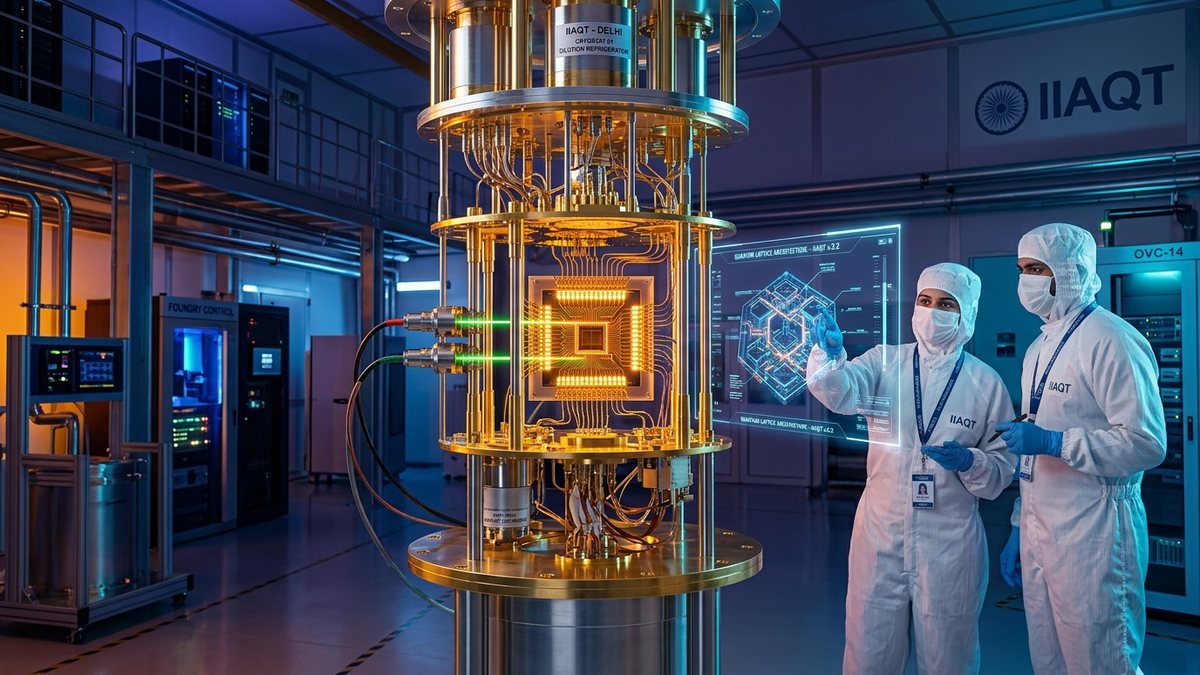
To avoid sole reliance on foreign cryptographic libraries, Indian defense research labs and academic institutions—including IIT Madras and IISc Bengaluru—are developing homegrown quantum-safe security microcontrollers and hardware security modules (HSMs).
These chips implement lattice-based mathematical hard problems that remain computationally infeasible for both classical supercomputers and quantum processors to solve.
Furthermore, as highlighted in our feature on India expanding Digital Public Infrastructure globally to 25 countries, integrating native PQC standards into the India Stack will provide a major competitive advantage when exporting DPI technologies to international partner nations.
Roadmap for Financial & Enterprise Compliance
Regulators are expected to mandate PQC readiness audits for all commercial banks, non-banking financial companies (NBFCs), and insurance providers starting in early 2027. Enterprise tech companies are advised to conduct comprehensive cryptographic asset inventories immediately to identify vulnerable legacy ciphers across internal databases and external API endpoints.