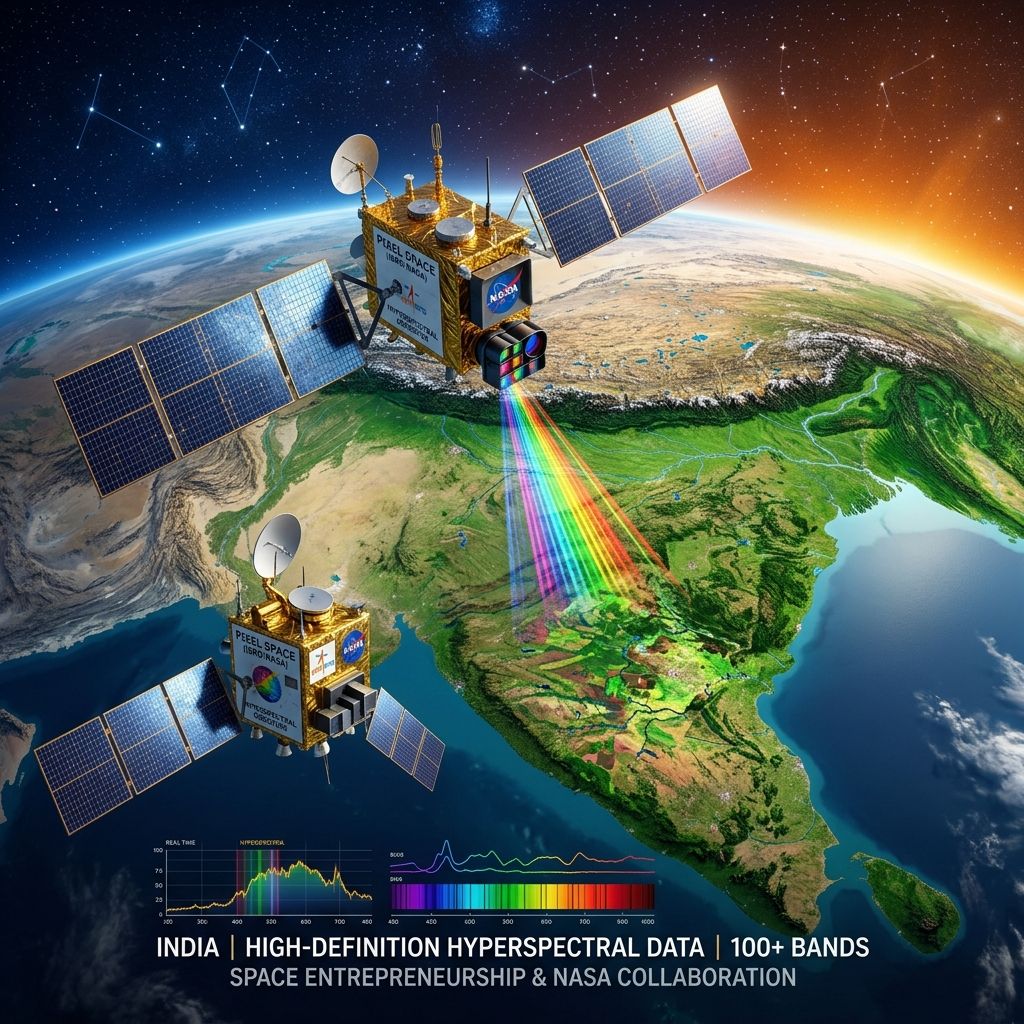
Pixxel's journey from a college campus project in Karnataka to partnering with NASA showcases the global caliber of India's next-gen spacetech pioneers.
Executive Key Takeaways
- Pixxel's journey from a college campus project in Karnataka to partnering with NASA showcases the global caliber of India's next-gen spacetech pioneers.
- Key Benchmark: **2019** — Founded at BITS Pilani campus by Awais Ahmed & Kshitij Khandelwal
- Today, Pixxel boasts multi-million dollar contracts with NASA, the US National Reconnaissance Office (NRO), and global agricultural conglomerates.
The remarkable story of Awais Ahmed, co-founder and CEO of Pixxel, has become a beacon of inspiration for thousands of aspiring deeptech entrepreneurs across India. Born in rural Karnataka and educated at BITS Pilani, Ahmed co-founded Pixxel at age 20 with a bold vision: building a constellation of hyperspectral Earth observation satellites capable of detecting environmental anomalies invisible to traditional satellite sensors.
Today, Pixxel boasts multi-million dollar contracts with NASA, the US National Reconnaissance Office (NRO), and global agricultural conglomerates.
Pixxel's Growth Journey & Key Milestones
| Timeline | Milestone / Breakthrough | Impact on Indian Spacetech |
|---|---|---|
| 2019 | Founded at BITS Pilani campus by Awais Ahmed & Kshitij Khandelwal | Demonstrated student-led deeptech potential |
| 2021 | Backed by Lightspeed, Radical Ventures, & prominent angels | Opened international VC doors for Indian space startups |
| 2022 | Launched first commercial satellite Shakuntala via SpaceX Falcon 9 | Verified in-orbit hyperspectral capabilities |
| 2023 | Awarded landmark NASA contract for Earth observation data | First Indian space startup selected by NASA |
| 2025–2026 | Deployed Firefly constellation & expanded global footprint | Set gold standard for commercial satellite imaging |
Lessons for Next-Generation Founders
Awais Ahmed's entrepreneurial playbook offers crucial principles for deeptech builders:
1. Target Unsolved Global Problems: Rather than competing in crowded software categories, tackle hard physics and hardware challenges with global applicability.
2. Leverage Frugal Capital Efficiency: Indian space startups build and launch satellites at a fraction of Western costs without sacrificing quality or payload precision.
3. Build Global Strategic Partnerships Early: Securing international validation from agencies like NASA accelerates enterprise sales across commercial markets.
Read more about the broader policy landscape enabling founders in our report on India's Space Reforms Boost and Private Space Investment Crossing $618M.