Autonomous AI Disrupts India’s $250B IT Services Model: Industry Accelerates High-Value AI Engineering Shift
By Rohan Varma | Published August 12, 2026 | 7 min read

Rapid enterprise AI adoption forces Indian IT giants and tech workers to pivot from traditional maintenance roles toward specialized AI engineering and architecture.
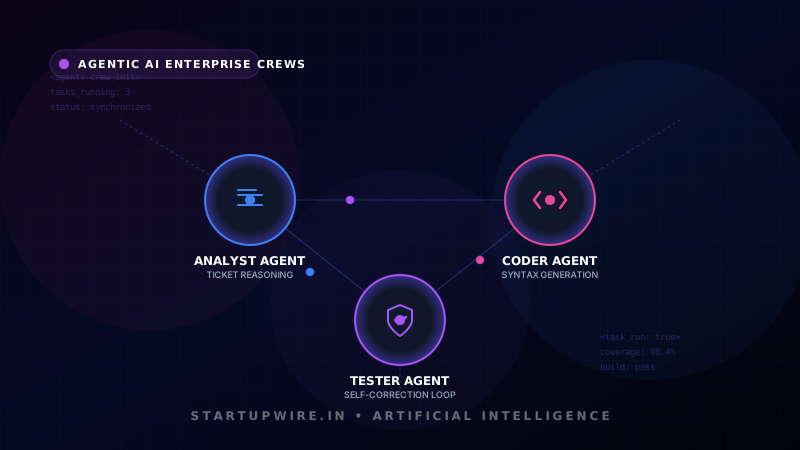
India's $250 billion IT services industry is confronting a structural paradigm shift as rapid global adoption of autonomous AI agents, automated code generation tools, and enterprise generative AI platforms disrupts traditional software maintenance and business process outsourcing (BPO) roles.
Industry benchmarks indicate that entry-level code verification, application maintenance, manual quality assurance (QA), and basic infrastructure monitoring—which historically accounted for nearly 35% of IT services revenue—are rapidly being automated by AI platforms. Consequently, Indian technology majors including TCS, Infosys, Wipro, and HCLTech are pivoting aggressively toward high-margin AI engineering, custom LLM fine-tuning, and agentic solution architecture.
Intent-First Workforce Transformation and AI Disruption
For decades, the Indian IT sector flourished on a labor-arbitrage business model characterized by large headcount deployments for enterprise software support. However, enterprise clients in North America and Europe are now demanding outcome-based pricing models integrated with autonomous AI capabilities.
Rather than contracting 50 software engineers for application migration projects, enterprise clients now expect smaller 5-person squads equipped with specialized AI coding copilots and automated deployment pipelines to deliver identical outcomes in half the time.
"The headcount-driven IT delivery model is rapidly yielding to an AI-augmented value creation model. The question facing Indian engineers is no longer whether AI will replace coding jobs, but how quickly coders can transform into AI systems architects."
"— Dr. K. S. Radhakrishnan, Senior Tech Policy Analyst & Former IT Executive"
IT Sector Transformation Matrix & Upskilling Metrics
The table below illustrates the shift in job role demand, billing models, and required technical skill sets across the Indian IT services ecosystem:
| IT Services Pillar | Legacy Operations (2020–2024) | Next-Gen AI Era (2026+) | Revenue & Skill Impact |
|---|---|---|---|
| Primary Billing Structure | Time & Material (T&M) per FTE | Outcome-based & AI-token volume | Margin pressure on basic FTE contracts |
| Core Workforce Roles | Java/C# Developers, QA Testers | AI Agents Engineers, RAG Architects | 45% decline in manual testing roles |
| Training Mandate | Generic Cloud & Agile certification | Full-stack GenAI, Vector DBs, PyTorch | Over 800,000 engineers undergoing AI reskilling |
|---|---|---|---|
| Entry-Level Hiring | Mass campus recruitment | Specialized AI & Math talent | Hiring selectivity index increased by 3.5x |
Upskilling Millions: Reskilling Programs Across Metros
To retain market dominance, Indian tech giants have launched massive internal upskilling initiatives. Infosys reported that over 250,000 employees have completed training on generative AI fundamentals, while TCS has trained more than 300,000 associates in machine learning and prompt engineering workflows.
Furthermore, educational institutions and university incubators across India are revamping their computer science curricula. As documented in our feature on IIM Calcutta and Google for Developers backing production AI startups, universities are integrating practical AI system design into undergraduate programs to ensure graduates meet industry requirements.
Long-Term Outlook: From Low-Cost Service to AI Innovation Powerhouse
While short-term disruption may cause headcount moderation across legacy BPO and testing business units, industry analysts emphasize that India is uniquely positioned to become the premier global delivery hub for enterprise AI implementation.
By combining deep domain expertise in financial services, healthcare, and retail with cutting-edge agentic AI engineering, Indian technology firms are evolving from cost-efficient service providers into essential AI transformation partners for global enterprises.