India’s Deeptech & AI Draw Fresh Investor Interest: Why Crane Venture Partners is Betting Up to $120M on Indian Engineering
By Elena Rostova | Published August 21, 2026 | 8 min read
Crane Venture Partners earmarks $100M–$120M of its $150M APAC Fund I for Indian AI and deeptech, backing capital-efficient software engineering and domain-specific hardware over compute-heavy model training.
BENGALURU — For the better part of a decade, global venture capital treated the Indian software ecosystem with a straightforward, repeatable playbook: build a solid B2B SaaS product out of Bengaluru or Chennai, arbitrage engineering costs against Silicon Valley payrolls, and sell into mid-market North American accounts.
That era is rapidly ending. The explosion of generative AI foundation models has commoditized generic software wrappers, putting intense pricing pressure on standard SaaS subscriptions. In its place, international venture investors are hunting for something far harder to replicate: capital-efficient deeptech, autonomous domain-specific AI workflows, and precision semiconductor architectures.
London-headquartered Crane Venture Partners is putting substantial capital behind that conviction. The firm has earmarked between $100 million and $120 million of its flagship $150 million APAC Fund I pool specifically for early-stage Indian deeptech and AI-native startups.
The Investment Thesis: Escaping the Silicon Valley "Compute Bubble"
Crane Venture Partners’ APAC strategy is spearheaded by Managing Director Anandamoy Roychowdhary, an industry veteran who previously spent years evaluating deeptech and enterprise software investments at Sequoia Capital India and Peak XV Partners.
Roychowdhary argues that while North American AI labs are trapped in an escalating capital race—burning hundreds of millions of dollars on compute clusters just to train general-purpose foundation models with uncertain revenue payback—Indian engineering teams are tackling high-friction industrial bottlenecks with remarkable capital discipline.
"If you look at where real enterprise value is captured, it isn't in training another generic chatbot that costs fifty million dollars to run,"Roychowdhary explained. "It is in building the deterministic software layer that hooks directly into an enterprise ERP, automates complex reconciliation, and executes with nine-nines reliability. Indian engineering founders are building those systems at one-third to one-fifth the burn rate of their Western peers. It is one of the most mispriced technology asset classes in the world today."
Where the Capital is Flowing: Allocation & Check Sizes
Crane is structuring its India investments around early-stage entry points, typically writing Seed to Series A checks ranging from $1.5 million to $4.0 million, while maintaining sizable reserves for pro-rata follow-ons in subsequent growth rounds.
The matrix below outlines the fund's sector allocation, operational benchmarks, and the architectural capabilities audited during due diligence:
| Sector Vertical | Fund Allocation | Typical Initial Check | Core Engineering Benchmark Audited |
|---|---|---|---|
| AI-Native Enterprise Systems | 35% ($35M – $42M) | $2.0M – $3.5M | Deterministic agent orchestration, SOC2 compliance, sub-50ms API execution |
| Fabless Silicon & Edge Hardware | 25% ($25M – $30M) | $2.5M – $4.0M | Custom RISC-V cores, ultra-low-power NPUs, precision thermal packaging |
| Cloud & GPU Infrastructure | 20% ($20M – $24M) | $1.5M – $3.0M | Inference cost optimization, SLM orchestration, high-throughput vector caching |
| Cybersecurity & Post-Quantum | 20% ($20M – $24M) | $1.5M – $3.0M | Zero-trust authentication, automated patch QA, cryptographic verification |
The Western Expansion Trap: Moving Beyond Cold Outbound
A persistent hurdle for early-stage Indian deeptech founders has always been commercial go-to-market execution in Western markets. While engineering teams can match or exceed Silicon Valley output, closing six-figure Annual Contract Value (ACV) enterprise deals with Fortune 500 CIOs from a desk in Indiranagar requires navigating complex procurement hurdles, legal audits, and security certifications.
To address this friction, Crane is deploying an operator-led model that connects portfolio founders directly with enterprise software buyers across London, Berlin, New York, and San Francisco:
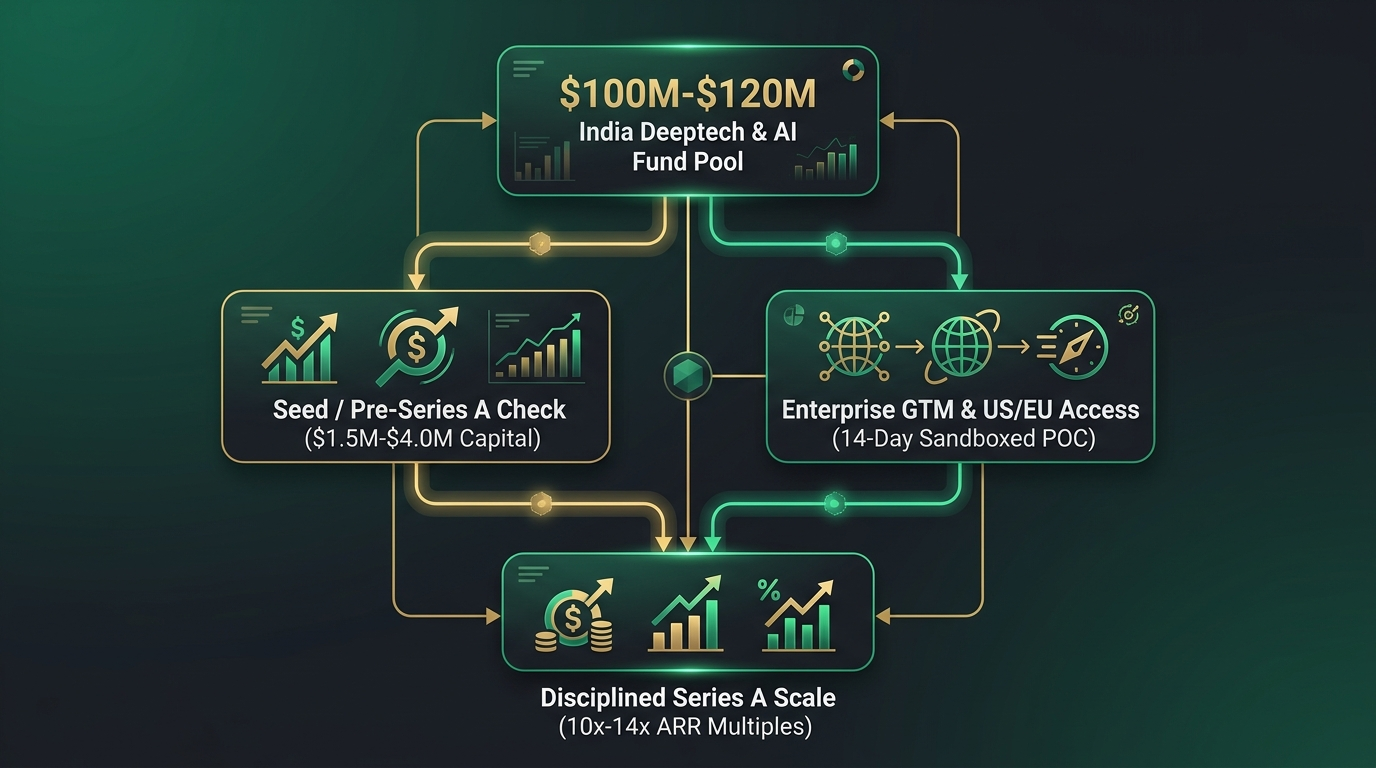
1. Structured 14-Day POCs: Replacing open-ended pilots with time-boxed sandbox evaluations featuring pre-agreed technical KPIs, bypassing months of procurement stall.
2. Account-Based Engineering (ABE): Transitioning sales development from automated email blasts to custom technical teardowns and ROI models, mirroring the methodology detailed in our B2B SaaS Global Outbound Playbook.
3. Preserving 75%+ Gross Margins: Helping founders swap expensive third-party foundational APIs for optimized small language models (SLMs) running on dedicated hardware, preventing the severe margin compression highlighted in industry AI cost analyses.
Macro Tailwinds: India's Shift from Labor Arbitrage to Product Ownership
The timing of Crane's dedicated India fund aligns with a broader structural maturation of the domestic startup landscape. As analyzed in our teardown of Seed to Series A Valuation Normalization in 2026 and the Rise of Autonomous AI Agents in Enterprise SaaS, institutional allocators are aggressively rewarding startups that demonstrate strong net revenue retention (NRR > 115%) and disciplined burn multiples (< 1.2x).
With state-backed compute subsidies under the IndiaAI Mission and accelerating sovereign semiconductor investments, specialized early-stage capital like Crane's $120M pool will play a pivotal role in transforming Indian engineers from back-office implementers into global product architects.
Track verified deeptech startups on our Ecosystem Directory and monitor early-stage deal velocity on the VC Radar.