The Rise of Autonomous AI Agents in Enterprise SaaS: How Multi-Agent Systems are Replacing Rigid Workflows
By Arjun Sundararajan | Published August 20, 2026 | 7 min read
Enterprise SaaS is undergoing a generational transition from conversational chatbots to autonomous multi-agent execution engines, transforming procurement, code QA, and complex supply-chain workflows.
The global enterprise software ecosystem is experiencing its most significant paradigm shift since the migration from on-premise infrastructure to multi-tenant cloud architectures. The era of static SaaS dashboards and simple conversational text interfaces is rapidly giving way to autonomous multi-agent AI architectures—orchestrated software entities designed not merely to answer prompts, but to perceive state, formulate multi-step plans, execute API transactions, and self-correct when edge cases emerge.
For enterprise buyers, the value proposition has shifted decisively from "software that assists human operators" to "digital colleagues that execute bounded workflows autonomously." According to industry data across mid-market and Fortune 500 tech stacks, enterprises deploying multi-agent systems are observing a 68% reduction in cycle times for cross-departmental operations including vendor contract reconciliation, automated security patch remediation, and real-time freight dispatch.
The Evolution: Chatbots vs. Multi-Agent Systems
The distinction between first-generation generative AI interfaces and modern agentic architectures lies in state persistence, tool calling, and recursive self-reflection. While single-model chatbots operate on immediate context windows, multi-agent frameworks divide complex problems into specialized functional roles that cross-verify outputs before final execution.
| Dimension | First-Gen AI Chatbots (2023–2024) | Autonomous Multi-Agent Systems (2026) |
|---|---|---|
| Core Architecture | Monolithic single LLM prompt loop | Orchestrated graph of specialized sub-agents (Planner, Executor, Verifier) |
| Execution Capability | Read-only summarization & text generation | Read-write API integration across CRMs, ERPs, databases & code repos |
| State Management | Ephemeral per-session chat context | Persistent vector memory, episodic cache & relational entity graph |
| Error Handling | Hallucination prone; requires human review | Automated reflection loops & fallback validation checks |
| Enterprise ROI | Incremental productivity gains (10–15%) | End-to-end workflow automation (60–80% manual labor displacement) |
Anatomy of an Enterprise Multi-Agent Graph
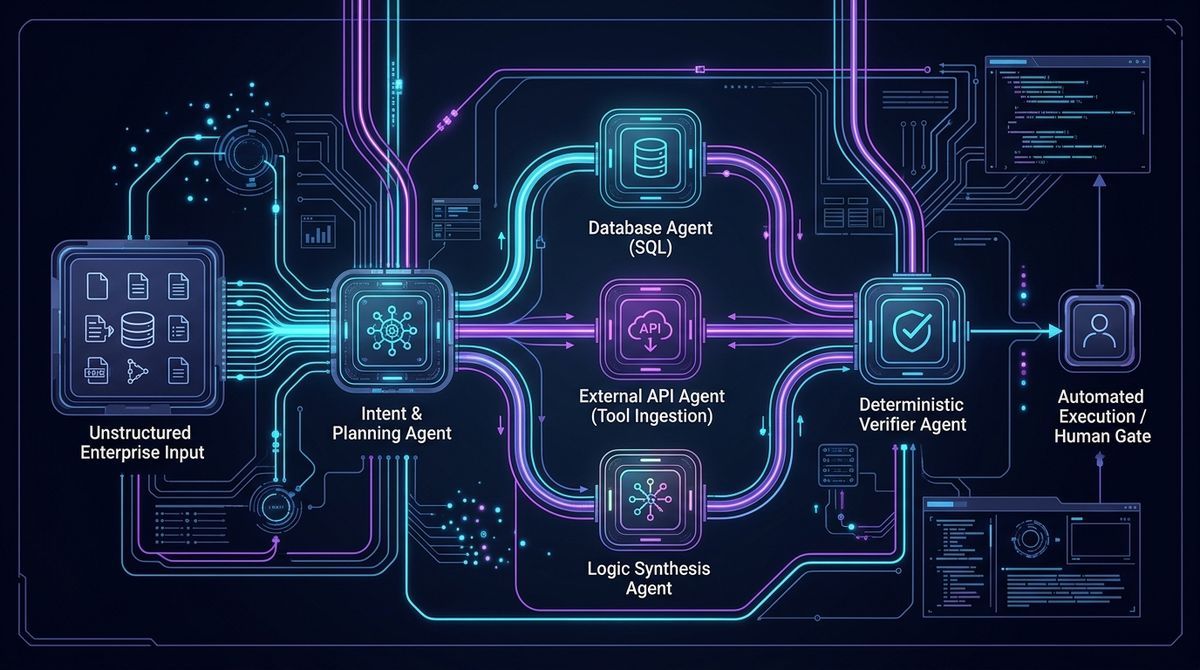
In production-grade enterprise deployments, single monolithic prompts have been completely superseded by directed acyclic graph (DAG) workflows. A typical enterprise agentic network deploys three discrete functional tiers:
1. Strategic Planner & Intent Parser: Analyzes unstructured enterprise inputs (e.g., incoming supplier RFPs or engineering bug tickets), deconstructs the objective into modular sub-tasks, and constructs a deterministic execution graph.
2. Tool-Equipped Domain Specialists: Individual micro-agents specialized in discrete tasks—such as SQL query generation against internal data warehouses, REST API calls to payment gateways, or AST parsing for automated syntax validation.
3. Deterministic Verification & Guardrail Engine: Evaluates every intermediate payload against internal compliance rules, security constraints, and data masking policies before committing persistent database transactions.
Core Business Verticals Leading Adoption
Indian enterprise software pioneers and global tech startups are concentrating deployment across three high-value operational clusters:
- Procurement and Supplier Reconciliation: Autonomous agents cross-reference purchase orders against warehouse receipt manifests, identify discrepancies in tax rates or shipping surcharges, and interface directly with supplier APIs to issue credit notes without human intervention.
- Autonomous Software Reliability & Code QA: In modern DevOps pipelines, specialized testing agents ingest failing regression test runs, synthesize minimal reproducible test cases, generate pull request patches, and run benchmark suites before alerting the primary maintainer.
- Supply-Chain & Freight Operations: Multi-agent platforms like those explored in our Fleetx.ai and Pando logistics analysis automatically assign dynamic freight routes based on real-time port congestion, toll surcharges, and regional weather volatility.
"The true enterprise leverage of artificial intelligence is not in summarizing documents faster; it is in turning complex multi-step digital operations into background processes that execute with nine-nines reliability."
The Infrastructure Challenge: Latency, Cost, and Governance
Despite massive operational upside, scaling autonomous agents introduces new architectural bottlenecks that enterprise engineering teams are currently solving:
- Token Cost and Compute Squeeze: Recursive planning loops can consume thousands of tokens per minute. As highlighted in Sridhar Vembu’s AI hardware cost analysis, optimizing inference workloads via small domain-specific models (SLMs) is essential for maintaining software gross margins.
- Deterministic Guardrails & SOC2 Compliance: Giving agents write access to production databases necessitates cryptographic audit logs, role-based permission delegation, and mandatory human-in-the-loop checkpoints for transactions exceeding defined monetary thresholds.
As model latency drops and reasoning tokens become more efficient, the SaaS companies that will lead the next decade are those transitioning from static record systems to proactive, autonomous execution engines.
Explore emerging startups pioneering these workflows in our Ecosystem Directory or benchmark enterprise valuations using the Valuation Calculator.