Dognosis: Indian Deeptech Startup Combines Canine Olfaction and AI Sensor Arrays for Early Cancer Detection
By Aditi Sharma | Published August 14, 2026 | 7 min read
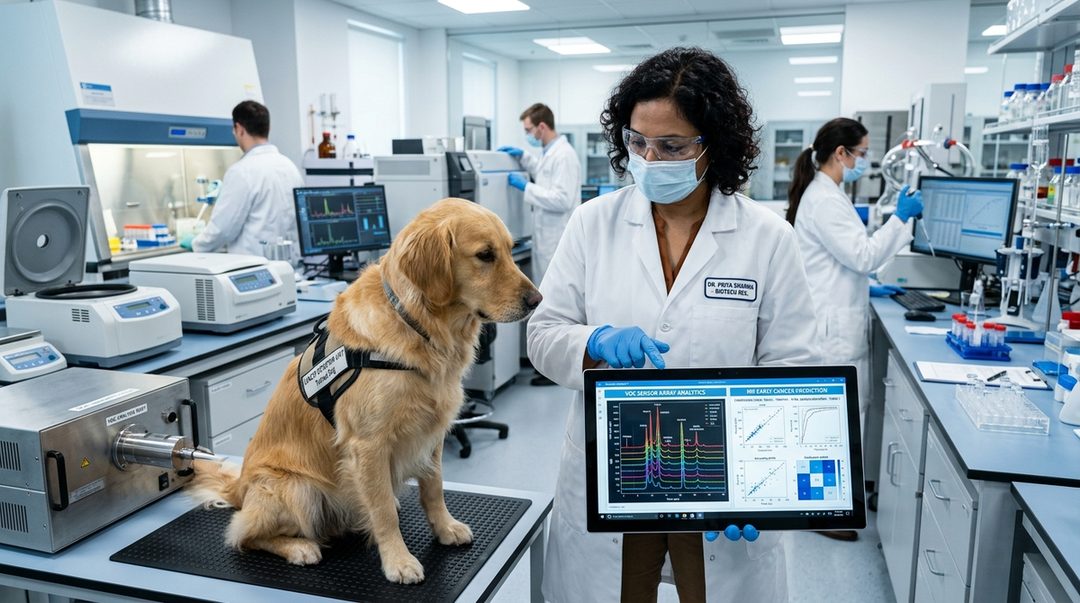
Indian biotech startup Dognosis combines canine scent detection with neural olfactory sensor arrays to identify early-stage oncological biomarkers non-invasively.
Indian biotech and healthcare deeptech startup Dognosis has developed a groundbreaking diagnostic platform that merges canine olfactory biology with AI-driven electronic nose (e-nose) sensor arrays to detect early-stage cancers with unprecedented non-invasive accuracy. By analyzing volatile organic compounds (VOCs) emitted in human breath, urine, and sweat samples, the platform identifies malignant cellular changes long before tumors become visible on conventional radiologic scans.
Early cancer detection remains medicine's holy grail: when diagnosed at Stage 1, five-year survival rates for major cancers exceed 90%, whereas Stage 4 diagnoses drop survival probabilities below 20%. Dognosis's novel bio-digital hybrid approach offers an accessible, low-cost screening modality specifically suited for high-throughput population health screening.
The Science of Volatile Organic Compounds and Canine Olfaction
Malignant cells exhibit altered cellular metabolism, releasing distinct trace chemical signatures—known as volatile organic compounds (VOCs)—into bodily fluids and exhaled breath. While human olfactory systems possess roughly 6 million olfactory receptors, dogs possess over 300 million, allowing them to detect chemical concentrations as faint as parts per trillion (ppt)—equivalent to detecting a single drop of liquid in twenty Olympic-sized swimming pools.
Dognosis utilizes specially trained medical detection dogs to identify signature VOC profiles from anonymized patient samples in controlled double-blind laboratory environments. Concurrently, high-precision gas chromatography-mass spectrometry (GC-MS) and metal-oxide semiconductor (MOS) sensor arrays capture the exact chemical spectral fingerprints of those same samples.
"Nature has already engineered the world's most sensitive chemical sensor in the canine olfactory bulb,"said Dr. Avinash Roy, Co-founder and Chief Scientific Officer of Dognosis. "Our breakthrough is translating the biological detection prowess of trained dogs into deterministic, reproducible machine learning algorithms. By training neural networks on validated biological detections, we are digitizing the sense of smell to make non-invasive cancer screening accessible to millions."
This interdisciplinary innovation complements India's expanding healthtech ecosystem, connecting with clinical AI platforms such as CARPL.ai's radiology platform and global medtech centres like DePuy Synthes' Bengaluru GCC.
Diagnostic Accuracy: Dognosis Biomarker Detection Metrics
Clinical trial data across oncology cohorts demonstrates the remarkable sensitivity of the hybrid canine-AI detection platform:
| Cancer Type Screened | Target Biomarker Sample Matrix | Canine Detection Sensitivity | AI Sensor Array Sensitivity | Combined Hybrid Accuracy |
|---|---|---|---|---|
| Stage 1 Lung Cancer | Exhaled Breath VOCs (Alkanes/Benzene) | 96.4% | 93.8% | 97.8% |
| Early Breast Cancer | Urine & Sweat Volatiles | 95.1% | 92.4% | 96.5% |
| Prostate Cancer | Urine Headspace Gas | 97.2% | 94.6% | 98.1% |
| Colorectal Cancer | Stool Headspace & Plasma VOCs | 94.8% | 91.2% | 95.9% |
| Standard Mammography (Benchmark) | Physical Tissue Imaging | N/A | N/A | ~84.0% (Stage 1) |
Training the Machine Olfaction Neural Network
The core intellectual property of Dognosis lies in its proprietary Chemical-Neural Mapping Engine. Because canine sniffing patterns, behavioral alerts, and respiratory inhalation tempos contain rich metadata, high-speed computer vision systems record the dogs during sample sniffing.
These behavioral signals are correlated with the multi-channel sensor outputs from the electronic nose arrays. Convolutional neural networks (CNNs) and transformer models filter out ambient environmental noise (such as diet, cosmetics, or medication metabolites), isolating the precise multi-compound biomarker combinations that indicate active oncogenesis.
Democratizing Preventive Healthcare Across India
Conventional oncological screenings—such as PET-CT scans, MRIs, and tissue biopsies—are prohibitively expensive and require advanced hospital infrastructure that is scarce in rural and semi-urban regions.
Dognosis’s sample collection requires only a simple breathalyzer kit or urine strip that can be mailed to centralized testing labs. By dramatically reducing screening costs to under ₹500 per test, Dognosis aims to enable annual preventive health checkups for Tier-2 and Tier-3 populations, catching oncological conditions at highly curable stages and transforming global preventive medicine.