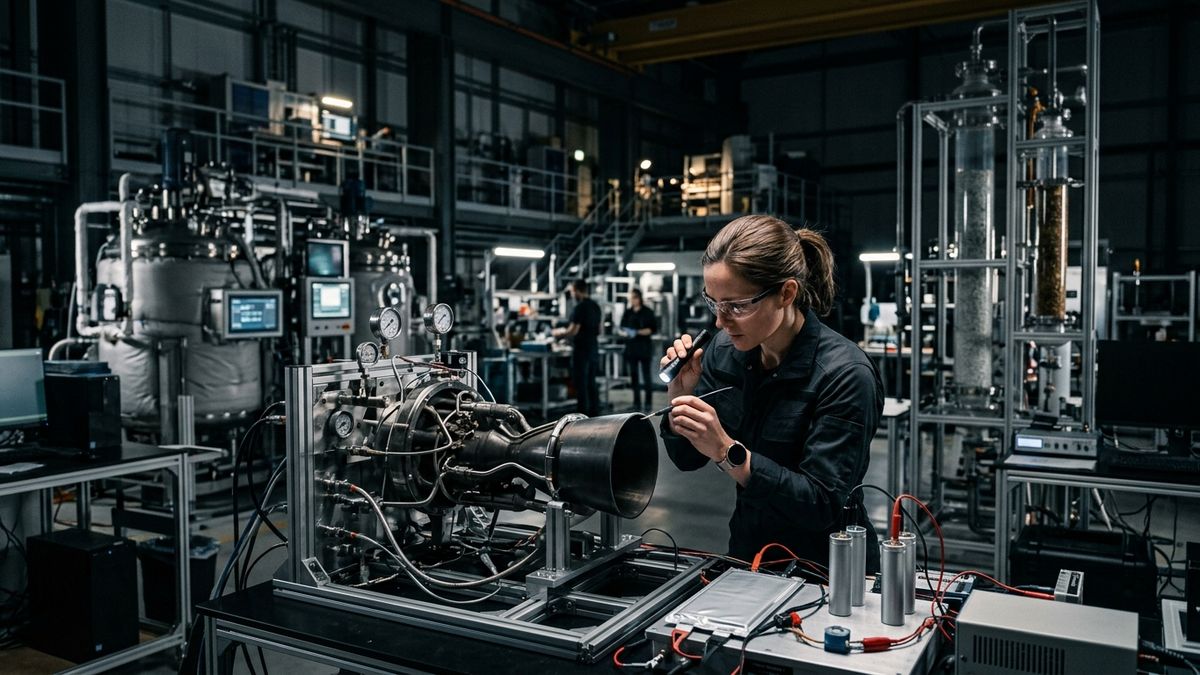
12 Deep-Tech Startups Enter the Race for Sovereign Support: DPIIT & Avaana Capital Unveil Flagship Cohort for Breakthrough Innovations
By Meera Krishnan | Published August 22, 2026 | 8 min read
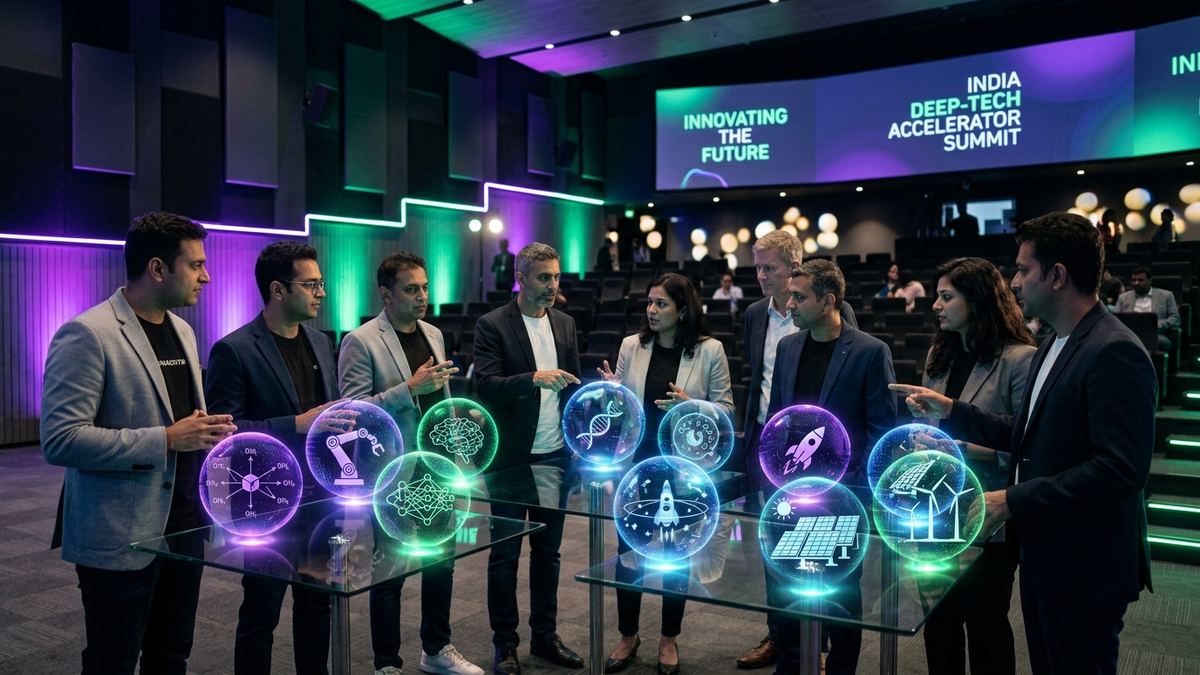
DPIIT and Avaana Capital shortlist 12 pioneering Indian deep-tech startups across quantum, climate tech, and advanced robotics for institutional funding and commercial sandboxes.
NEW DELHI — In a major boost to India's frontier engineering ecosystem, the Department for Promotion of Industry and Internal Trade (DPIIT), in strategic alliance with leading climate and deep-tech venture firm Avaana Capital, has officially shortlisted 12 high-impact Indian deep-tech startups for the 2026 National Deep Tech Acceleration Program.
The selected cohort represents the vanguard of India’s transition from consumer software aggregators to hard-tech, patent-protected innovation. Under the National Deep Tech Startup Policy (NDTSP) framework, the 12 shortlisted startups will gain access to non-dilutive government grants of up to ₹5 crore each, fast-tracked regulatory sandboxes, prioritized patent examinations, and institutional co-investment matching from a $150 million dedicated syndicate.
The Structural Shift in Indian Venture Capital
For over a decade, Indian venture capital was heavily concentrated in consumer internet, quick commerce, and B2B marketplace rollups. However, macroeconomic normalization and corporate margin scrutiny have redirected institutional capital toward high-barrier technological moats, as detailed in our analysis of Seed to Series A Valuation Normalization in 2026.
The joint DPIIT–Avaana program addresses the historic "valley of death" faced by deep-tech founders: extended R&D lifecycles, capital-intensive lab prototyping, and complex enterprise procurement timelines.
"Deep-tech innovation cannot be measured on 12-month consumer growth metrics,"said Anjali Bansal, Founding Partner at Avaana Capital. "These 12 startups are building foundational intellectual property in industrial decarbonization, quantum cryptography, and sovereign robotics. By combining patient venture capital with sovereign regulatory clearances and commercial testbeds, India is proving it can produce world-class frontier science ventures."
Deep-Dive: The 12 Shortlisted Deep-Tech Verticals
The shortlisted ventures span six critical technological domains, selected after a rigorous multi-tier evaluation of over 850 applicant startups:
| Strategic Domain | Core Engineering Moat | Target Industrial Impact | Commercial Sandbox & Pilot Partners |
|---|---|---|---|
| Quantum Sensing & Cryptography | Diamond NV-center magnetometry & post-quantum key distribution | Defense communication & GPS-denied navigation | DRDO, Indian Navy, Bharat Electronics |
| Next-Gen Energy Storage | Solid-state sodium-ion cells with dendrite-suppressing electrolytes | Grid-scale renewable storage & heavy EV mobility | NTPC, PowerGrid, Tata Power |
| Precision Industrial Robotics | Multi-axis autonomous robotic welding with sub-millimeter computer vision | Heavy shipbuilding, aerospace fabrication & rail engineering | Mazagon Dock, L&T Heavy Engineering |
| Synthetic Biology & Bio-Materials | Precision fermentation of microbial enzymes for bio-plastics | 100% biodegradable industrial packaging & circular chemistry | Reliance Industries, Marico, Aditya Birla |
| Fabless Edge Silicon & RISC-V | Ultra-low-power neuromorphic NPU cores for on-device inference | Industrial IoT, smart metering, and agritech sensors | MeitY SCL, Tata Elxsi, Schneider Electric |
| Spacetech & Thermal Propulsion | Additively manufactured aerospike rocket engines & cryogenic valves | Responsive small-satellite orbital injection | ISRO IN-SPACe, NewSpace India (NSIL) |
Comprehensive Support Framework Under the NDTSP
The 12 cohort companies will participate in an intensive 18-month commercialization pipeline structured around four operational pillars:
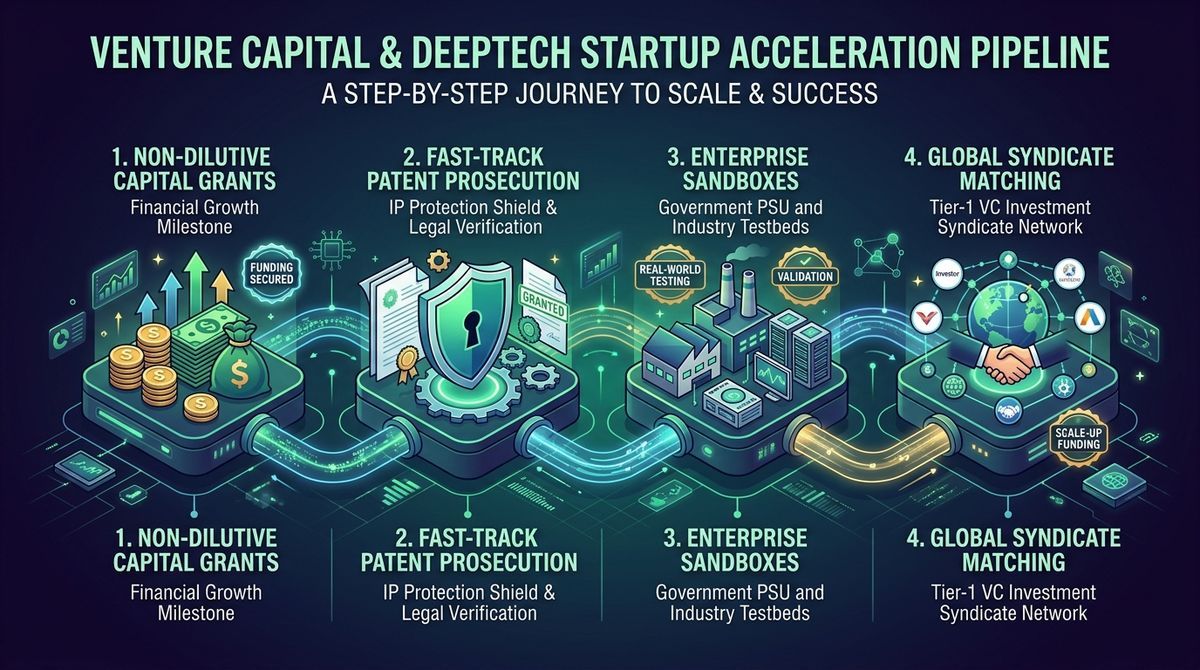
1. Expedited Intellectual Property Clearance: Through DPIIT's dedicated patent facilitation corridor, patent prosecution timelines are reduced from 36 months to under 90 days.
2. Public Enterprise Commercial Procurement: Bypassing traditional restrictive tender qualification criteria (such as historical turnover requirements) to allow startups to deploy commercial pilots directly across public sector undertakings (PSUs).
3. Cross-Border Export & Dual-Use Certification: Fast-tracking SCOMET (Special Chemicals, Organisms, Materials, Equipment and Technologies) export authorizations for global defense and space markets.
4. Institutional Syndicate Deployment: Direct matching with sovereign and international venture pools, such as the recently announced Crane Venture Partners $120M India Deeptech Fund.
Ecosystem Impact & Secondary Market Liquidity
The institutionalization of deeptech support also marks an important evolution in investor liquidity. As detailed in our report on How Deep-Tech Exits are Changing in India, early deeptech investors are increasingly finding secondary liquidity through strategic corporate acquisitions and sovereign fund buyouts rather than relying exclusively on public IPO markets.
With formal induction underway, the DPIIT–Avaana cohort establishes a blueprint for how state backing and private risk capital can jointly accelerate India's technological self-reliance over the coming decade.