IBM Chairman and CEO Arvind Krishna argues that specialized small language models (SLMs) beat brute-force generalist LLMs on enterprise accuracy, latency, and cost efficiency.
Executive Key Takeaways
- IBM Chairman and CEO Arvind Krishna argues that specialized small language models (SLMs) beat brute-force generalist LLMs on enterprise accuracy, latency, and cost efficiency.
- You do not need a model that knows how to write French sonnets or debate 18th-century European philosophy when your objective is to parse a bill of lading or validate a COBOL transaction on a banking mainframe, emphasized Arvind Krishna. Small models trained on pristine enterprise data are faster, cheaper, more transparent, and dramatically more secure.
- Key Benchmark: **Inference Hardware Requirement** — Dedicated 8x H100/B200 GPU cluster ($300,000+)
ARMONK & BENGALURU — In an influential keynote that is reshaping enterprise IT procurement strategies worldwide, IBM Chairman and Chief Executive Officer Arvind Krishna has forcefully advocated for a transition away from monolithic trillion-parameter artificial intelligence models in favor of compact, domain-specialized Small Language Models (SLMs).
Speaking on the operational economics of enterprise AI, the IIT Kanpur alumnus asserted that corporate CIOs have been caught in a costly cycle of over-provisioning compute for routine business tasks. Krishna argued that for 90% of enterprise applications—ranging from financial reconciliation and code modernization to supply chain telemetry—smaller, purpose-built models ranging between 2 billion and 8 billion parameters outperform massive generalist LLMs in task accuracy, inference speed, data security, and total cost of ownership.
Krishna’s thesis aligns closely with the practical enterprise implementations observed in Infosys Bets on AI Startup Aerchain to Transform Enterprise Procurement and the hardware-software co-design philosophies emerging from Indian academic corridors detailed in IIT-Kanpur Startup Armatrix Wins ETSA Best on Campus for Snake-Like Industrial Robots.
The Economic Reality of the 'Bigger Is Better' Fallacy
Since the debut of frontier foundation models, tech industry headlines have fixated on staggering compute metrics: models trained on tens of thousands of clustered H100 GPUs costing upwards of $100 million per training run. However, as enterprise CFOs review their 2025 and 2026 cloud invoices, the reality of running inference at scale has become impossible to ignore.
Querying a 1.8-trillion-parameter mixture-of-experts model to summarize an internal compliance memo or parse an insurance claim costs roughly $0.02 to $0.05 per API call. When multiplied across tens of millions of monthly enterprise transactions, annual compute bills rapidly spiral into the tens of millions of dollars.
Furthermore, monolithic generalist models frequently suffer from "hallucination creep"—inadvertently fabricating citations or introducing creative liberties when rigorous, deterministic factual precision is required.
"You do not need a model that knows how to write French sonnets or debate 18th-century European philosophy when your objective is to parse a bill of lading or validate a COBOL transaction on a banking mainframe,"emphasized Arvind Krishna. "Small models trained on pristine enterprise data are faster, cheaper, more transparent, and dramatically more secure."
Performance Benchmark: Monolithic LLMs vs. Specialized SLMs (IBM Granite Family)
The matrix below illustrates the trade-offs between generalist frontier models and enterprise-tuned small language models:
| Performance Metric | Frontier Generalist LLM (100B – 1.8T Parameters) | Specialized Enterprise SLM (3B – 8B Parameters) | Strategic Business Impact |
|---|---|---|---|
| Inference Hardware Requirement | Dedicated 8x H100/B200 GPU cluster ($300,000+) | Single Commodity GPU or Standard Server CPU | 90% Reduction in Infrastructure Capex |
| Token Processing Latency | 350ms – 1,200ms per transaction | 8ms – 35ms per transaction | Enables Real-Time Millisecond Edge Execution |
| Deployment Security | Multi-tenant public cloud API | Air-Gapped On-Premises or Private VPC | Zero Risk of Intellectual Property Leakage |
| Domain Task Accuracy | 88% – 93% (subject to hallucination drift) | 96% – 99% (deterministic domain fine-tuning) | Higher Operational Compliance & Reliability |
| Power Draw & Carbon Impact | ~3.5 kWh per 1,000 complex queries | ~0.07 kWh per 1,000 complex queries | 98% Lower Energy Footprint; ESG Compliant |
The Granite Blueprint and Open Source Commercialization
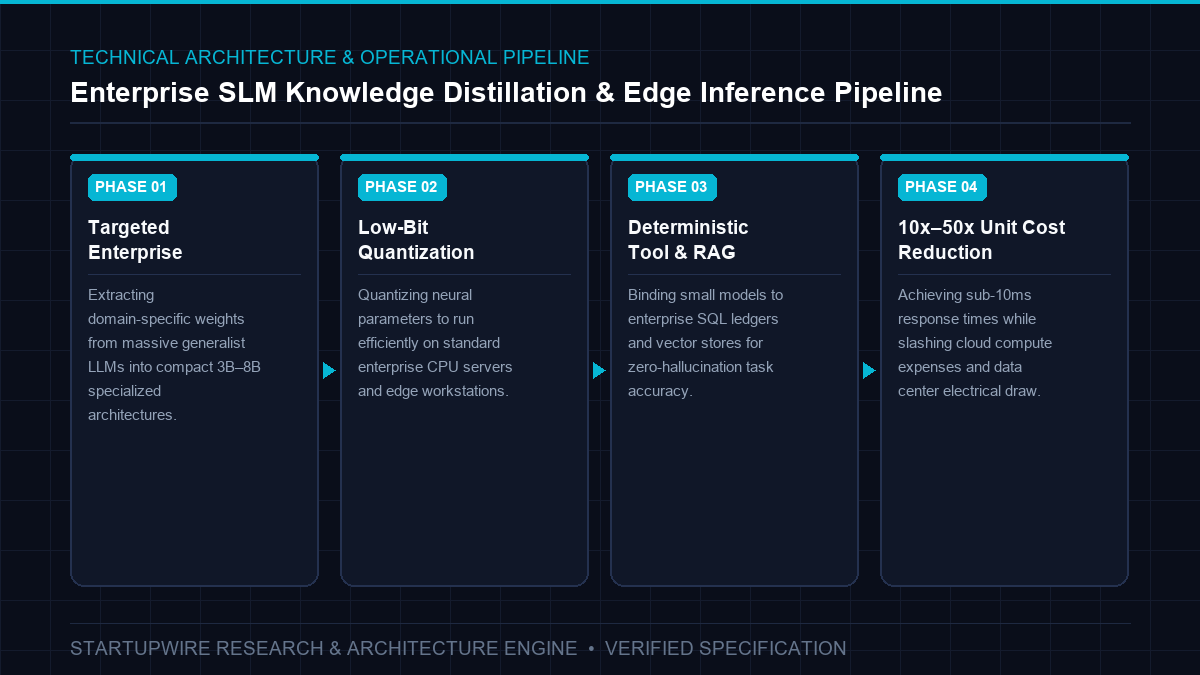
Under Krishna’s leadership, IBM has operationalized this philosophy through its Granite model family, releasing open-source models under liberal Apache 2.0 licenses. By pairing compact models with retrieval-augmented generation (RAG) and deterministic vector search, enterprise clients can run complete automated customer workflows inside their existing on-premises server racks without ever routing unencrypted customer records over the open internet.
As IT service providers and enterprises overhaul their multi-agent architectures, as seen in Wipro Expands Google Cloud Partnership to Accelerate Agentic AI Adoption, Arvind Krishna’s pragmatic focus on small, specialized AI models is setting the new industry standard for enterprise sustainability.