The Department of Telecommunications has expanded institutional, financial, and regulatory backing for Indian telecom startups and MSMEs through a dedicated advisory panel, TTDF grants, and 5G testbeds.
Executive Key Takeaways
- The Department of Telecommunications (DoT) has constituted a dedicated Advisory Group for Telecom Startups and MSMEs to resolve regulatory, procurement, and market-entry bottlenecks directly with policymakers.
- Financial backing is anchored by the Telecom Technology Development Fund (TTDF) under Digital Bharat Nidhi and the Digital Communication Innovation Square (DCIS), funding indigenous 5G, 6G, quantum, and satcom R&D.
- To lower hardware validation costs, the government provides access to 100 5G Use Case Labs nationwide alongside Regulatory Sandbox and Captive Non-Public Network (CNPN) provisions under the Telecommunications Act, 2023.
The Indian government has significantly strengthened its institutional, financial, and regulatory support framework for domestic telecom startups and Micro, Small, and Medium Enterprises (MSMEs), aiming to transition India from a net importer of networking gear into a global creator and exporter of indigenous telecom intellectual property. Led by the Department of Telecommunications (DoT), the expanded push combines a dedicated Startup and MSME Advisory Group, milestone-based R&D grants under the Telecom Technology Development Fund (TTDF), and nationwide access to 100 5G Use Case Labs.
Institutionalizing Direct Policy Engagement
Historically, smaller telecom hardware and software innovators struggled to navigate spectrum allocation rules, carrier procurement cycles, and legacy compliance frameworks dominated by Tier-1 global original equipment manufacturers (OEMs). To bridge this gap, Union Minister for Communications Jyotiraditya M. Scindia announced the creation of a dedicated Advisory Group for Telecom Startups and MSMEs.
Modeled on existing consultative panels for major telecom service providers (TSPs) and large OEMs, the advisory body convenes founders, MSME engineering leaders, and DoT officials on a regular cadence. Its mandate is to surface grassroots operational bottlenecks, streamline public procurement norms, and accelerate standards adoption for homegrown equipment makers—mirroring broader sovereign hardware initiatives covered in our report on India's sovereign hardware and deep-tech push.
"India's telecom sector is moving decisively from being a consumer of imported technology to a designer, developer, and exporter of trusted global standards,"officials noted during the Telecom Startups and MSME Conclave.
Financial Instruments Driving Indigenous R&D
Capital intensity remains the primary barrier in telecom hardware, where radio-frequency (RF) engineering, optical transport systems, and core network stacks require multi-year validation before generating commercial revenue. The DoT has structured three complementary funding channels to de-risk early-stage innovation:
- Telecom Technology Development Fund (TTDF): Administered through Digital Bharat Nidhi (formerly the Universal Service Obligation Fund), TTDF disburses milestone-based grants for indigenous R&D, prototyping, and field commercialization across 5G, 6G, quantum communications, IoT, and satellite connectivity.
- Digital Communication Innovation Square (DCIS): Targets early-stage startups and MSMEs to nurture novel telecom concepts from lab prototypes into market-ready commercial products.
- Technology Development and Investment Promotion (TDIP): Supports domestic intellectual property creation and funds active Indian participation in global standards-setting bodies such as 3GPP and ITU.
| Support Pillar | Implementing Body / Mechanism | Primary Target Beneficiaries | Core Strategic Objective |
|---|---|---|---|
| Policy & Governance | Dedicated Startup & MSME Advisory Group | Telecom Founders, MSME OEMs | Direct resolution of regulatory and market-entry hurdles |
| R&D Grant Capital | TTDF (via Digital Bharat Nidhi) | Startups, MSMEs, IITs, NITs | Indigenous 5G, 6G, quantum, and rural connectivity R&D |
| Commercialization | DCIS & TDIP Schemes | Early-stage Telecom Ventures | Lab-to-market productization and global standards participation |
| Testing & Validation | 100 5G Use Case Labs | Engineering Teams, Enterprise Innovators | Low-cost hardware validation and enterprise use-case trials |
| Regulatory Agility | Telecommunications Act, 2023 Sandbox | Emerging Tech & CNPN Providers | Live field testing without legacy licensing bottlenecks |
Lowering Testing Costs and Regulatory Friction
100 5G Use Case Labs and Hardware Validation
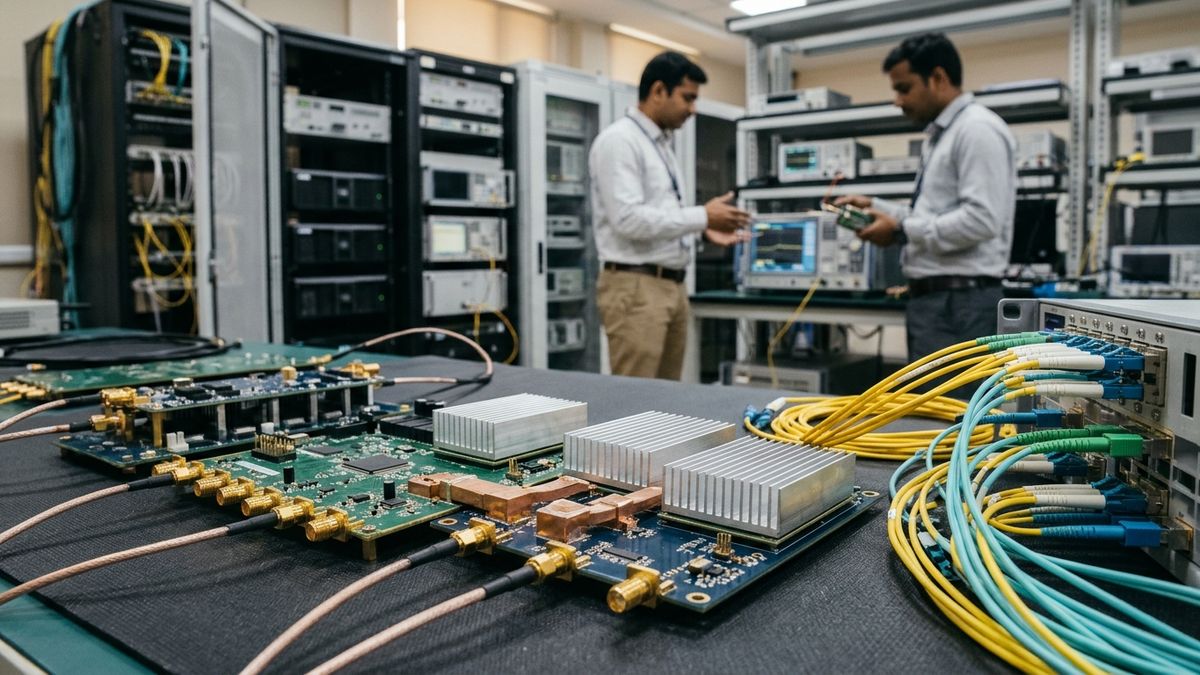
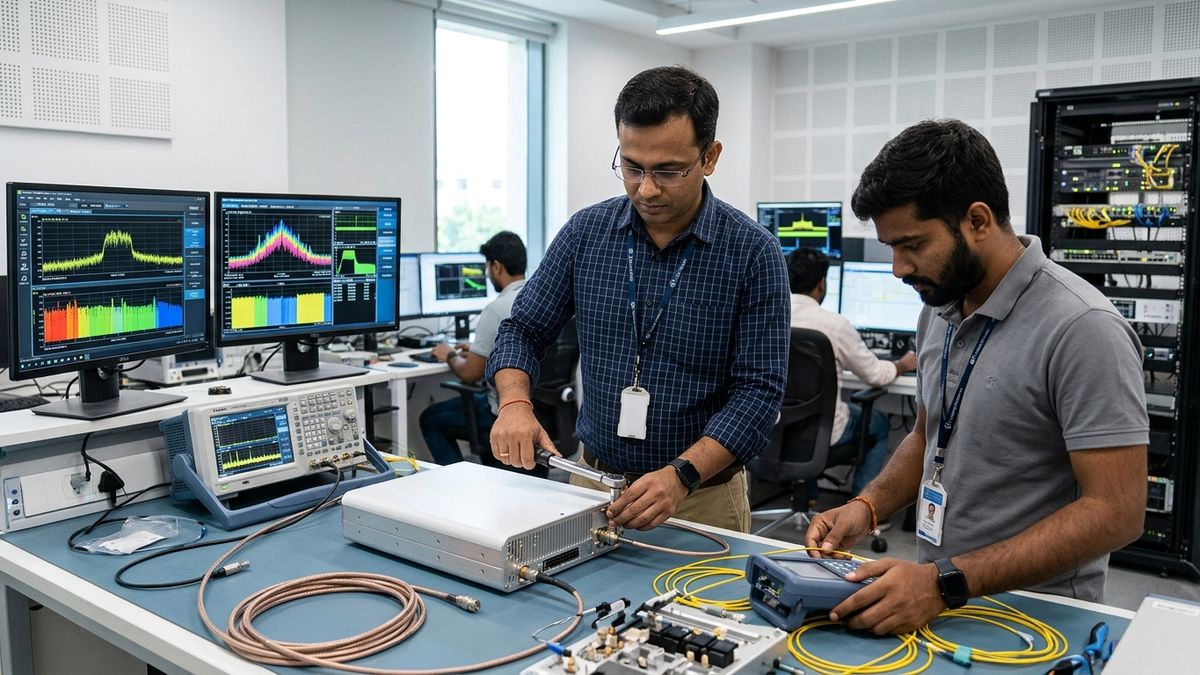
Building carrier-grade telecom equipment requires expensive spectrum analyzers, anechoic chambers, and core network emulators that early-stage MSMEs cannot easily finance on their own. By deploying 100 5G Use Case Labs across technical universities and research institutions nationwide, the DoT has effectively decentralized access to validation infrastructure. Startups developing private 5G radios, Open RAN software stacks, and industrial IoT gateways can benchmark performance alongside academic researchers—complementing parallel hardware design momentum seen in Cyient Semiconductors and GlobalFoundries' ASIC chip design partnership and India's expansion of robotics and engineering seats across IITs.
Regulatory Sandbox Under the Telecommunications Act, 2023
Complementing physical testbeds, the Telecommunications Act, 2023 provides a statutory Regulatory Sandbox alongside simplified frameworks for Captive Non-Public Networks (CNPNs). Startups testing non-terrestrial networks, dynamic spectrum sharing, or AI-managed network slicing can obtain time-bound experimental clearances without navigating full commercial carrier licensing. For enterprise-focused MSMEs deploying private wireless networks across ports, mines, and automated factories, CNPN provisions open a direct commercial runway.
Strategic Outlook for Indian Telecom Innovators
As global telecom operators diversify supply chains toward trusted vendors, India's combination of non-dilutive R&D grants, shared testing labs, and direct ministerial consultation gives domestic startups a rare structural advantage. Execution over the next 18 months will hinge on faster procurement onboarding by both public-sector carriers and private telcos so that validated indigenous products transition smoothly from sandbox pilots into large-scale commercial deployments.
Frequently Asked Questions
How is the Indian government supporting telecom startups and MSMEs?
Through the Department of Telecommunications (DoT), the government has established a dedicated Startup and MSME Advisory Group, expanded milestone-based R&D grants under the Telecom Technology Development Fund (TTDF) and DCIS, deployed 100 5G Use Case Labs, and enabled live testing via Regulatory Sandboxes.
What is the Telecom Technology Development Fund (TTDF)?
Implemented via Digital Bharat Nidhi (formerly USOF), TTDF provides milestone-based financial assistance to Indian startups, MSMEs, and academic institutions for indigenous research, prototyping, and commercialization of 5G, 6G, quantum communication, IoT, and satellite telecom products.
How does the Telecommunications Act, 2023 help smaller telecom innovators?
The Telecommunications Act, 2023 introduces formal Regulatory Sandbox provisions and Captive Non-Public Network (CNPN) frameworks, allowing startups and MSMEs to test emerging wireless and enterprise networking technologies in live environments without legacy licensing barriers.
What role do the 100 5G Use Case Labs play for MSMEs?
Set up across academic and technical institutions nationwide, the 100 5G Use Case Labs give startups and MSMEs affordable access to carrier-grade testing equipment, spectrum environments, and validation infrastructure needed to move prototypes toward commercial deployment.
Primary Sources & Official References
- Department of Telecommunications (DoT): Telecom Technology Development Fund (TTDF), Digital Communication Innovation Square (DCIS), and TDIP scheme guidelines.
- Press Information Bureau (PIB): Official briefings from the Telecom Startups and MSME Conclave announcing the dedicated Advisory Group and 100 5G Use Case Labs.
- The Telecommunications Act, 2023: Statutory provisions governing Regulatory Sandboxes and Captive Non-Public Networks (CNPNs).