Pune-based renewable biofuels pioneer Greenjoules secures ₹150 crore in Series B capital to commission commercial drop-in bio-fuel processing facilities across Maharashtra.
Executive Key Takeaways
- Greenjoules secured ₹150 crore in Series B funding to scale commercial drop-in green fuel production from non-food agricultural and industrial waste.
- The company's proprietary thermochemical cracking technology produces drop-in biofuels that replace diesel without requiring engine or boiler retrofits.
- Proceeds will finance three commercial biorefineries in Maharashtra, expanding collective processing capacity to 200,000 liters per day.
Greenjoules Raises ₹150 Crore in Series B Funding to Scale Biofuel Refineries and Drop-In Clean Energy marks a major acceleration in India's industrial decarbonization and renewable fuels landscape. Headquartered in Pune, Greenjoules has secured ₹150 Crore ($18 Million) in Series B equity financing, backed by leading climate-focused institutional venture funds and prominent family offices, to transition its proprietary waste-to-fuel technology from proven commercial pilot scale into high-volume continuous industrial production.
As domestic manufacturing hubs face stringent regulatory emissions caps and international supply chain carbon audits, industrial enterprises are urgently seeking drop-in renewable fuels that do not require multi-million-dollar capital replacements for existing boilers, generators, and heavy equipment. Greenjoules directly answers this market demand, converting agricultural residues and non-edible industrial waste streams into drop-in renewable fuels that function as direct 1:1 replacements for standard petroleum diesel.
Commercial Breakthrough: True Drop-In Hydrocarbon Chemistry
Traditional biofuels like first-generation biodiesel (FAME) and bio-ethanol present significant operational limitations for heavy industry. They often cause fuel injector clogging, moisture absorption, and thermal degradation, necessitating complex fuel blending limits (e.g., B20) or costly engine retrofits.
Greenjoules has overcome these limitations through a proprietary, low-emissions thermochemical cracking process. The resulting renewable liquid fuel matches petroleum-based light diesel oil (LDO) and high-speed diesel (HSD) across viscosity, flash point, and energy density:
- Zero Retrofitting: Industrial clients can immediately transition furnace boilers, thermal heaters, and heavy transport equipment without modifying pumps, seals, or combustion chambers.
- Superior Environmental Profile: The drop-in bio-fuel delivers up to an 80% lifecycle reduction in greenhouse gas emissions, alongside zero sulfur content and drastically reduced particulate matter emissions.
- Non-Food Circular Feedstock: Operating strictly on non-food biomass—such as bagasse, rice husk, press mud, and agro-processing residues—the refining process avoids competing with food security ecosystems.
"Decarbonizing heavy industrial manufacturing cannot wait for next-generation hydrogen infrastructure or complete factory electrification,"stated the leadership team at Greenjoules. "Our drop-in biofuels allow industrial enterprises to achieve immediate, verified Scope-1 emissions reductions today using their existing equipment and infrastructure."
Biorefinery Expansion & Capital Allocation Metrics
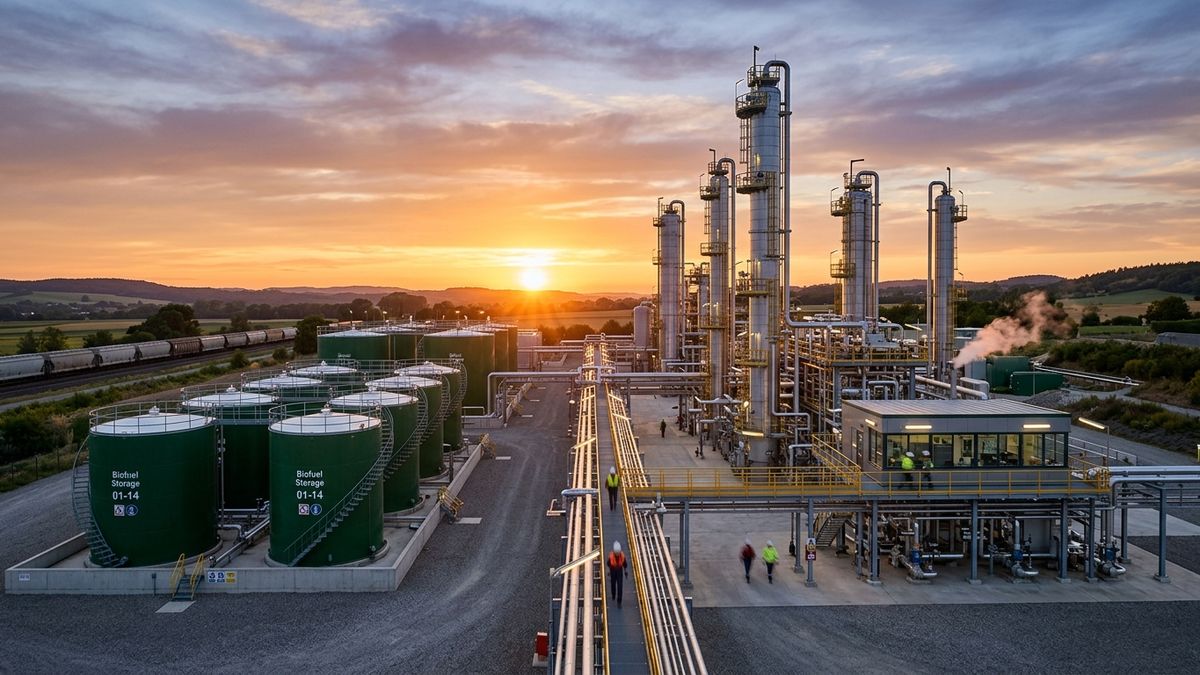
The fresh Series B capital will primarily finance the construction of three advanced continuous-flow biorefinery plants in Maharashtra, expanding the company's daily refining capacity from pilot volumes to over 200,000 liters per day. These facilities will anchor regional agro-residue collection networks, providing local farming communities with supplementary income while preventing seasonal crop stubble burning.
The structured comparative matrix below highlights Greenjoules' fuel parameters against conventional industrial fuels:
| Technical & Economic Dimension | Greenjoules Drop-In Biofuel | Conventional Petroleum Diesel (HSD) | Standard First-Gen Biodiesel (FAME) |
|---|---|---|---|
| Combustion Equipment Retrofit | Zero Equipment Changes Required | Baseline Benchmark | Requires Modified Seals & Injectors |
| Sulfur Content | < 10 ppm (Ultra-Low) | ~50 ppm (BS-VI Standard) | Trace |
| Lifecycle GHG Reduction | Up to 80% Emissions Cut | Baseline High Carbon Footprint | 40% – 50% Reduction |
| Cold-Flow Viscosity | Stable Year-Round (4.2 cSt) | 2.0 – 4.5 cSt | Prone to Waxing & Gelling Below 15°C |
| Feedstock Security | 100% Non-Food Biomass & Waste | Depleting Fossil Reserves | Often Uses Edible Seed Oils |
Industrial Commercial Traction and Corporate ESG Mandates
Greenjoules has already contracted long-term off-take agreements with major industrial conglomerates operating across Pune, Aurangabad, and Gujarat's chemical manufacturing belts. Heavy manufacturing giants, which are increasingly subject to carbon border adjustments and domestic ESG disclosures under SEBI's Business Responsibility and Sustainability Reporting (BRSR) framework, represent a resilient and growing customer base.
The company's expansion mirrors the broader momentum across sustainable manufacturing and hardware innovation in India, highlighted in recent developments such as Voltas and Atomberg's joint manufacturing initiatives and Suzlon's capital investments in clean industrial technology.
Strategic Significance for India's National Biofuel Ambitions
India's National Policy on Biofuels sets an aggressive target of achieving 20% biofuel blending by 2030, while simultaneously expanding second-generation (2G) drop-in biofuels for heavy industrial and transport corridors. By establishing decentralized, scalable biorefining plants, Greenjoules demonstrates a commercially sustainable blueprint for achieving these policy objectives.
With its capital base secured and commercial contracts expanding, Greenjoules is positioned to become India's benchmark clean fuels producer. By converting rural agricultural liabilities into high-value industrial energy assets, the company bridges agricultural prosperity with industrial decarbonization, creating an enduring competitive moat in the global energy transition.
Frequently Asked Questions
What is unique about Greenjoules' drop-in biofuel technology?
Unlike traditional biodiesel or ethanol blends that require engine recalibration or blend limitations, Greenjoules produces a full hydrocarbon drop-in fuel. It exhibits chemical equivalence to petroleum diesel, allowing direct usage in heavy industrial furnaces, boilers, and diesel engines without any equipment modifications.
What feedstock does Greenjoules use for biofuel generation?
Greenjoules utilizes 100% non-food biomass, agricultural crop residues, and industrial waste byproducts, ensuring that its fuel production does not compete with food security or require dedicated arable cropland.
Which industries represent the primary customer base for Greenjoules?
The primary off-takers include heavy industrial manufacturing plants, specialty chemical producers, steel manufacturing facilities, cement kilns, and commercial mining fleets seeking rapid carbon emissions reduction to meet institutional ESG mandates.
How will the fresh Series B capital be deployed?
The ₹150 crore round will be deployed toward constructing three continuous-flow biorefineries in Maharashtra, upgrading automated refinery process controls, expanding regional agricultural feedstock aggregation hubs, and securing global environmental product declarations (EPDs).
Primary Sources & Official References
- Greenjoules Corporate Regulatory Disclosures and Series B Press Release: Official corporate filing and capital allocation roadmap (https://www.greenjoules.in).
- Ministry of Petroleum and Natural Gas (MoPNG) National Policy on Biofuels: Statutory biofuel mandates and alternative fuel definitions (https://mopng.gov.in).
- Bureau of Indian Standards (BIS) Technical Specifications for Alternate Industrial Fuels: Quality and emissions specifications for non-petroleum fuels (https://www.bis.gov.in).