Suzlon Energy commits ₹550 crore to establish three AI-powered wind-blade manufacturing facilities across Gujarat, Karnataka, and Tamil Nadu, merging AI with renewables.
Executive Key Takeaways
- Suzlon Energy has approved a ₹550 crore investment to construct three AI-integrated wind turbine blade manufacturing factories across Gujarat, Karnataka, and Tamil Nadu.
- The smart manufacturing plants will deploy real-time computer vision, laser-guided carbon-fiber composite layup, and thermal curing optimization algorithms to build ultra-long 80+ meter rotor blades.
- The capital expenditure supports Suzlon's rapidly growing order book, advancing India's sovereign clean energy manufacturing target of 500 GW non-fossil capacity by 2030.
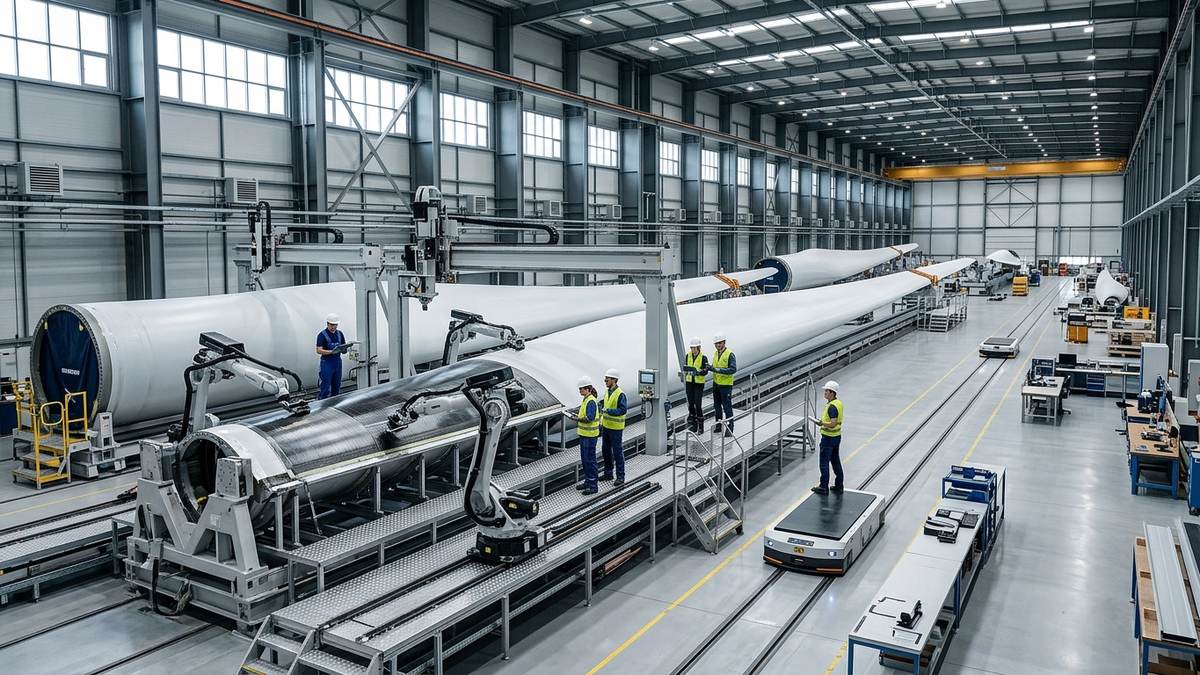
Suzlon Energy Limited, India's premier renewable energy solutions provider, has approved a strategic capital expenditure of ₹550 crore to build three state-of-the-art, artificial intelligence-powered wind turbine blade manufacturing plants. The advanced greenfield and expanded facilities—to be established across Gujarat, Karnataka, and Tamil Nadu—will integrate computer vision defect diagnostics, automated carbon composite layup, and machine learning curing cycle analytics to build next-generation rotor blades for 3.X MW and 4.X MW wind turbine platforms.
The substantial investment comes amidst an unprecedented resurgence in India's wind energy sector, driven by commercial and industrial (C&I) decarbonization mandates, round-the-clock (RTC) renewable energy auctions, and sovereign clean energy capacity goals.
Engineering Complexity: Aerodynamic Blades at Massive Scale
Modern utility-scale wind turbine blades are among the largest single-piece composite structures manufactured on Earth. Exceeding 80 to 85 meters in length—longer than the wingspan of a Boeing 747 aircraft—each blade must withstand severe aerodynamic loads, hurricane-force wind gusts, cyclic fatigue, and intense ultraviolet radiation over a 25-year operational lifespan.
Traditionally, manufacturing these massive structures required labor-intensive vacuum-assisted resin infusion molding, where slight human errors during composite fabric layering or resin curing could introduce microscopic voids, structural delamination, or blade imbalances.
Suzlon's ₹550 crore AI-powered factory architecture introduces automated precision at every production stage:
- Laser-Guided Layup Guidance: Augmented reality projection systems coupled with edge AI ensure that hundreds of layers of biaxial glass fabric and carbon structural caps are positioned with sub-millimeter precision along the 80-meter mold.
- Inline Computer Vision Defect Diagnostics: Multi-spectrum 4K cameras inspect resin wetting in real-time, automatically detecting dry spots, fiber wrinkles, or micro-voids prior to vacuum bag consolidation.
- Thermodynamic Machine Learning Curing Models: Thousands of fiber-optic temperature and pressure sensors embedded within the molds feed algorithmic models that dynamically adjust heating rates, reducing cure cycle times by 25% while maximizing composite shear strength.
- Digital Twin Dynamic Balancing: Post-molding algorithmic weight and center-of-gravity scanners compute micro-adjustments for trailing-edge balance chambers, guaranteeing aerodynamically matched blade sets.
"Wind energy engineering is entering a new frontier where mechanical design alone is insufficient,"explained clean energy manufacturing engineers. "By fusing artificial intelligence with composite aerodynamics, Suzlon is achieving aerospace-grade manufacturing tolerances at commercial renewable energy speeds."
Strategic Regional Footprint Across High-Yield Wind Corridors
The geographic placement of the three manufacturing facilities in Gujarat, Karnataka, and Tamil Nadu is strategically calculated. These three states represent India's richest wind energy corridors, accounting for the lion's share of planned hybrid wind-solar installations.
Moreover, transporting 80-meter-long blades across interstate road networks presents immense logistical complexity. Locating blade factories close to major wind farm clusters and deep-water ports drastically lowers transit logistics costs, reduces project lead times, and facilitates export shipments.
The operational parameters of Suzlon's AI-powered blade manufacturing facilities are detailed below:
| Dimension | Facility 1: Gujarat (Kutch Hub) | Facility 2: Karnataka (Dharwad) | Facility 3: Tamil Nadu (Coimbatore) |
|---|---|---|---|
| Capital Allocation | ₹220 Crore | ₹170 Crore | ₹160 Crore |
| Target Blade Platforms | 3.14 MW & 4.X MW Blades (84m) | 3.X MW Series Blades (78m) | 3.X MW Repowering Blades (70m - 78m) |
| Core AI Technologies | Autonomous composite layup, 4K vision | Laser projection, resin thermal curing | Ultrasonic automated NDT defect scanning |
| Target Annual Capacity | 1,200 MW Equivalent | 900 MW Equivalent | 800 MW Equivalent |
| Commissioning Timeline | Q1 FY27 | Q2 FY27 | Q3 FY27 |
Supporting India's 500 GW Clean Energy Ambition
The manufacturing expansion is pivotal to India's national commitment to achieve 500 gigawatts of non-fossil power capacity by 2030, which requires adding between 8 and 10 gigawatts of new wind generation capacity annually.
Suzlon has rebuilt its balance sheet, extinguished legacy debt, and amassed a multi-gigawatt order book from major independent power producers (IPPs) including NTPC Green, Adani Green, and state utilities. Expanding high-efficiency domestic blade capacity ensures Suzlon can honor delivery schedules without depending on imported European or Chinese blade components.
Reinventing Renewable Energy Manufacturing
Suzlon's ₹550 crore commitment signals a mature phase for India's clean energy transition. By incorporating artificial intelligence, robotic composite handling, and predictive telemetry into factory operations, the company demonstrates that sustainable infrastructure can be built with world-class engineering precision.
As these three smart factories come online across Gujarat, Karnataka, and Tamil Nadu, they will solidify India's position as a global hub for cost-competitive, technologically sophisticated renewable energy manufacturing.
Frequently Asked Questions
What is Suzlon Energy's new ₹550 crore manufacturing investment plan?
Suzlon is investing ₹550 crore to set up three artificial intelligence-powered wind turbine blade manufacturing plants in Gujarat, Karnataka, and Tamil Nadu to accelerate production of next-generation rotor blades.
How will artificial intelligence be utilized in wind turbine blade production?
AI will power laser-guided precision composite layup, high-resolution computer vision inspection to detect sub-millimeter resin voids, and predictive thermodynamic models to optimize curing autoclave cycles.
Which wind turbine platforms will these new facilities manufacture blades for?
The facilities will produce aerodynamic rotor blades exceeding 80 meters in length tailored for Suzlon's flagship 3.X MW series and upcoming 4.X MW high-capacity wind turbine generators.
Why are the three factories located in Gujarat, Karnataka, and Tamil Nadu?
These three states represent India's highest wind-yield corridors, coastal transport accessibility for shipping oversize blades, and established industrial clean energy supply networks.
Primary Sources & Official References
- Suzlon Energy Limited: Corporate Disclosures and Investor Relations Regulatory Filings (NSE/BSE)
- Ministry of New and Renewable Energy (MNRE): National Wind Energy Capacity Addition Projections
- Central Electricity Authority (CEA): Renewable Power Generation and Equipment Sourcing Benchmarks
- The Economic Times: Industrial CleanTech & Renewable Manufacturing Investment Reports