HCLTech Unveils AI-Native Telecom Framework, Open RAN Engineering, and 6G Architecture at India Mobile Congress 2026
By Sanjay Patel | Published October 8, 2026 | 9 min read
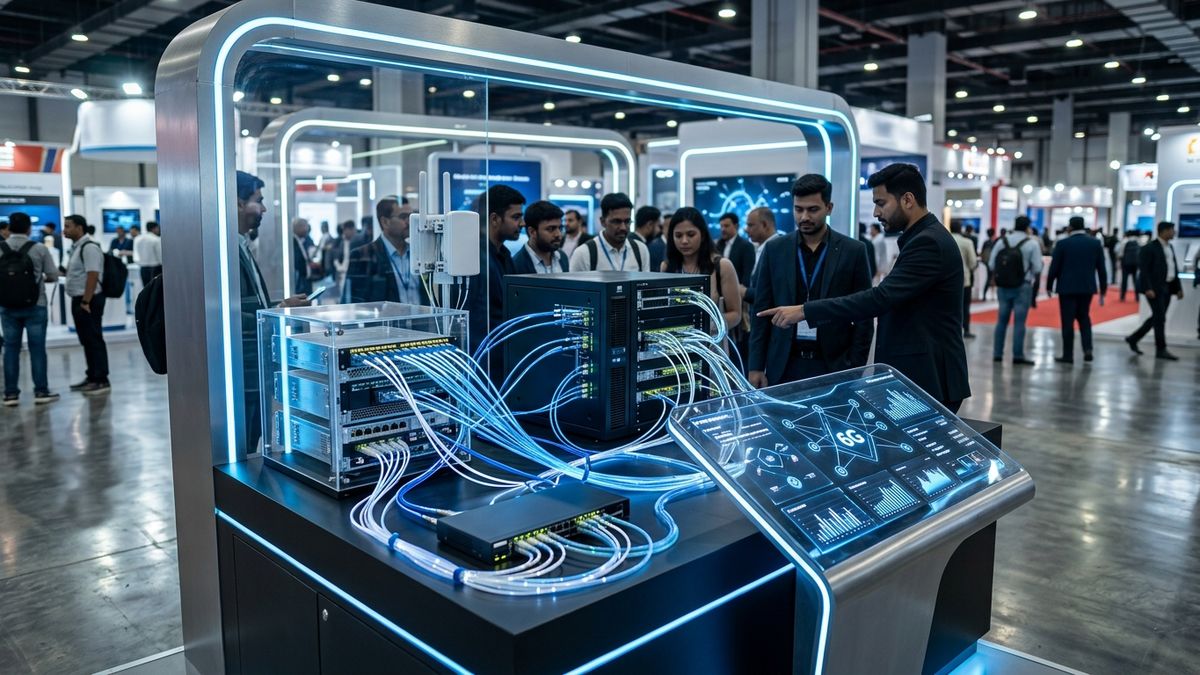
HCLTech demonstrates autonomous AI-native telecom infrastructure, Open RAN disaggregation, and 6G wireless testbeds at India Mobile Congress 2026.
Global engineering and IT solutions enterprise HCLTech has unveiled a comprehensive suite of AI-native telecommunications architectures, Open RAN interoperability accelerators, and early 6G testbed solutions at the India Mobile Congress (IMC) 2026 in New Delhi. The showcase highlights Indian engineering prowess on the world stage, offering global communication service providers (CSPs) the software frameworks required to transition from rigid legacy wireless networks to fully autonomous, self-optimizing telecom clouds.
As telecommunications operators face massive capital expenditure commitments for 5G Advanced while grappling with compressed average revenue per user (ARPU), AI-native network automation has emerged as an indispensable tool to compress operating expenditures (OpEx) and slash energy consumption.
Autonomous Networks and Self-Healing Radio Access Operations
Modern cellular networks generate petabytes of real-time telemetry across thousands of distributed cell towers, radio units, and fiber backhaul conduits. Historically, network optimization required specialized operations centers (NOCs) where engineers manually diagnosed signal interference, adjusted transmission tilt, and dispatched physical repair crews.
HCLTech's AI-native architecture replaces this reactive model with autonomous closed-loop intelligence. Utilizing reinforcement learning models and predictive telemetry algorithms embedded within the RAN Intelligent Controller (RIC), the platform continuously monitors signal-to-interference-plus-noise ratios (SINR), subscriber mobility patterns, and environmental factors.
When anomalies occur—such as sudden cell congestion at a sporting arena or hardware degradation at a rooftop antenna—the system autonomously reconfigures radio beamforming angles and spectrum slicing channels in milliseconds, resolving issues before end-users experience dropped calls.
"Telecommunications infrastructure is undergoing the most radical architectural transformation in its history,"stated HCLTech engineering leadership at IMC 2026. "By infusing predictive and generative AI directly into the radio access layer, we are enabling operators to build networks that think, heal, and optimize themselves autonomously."
This industrial focus on deep technical engineering aligns with broader domestic technology milestones, including Cyient introducing the CYiNGINE platform for AI-led product engineering and HCLTech's simultaneous expansion of its IT City campus in Lucknow.
Architectural Matrix: Telecom Evolution Across Network Generations
The table below benchmarks conventional monolithic 5G networks against Open RAN disaggregated systems and HCLTech's AI-native 6G-ready stack:
| Network Attribute | Monolithic 5G Architecture | Open RAN Disaggregated Stack | HCLTech AI-Native 6G Architecture |
|---|---|---|---|
| Hardware & Software Coupling | Proprietary Locked Hardware | Standard COTS Hardware / Disaggregated | Cloud-Native Virtualized & AI-Accelerated |
| Network Optimization | Manual NOC & Static Rules | Algorithmic Non-RT / Near-RT RIC | Autonomous Deep Reinforcement Learning |
| Energy Management | Static Power Curves | Rule-Based Sector Sleep Modes | Predictive Sub-Millisecond Dynamic Throttling |
| Vendor Interoperability | Single Proprietary Vendor | Multi-Vendor Standard Interfaces | Universal API Connectors & Model Sandbox |
| Energy Savings | Baseline Standard | 10% to 15% Reduction | Up to 30% Verified OpEx & Energy Reduction |
| Latency & Processing | Fixed Processing Chains | Software-Defined Latency Bounds | Distributed Edge AI with Sub-1ms Latency |
Open RAN Interoperability and Multivendor Telco Cloud Integration
A core highlight of HCLTech's demonstration was its vendor-neutral Open RAN engineering lab. By adhering strictly to O-RAN ALLIANCE specifications, HCLTech demonstrated seamless interoperability between disaggregated open radio units (O-RU), distributed units (O-DU), and centralized units (O-CU) sourced from disparate global hardware manufacturers.
The solution enables operators to evade traditional single-vendor lock-in, driving down cellular equipment procurement costs by up to 25% while maintaining telecom-grade 99.999% availability.
Pioneering the Bharat 6G Vision with Terahertz Wireless Testbeds
Looking beyond commercial 5G, HCLTech presented its experimental research into 6G wireless architectures, directly supporting the Department of Telecommunications' (DoT) Bharat 6G Vision.
The company's testbed demonstrated AI-assisted channel estimation across sub-terahertz frequency bands (100 GHz to 300 GHz). At these extreme frequencies, wireless signals suffer from severe atmospheric attenuation and physical blockage. HCLTech's neural beam-tracking algorithms dynamically predict physical obstacles and redirect terahertz beams via intelligent reflecting surfaces (IRS), demonstrating theoretical data transmission rates exceeding 100 Gbps.
Future Outlook for India's Global Telecom Leadership
India Mobile Congress 2026 has established India not merely as the world's fastest-growing telecom subscriber base, but as a premier producer of high-value telecommunications intellectual property.
Through its advanced AI-native frameworks, Open RAN software platforms, and 6G propagation architectures, HCLTech is proving that Indian enterprise technology providers are positioned to shape the global standard for next-generation wireless communications.
Frequently Asked Questions
What did HCLTech showcase at India Mobile Congress 2026?
HCLTech unveiled an AI-native telecom portfolio encompassing autonomous self-healing network management, Open RAN disaggregation tools, near-real-time RAN Intelligent Controllers (RIC), and experimental 6G sub-terahertz engineering frameworks.
How does AI make telecommunications networks autonomous and self-healing?
By analyzing telemetry across base stations in real time, reinforcement learning agents dynamically predict traffic congestion, adjust beamforming angles, re-route spectrum channels, and power down idle radio nodes during off-peak hours without human intervention.
What is the strategic significance of Open RAN for global telecom operators?
Open RAN decouples specialized cellular hardware from software, breaking vendor lock-in from legacy telecom giants and enabling operators to mix and match baseband units and radio hardware from diverse suppliers at substantially lower capital costs.
How does HCLTech align with India's Bharat 6G Vision?
HCLTech's 6G testbeds support the Department of Telecommunications' Bharat 6G Vision, researching intelligent reflecting surfaces (IRS), terahertz spectrum propagation, and integrated sensing and communications (ISAC).
Primary Sources & Official References
- Department of Telecommunications (DoT): Bharat 6G Vision Document and Strategy
- HCL Technologies Limited: Official IMC 2026 Telecom Engineering Showcase Briefing
- O-RAN ALLIANCE: Open RAN Specifications and Security Architecture
- Cellular Operators Association of India (COAI): India Mobile Congress 2026 Executive Summary