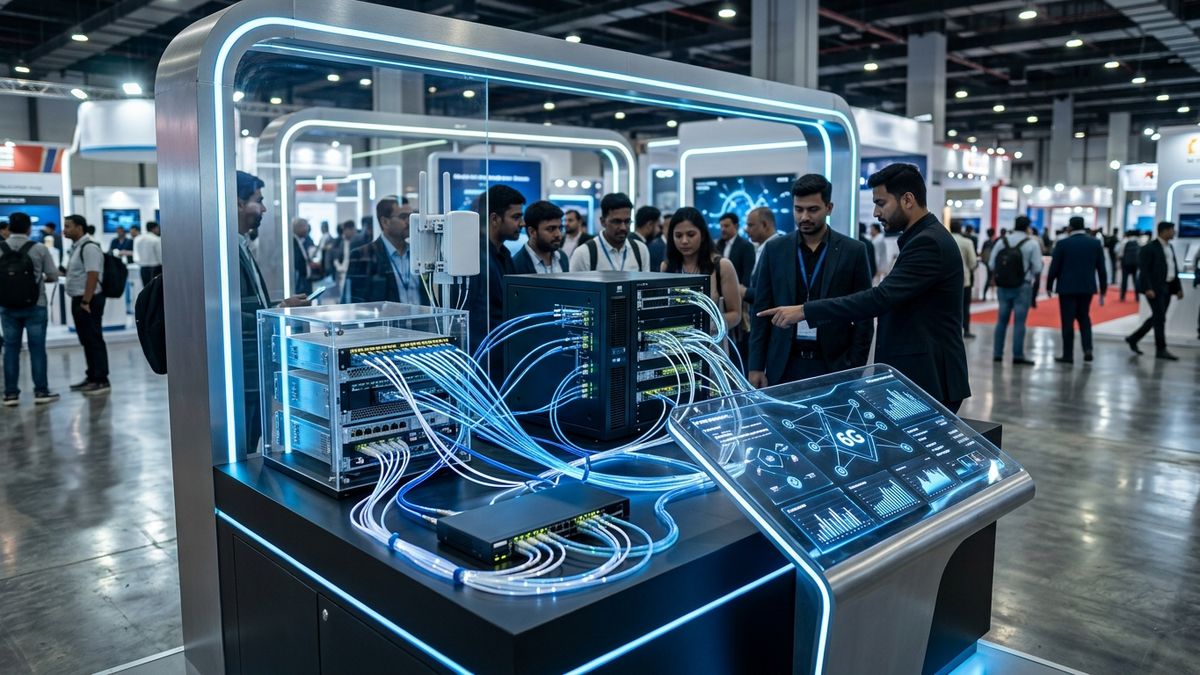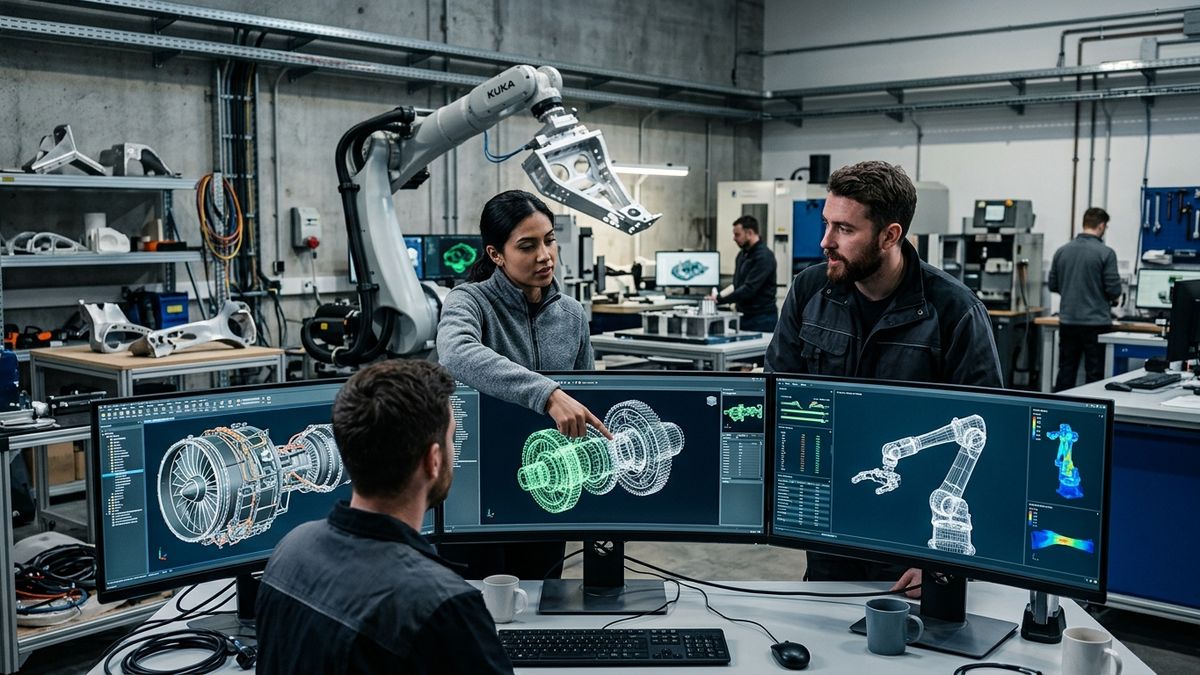
HCLTech expands automotive engineering capabilities, deploying NVIDIA Omniverse and Isaac Sim to automate testing for Software-Defined Vehicles.
Executive Key Takeaways
- HCLTech launched an AI-driven Verification and Validation (V&V) platform for automotive software in collaboration with NVIDIA.
- The platform leverages NVIDIA Omniverse, Cosmos, Isaac Sim, and Nemotron open-model agents to simulate physical testing environments.
- Automakers and Tier-1 suppliers can reduce physical fleet validation costs by up to 60% while accelerating over-the-air (OTA) software release cycles.
Global technology services enterprise HCLTech has unveiled an advanced AI-driven Verification and Validation (V&V) solution for automotive software, engineered in direct collaboration with NVIDIA. The breakthrough testing suite integrates NVIDIA's physical AI, robotics simulation, and agentic reasoning toolkits into HCLTech's proprietary "Validation Factory" architecture, enabling automotive original equipment manufacturers (OEMs) and Tier-1 suppliers to transition from labor-intensive physical testing fleets to high-fidelity virtual simulation.
As passenger vehicles evolve into Software-Defined Vehicles (SDVs) containing over 100 million lines of code, traditional periodic testing models have become a crippling bottleneck. By uniting NVIDIA Omniverse, Cosmos, Isaac Sim, and Nemotron AI agents, HCLTech's solution automates test generation, execution, anomaly detection, and regulatory safety compliance, cutting validation cycles by as much as 60%.
The Software-Defined Vehicle Dilemma: Why Physical Testing Fails
Modern vehicles are no longer static mechanical machines; they are distributed supercomputers on wheels requiring frequent Over-The-Air (OTA) firmware updates, autonomous driver-assistance algorithms, and complex battery management software. Validating software updates across thousands of vehicle variants, hardware microcontroller revisions, and driving climates using physical test tracks is economically unsustainable.
Furthermore, safety-critical edge cases—such as sudden black ice formation, blinding sunset glare, or rogue pedestrians crossing high-speed expressways—are extraordinarily dangerous and difficult to stage physically.
"Automotive engineering has reached an inflection point where physical road testing can no longer match the velocity of software updates,"explained automotive engineering leads. "By combining HCLTech's deep automotive domain expertise with NVIDIA's physical AI simulation stack, we empower global OEMs to validate billions of simulated miles in photorealistic virtual environments before vehicle code ever touches physical asphalt."
This physical-simulation paradigm closely mirrors academic and research advancements across Indian engineering hubs, such as Avathon's physical AI laboratory partnership with IIT Roorkee and breakthrough domain architectures demonstrated by Skyfall AI's engineering model benchmarks.
Core NVIDIA Technology Integration and Functional Architecture
The HCLTech solution deploys an integrated multi-tiered architecture that spans high-fidelity visual rendering, physics-based sensor simulation, and multi-agent AI coordination:
The structured table below details the NVIDIA technology modules and their operational functions within HCLTech's automotive testing platform:
| NVIDIA Technology Module | Architectural Role | Engineering Functionality |
|---|---|---|
| NVIDIA Omniverse & NuRec | Digital Twin & Neural Reconstruction | Generates photorealistic 3D virtual road networks and dynamic weather conditions |
| NVIDIA Cosmos & Isaac Sim | Physical AI & Sensor Modeling | Models vehicle dynamics, tire friction coefficients, lidar point clouds, and camera distortion |
| NVIDIA Alpamayo | Extreme Edge-Case Synthesis | Synthesizes rare, hazardous accident scenarios to stress-test ADAS decision algorithms |
| NVIDIA Agent Toolkit & Nemotron | Agentic Test Orchestration | Coordinates autonomous AI agents to auto-generate test scripts and diagnose telemetry logs |
| HCLTech Validation Factory | Hardware-in-the-Loop Integration | Bridges virtual software models with physical electronic control units (ECUs) and test benches |
Continuous Compliance and ISO 26262 Traceability
Automotive software validation requires uncompromising adherence to global safety mandates, including ISO 26262 for functional safety and UNECE R155/R156 for automotive cybersecurity and over-the-air update management.
HCLTech's platform establishes an immutable digital traceability trail linking high-level functional safety requirements directly to virtual simulation test results. Automated compliance reporting ensures that OEMs can provide regulatory bodies with verifiable algorithmic proofs of safety before rolling out firmware updates to global consumer fleets.
Market Deployment and Automotive Client Engagements
HCLTech has already commenced deployments of the NVIDIA-powered validation suite across leading European, North American, and Asian automotive manufacturers. As automakers accelerate their transitions toward Level 2+ and Level 3 autonomous driving architectures, the virtual validation suite serves as an essential technological foundation for safe, scalable commercial mobility.
Frequently Asked Questions
What is HCLTech's new automotive testing platform?
It is an AI-powered automotive Verification and Validation (V&V) solution developed by HCLTech and NVIDIA to automate virtual software testing for Software-Defined Vehicles (SDVs).
Which NVIDIA technologies are integrated into the solution?
The platform integrates NVIDIA Omniverse, Omniverse NuRec, NVIDIA Cosmos, Isaac Sim, NVIDIA Alpamayo, and the NVIDIA Agent Toolkit with Nemotron open models.
Why are automakers shifting from physical testing to virtual simulation?
Physical road testing of prototype vehicles is slow, cost-prohibitive, and dangerous for extreme edge cases. Virtual simulation allows continuous, safe, and automated testing across millions of driving miles.
How does the platform assist with automotive safety compliance?
The solution creates a continuous digital traceability matrix linking functional safety requirements (ISO 26262) directly to automated virtual test executions and diagnostic failure analysis.
Primary Sources & Official References
- HCL Technologies Limited: Official Automotive Engineering Press Release
- NVIDIA Corporation: Automotive Simulation and Omniverse Platform Technical Architecture
- International Organization for Standardization (ISO): ISO 26262 Road Vehicles Functional Safety Standards
- Society of Automotive Engineers (SAE International): Automated Driving Systems (ADS) Testing Frameworks