IIT Bombay and Russia's Rosatom launch Atomic Hack India 2026, challenging engineering students to solve advanced nuclear technology and clean energy problems.
Executive Key Takeaways
- IIT Bombay and Rosatom have launched Atomic Hack India 2026, a nationwide deeptech innovation challenge with registrations open until 20 October 2026.
- The hackathon features four core tracks: Small Modular Reactors (SMRs), Computational Thermal Hydraulics, Nuclear Medicine, and Clean Energy Grid Integration.
- Winning cohorts receive academic fellowships, international research access, and incubation support to advance civilian nuclear and clean tech hardware.
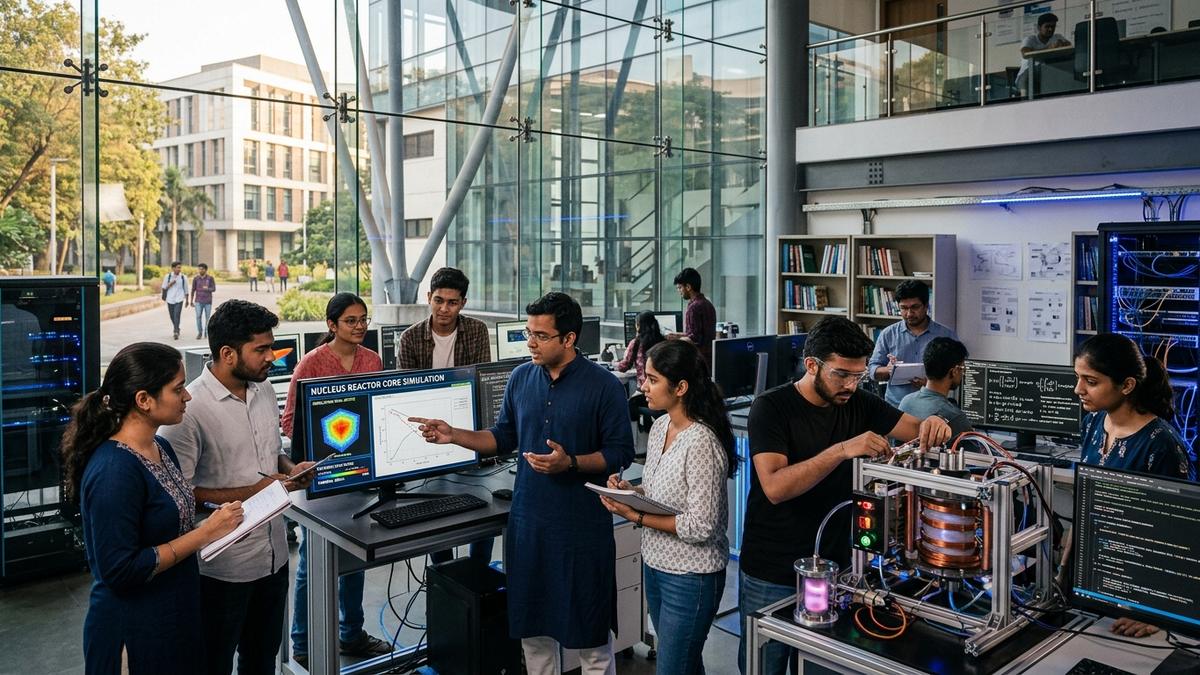
The Indian Institute of Technology Bombay (IIT Bombay), in institutional collaboration with Russian State Atomic Energy Corporation Rosatom, has officially launched 'Atomic Hack India 2026'. Designed to mobilize top-tier engineering minds across the country, the nationwide innovation challenge aims to catalyze student-led breakthroughs in civilian nuclear technology, carbon-free baseload energy, advanced medical radioisotopes, and thermal materials science.
Registrations for the prestigious engineering hackathon remain open until 20 October 2026, inviting teams of undergraduate, postgraduate, and doctoral students from technical institutes nationwide to submit proposals tackling urgent global energy and healthcare hurdles.
Catalyzing Deeptech Innovation in Non-Carbon Energy
As India charts a resolute roadmap toward achieving net-zero greenhouse gas emissions by 2070, relying solely on intermittent renewable energy sources—such as solar and wind—is mathematically insufficient to power the nation's rapidly expanding industrial grid and hyper-scale data center corridors. Nuclear energy provides firm, dispatchable, zero-emission baseload power.
Atomic Hack India 2026 bridges theoretical academic coursework and real-world industrial deployment. By partnering with Rosatom—the primary technology partner behind Tamil Nadu's Kudankulam Nuclear Power Plant—IIT Bombay provides participants with direct exposure to commercial reactor operational constraints and cutting-edge computational physics models.
"Energy security in the twenty-first century demands cross-disciplinary engineering mastery,"noted academic coordinators at IIT Bombay. "Atomic Hack India 2026 challenges young innovators to apply modern machine learning, quantum simulations, and advanced materials engineering to the nuclear domain."
Four Core Innovation Tracks
The competition challenges engineering cohorts to build solutions across four meticulously curated technological verticals:
- Small Modular Reactors (SMRs) & Microreactors: Designing decentralized, passively safe modular reactor architectures capable of powering remote industrial clusters, green hydrogen electrolysis plants, and desalination hubs.
- Computational Thermal Hydraulics & Safety: Leveraging computational fluid dynamics (CFD) and physics-informed neural networks to model non-linear heat transfer, cooling loops, and emergency core cooling mechanisms.
- Nuclear Medicine & Radiopharmaceutical Synthesis: Innovating production pipelines for targeted medical radioisotopes (such as Lutetium-177 and Actinium-225) used in precision cancer theranostics.
- Advanced Metallurgy & Radiation Shielding: Formulating next-generation metal alloys, composite ceramics, and nanostructured coatings capable of enduring neutron bombardment and extreme operating temperatures.
The structured table below details the challenge tracks, target deliverables, and core toolchains:
| Challenge Track | Target Problem Statement | Core Engineering Toolchains | Primary Evaluation Metrics |
|---|---|---|---|
| Modular SMR Architecture | Factory-fabricated, passively safe SMR core layout | OpenMC, Serpent, ANSYS Fluent | Thermal efficiency, safety redundancy, scalability |
| Physics-Informed Core AI | Real-time predictive anomaly detection in reactor loops | PyTorch, TensorFlow, RELAP5 | Inference latency (<10ms), predictive accuracy |
| Medical Radioisotope Synthesis | Automated yield extraction for cancer theranostics | Monte Carlo N-Particle (MCNP), Geant4 | Specific activity yield, purity, cost-efficiency |
| Radiation Shielding Composites | Lightweight neutron and gamma radiation attenuation | Quantum ESPRESSO, Materials Studio | Mass attenuation coefficient, mechanical tensile strength |
Bridging Academic Research and Commercial Deeptech
Competitions like Atomic Hack India 2026 reflect a broader structural transformation across Indian higher education: moving beyond rote software hackathons to address complex physical hardware challenges. This mirrors state-level initiatives to nurture advanced deeptech hubs, such as Uttar Pradesh incubating specialized AI and hardware startups, and national data infrastructure rollouts like IndiaAI expanding open-source model repositories across technical institutes.
Selected finalists in Atomic Hack India 2026 will receive comprehensive mentorship from veteran nuclear physicists and thermal engineering specialists, access to high-performance computing clusters, and project development stipends. Winning teams will be considered for incubation support at IIT Bombay's Society for Innovation and Entrepreneurship (SINE) and educational exchange visits to advanced nuclear research facilities.
Engineering cohorts have until 20 October 2026 to assemble multi-disciplinary teams and submit their initial architectural briefs.
Frequently Asked Questions
What is Atomic Hack India 2026 and who can participate?
Atomic Hack India 2026 is a national engineering and innovation competition organized by IIT Bombay and Rosatom. It is open to undergraduate, postgraduate, and PhD engineering and science students across India.
What is the registration deadline for Atomic Hack India 2026?
Registrations for the hackathon close on 20 October 2026 through the official IIT Bombay and challenge portal.
What are the key technical tracks covered in the challenge?
The competition covers Small Modular Reactor (SMR) designs, computational fluid dynamics in reactor cores, advanced materials for radiation shielding, and radioisotopes for cancer theranostics.
What prizes and research opportunities are offered to winning students?
Winners receive cash grants, research sponsorships, mentorship from premier nuclear scientists, and opportunities for academic exchange programs and prototype incubation.
Primary Sources & Official References
- Indian Institute of Technology Bombay (IIT Bombay): Department of Energy Science & Engineering Announcements
- Rosatom State Atomic Energy Corporation: International Youth & Academic Cooperation Disclosures
- Department of Atomic Energy (DAE), Government of India: Nuclear Energy Mission & Civil R&D Blueprint
- International Atomic Energy Agency (IAEA): Small Modular Reactors and Clean Baseload Power Guidelines