India-EU Expand AI & Semiconductor Collaboration
By Vikram Mehta | Published July 16, 2026 | 8 min read
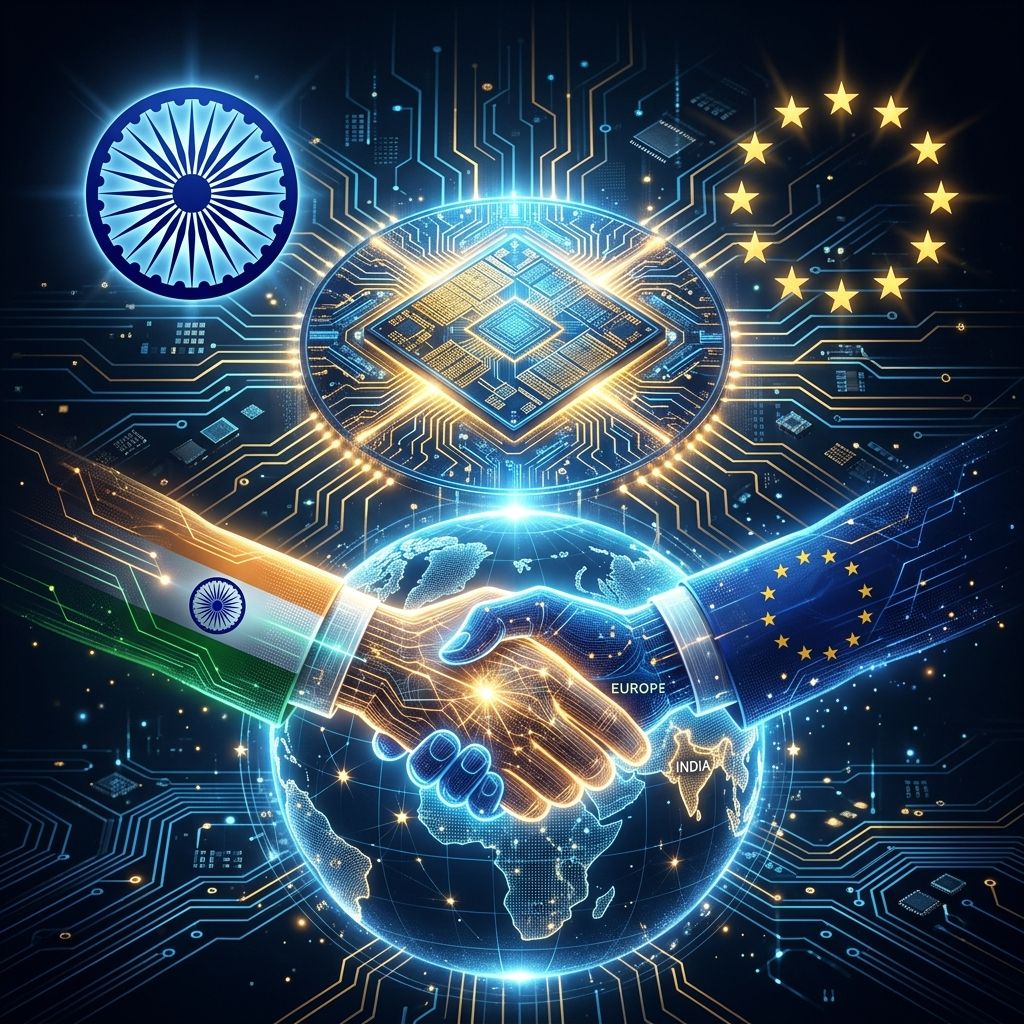
The India-EU Trade and Technology Council strengthened cooperation on AI, semiconductors, digital infrastructure, and innovation, creating fresh opportunities for Indian deep-tech startups.
The India-European Union Trade and Technology Council (TTC) has concluded its latest ministerial meeting with a landmark package of agreements that significantly deepens bilateral cooperation across artificial intelligence, semiconductors, digital infrastructure, and clean technology innovation. For Indian deep-tech startups, the outcomes represent some of the most concrete and actionable opportunities in the history of the India-EU technology relationship.
What Is the India-EU Trade and Technology Council?
Established in 2023, the India-EU TTC is a high-level strategic forum that brings together government ministers, senior officials, and industry leaders from both sides to coordinate on technology policy, trade facilitation, and investment frameworks. It operates through three working groups:
1. Strategic Technologies, Digital Governance, and Digital Connectivity
2. Green and Clean Energy Technologies
3. Trade, Investment, and Resilient Value Chains
The latest TTC meeting — held in Brussels — marks the third full ministerial session since the council's founding and is being described by diplomats on both sides as the most substantive to date.
AI Cooperation: From Principles to Practice
Previous TTC meetings established shared principles around trustworthy AI, data governance, and AI safety. This session moved the agenda firmly into operational territory, with specific agreements on:
Joint AI Research Initiatives
India and the EU announced the launch of AI Horizon India — a joint research funding program backed by €200 million in combined government commitments. The program will support collaborative projects between Indian institutions (IITs, IISc, C-DAC) and European universities (TU Delft, ETH Zurich, INRIA) across five priority areas:
| Research Priority | Key Focus Areas |
|---|---|
| Multilingual AI | Low-resource language models for Indian and European minority languages |
| AI for Healthcare | Cross-border clinical AI validation and regulatory harmonization |
| AI Safety & Alignment | Red-teaming, evaluation frameworks, and risk classification |
| Agri-AI | Precision farming, supply chain traceability, and climate adaptation |
| Explainable AI (XAI) | Regulatory compliance tools for GDPR and India's Digital Personal Data Protection Act |
Both parties agreed to work toward mutual recognition frameworks for AI systems certified under the EU AI Act and India's forthcoming national AI framework. This is significant: Indian startups that build AI products compliant with EU standards will, under the proposed framework, have a streamlined pathway to market access across all 27 EU member states without duplicate certification.
"Regulatory convergence is worth billions to Indian AI startups. If you build to EU AI Act standards from day one, you get Europe for free," said an Indian Ministry of Electronics and Information Technology (MeitY) official.
The Semiconductor Accord: India's Chip Ambitions Go Global
The semiconductor cooperation announced at this TTC session is, by any measure, the most significant outcome of the entire meeting.
#### Europe's Chipmaking Strengths + India's Scale
The EU Chips Act (2023) committed €43 billion to rebuild European semiconductor manufacturing capacity. European companies like ASML, Infineon, STMicroelectronics, and NXP Semiconductors are global leaders in specialized chip design, equipment, and automotive/industrial semiconductors — but they lack manufacturing scale.
India, through its Semiconductor Mission and recent fab investments by Tata Electronics, CG Power (Renesas JV), and Kaynes Semicon, is rapidly building chip packaging, testing, and ATMP (Assembly, Test, Marking, and Packaging) capabilities — but needs access to advanced design IP and equipment.
The TTC semiconductor agreements create a framework to bridge these complementary strengths:
| Agreement Area | Details |
|---|---|
| Equipment Access | ASML to provide training and calibration support for India's nascent lithography ecosystem |
| IP Licensing | Simplified framework for European fabless chip designers to license IP to Indian design houses |
| Talent Exchange | Annual exchange of 500 engineers between Indian semiconductor institutes and European chip companies |
| Joint Fabs | Feasibility study for a jointly funded specialty chip fab (28nm and above) targeting automotive and power electronics |
| Supply Chain | Mutual preferential access to critical minerals — India's rare earths for Europe, Europe's refined materials for India |
For Indian deep-tech startups working in chip design, embedded systems, and hardware, the TTC semiconductor accord opens doors that were previously firmly closed:
- Fabless chip design startups can now more easily access European IP libraries and engage with European foundries
- ATMP-focused companies get potential off-take agreements with European automotive chip makers who are desperately diversifying away from single-source dependencies
- AI hardware startups building inference accelerators get exposure to European automotive and industrial AI chip markets — which are projected to grow to €25 billion by 2030
Digital Infrastructure: The Transatlantic Data Bridge
A recurring frustration in India-EU tech relations has been the lack of a formal data transfer agreement — similar to the EU-US Data Privacy Framework — that would allow Indian companies to seamlessly process European citizen data without complex legal workarounds.
At this TTC session, both sides announced the India-EU Adequacy Roadmap — a structured 18-month process designed to assess India's data protection framework under the Digital Personal Data Protection (DPDP) Act and potentially grant India adequacy status under GDPR.
An adequacy decision would be transformative for Indian tech companies handling European data:
- Elimination of Standard Contractual Clauses (SCCs) for routine data transfers
- Simplified GDPR compliance for Indian SaaS, AI, and cloud companies serving European clients
- Increased confidence among European enterprises and regulators in deploying Indian-built AI tools
Clean Technology: The Renewable Energy-Semiconductor Nexus
The TTC also made progress on joint clean technology cooperation, recognizing that the semiconductor and AI sectors are major consumers of electricity and critical minerals:
- Solar module supply chains: Joint investment in solar manufacturing supply chain resilience, reducing over-dependence on Chinese module imports for both India and the EU
- Green hydrogen: Collaborative R&D on electrolysis technology, with Indian scale and European electrolyzer technology as complementary inputs
- Critical minerals: Framework for investment in India's rare earth processing capabilities, which are essential for both semiconductor manufacturing and clean energy transition
Opportunities for Indian Deep-Tech Startups
The India-EU TTC outcomes create tangible, near-term opportunities for startups across multiple verticals:
Immediately Actionable
- Apply for AI Horizon India research grants (applications open Q3 2026)
- Engage with ASML's India training programs for semiconductor equipment exposure
- Begin building to EU AI Act compliance standards to position for European market access
Medium-Term (12–24 Months)
- Participate in joint chip design consortiums being formed under the semiconductor accord
- Explore European partnerships for ATMP capacity offtake agreements
- Monitor the India-EU Adequacy Roadmap process and align DPDP compliance efforts
Strategic (2–5 Years)
- Position for joint fab feasibility participation if specialty chip manufacturing plans advance
- Build European distribution and partnership networks now while India-EU relations are at a historic high
The Geopolitical Context
The India-EU technology partnership is accelerating against a backdrop of global supply chain realignment. Both India and the EU are seeking to reduce strategic dependencies on China across semiconductors, clean energy equipment, and critical digital infrastructure. This shared geopolitical objective is a powerful accelerant for practical cooperation.
"India and the EU are natural partners in building a technology order that is open, rules-based, and doesn't have single points of failure," said the EU Commissioner for Technology and Innovation at the closing press conference.
Benchmark your deep-tech startup's financial health with StartupWire's Burn Multiple Calculator before approaching international partnerships.