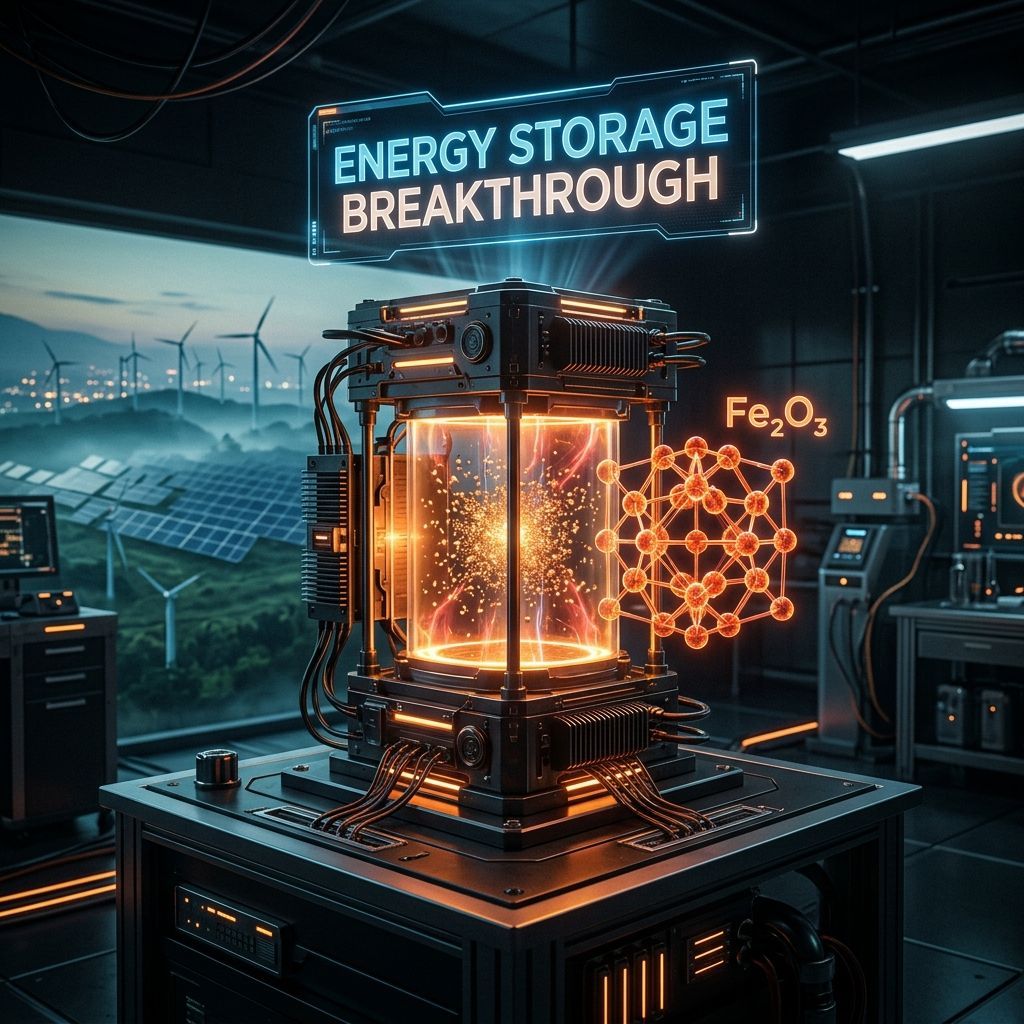
The breakthrough in long-duration energy storage could accelerate India's clean energy and deep-tech ecosystem, offering a low-cost alternative to lithium-ion batteries.
Executive Key Takeaways
- The breakthrough in long-duration energy storage could accelerate India's clean energy and deep-tech ecosystem, offering a low-cost alternative to lithium-ion batteries.
- Iron-air batteries represent a class of metal-air electrochemical cells that use iron as the anode and oxygen from the air as the cathode reactant.
Indian deep-tech startup Meine Electric has achieved a landmark breakthrough — successfully validating its proprietary iron-air battery technology at a prototype scale, potentially setting the stage for a commercially viable, low-cost, long-duration energy storage solution built entirely on India's abundant iron resources.
What Is Iron-Air Battery Technology?
Iron-air batteries represent a class of metal-air electrochemical cells that use iron as the anode and oxygen from the air as the cathode reactant. Unlike conventional lithium-ion batteries, which rely on expensive, geopolitically concentrated materials (lithium, cobalt, nickel), iron-air batteries are built from one of Earth's most abundant and affordable elements: iron.
The electrochemical reaction in an iron-air cell works on a rust-and-unrust cycle:
- During discharge (power release): Iron oxidizes (rusts), releasing electrons and generating electricity.
- During charging: Electrical energy reverses the process, converting iron oxide back to iron.
This approach theoretically allows for 100+ hours of energy storage — far beyond what lithium-ion technology can economically achieve — making it ideal for grid-scale long-duration energy storage (LDES).
Meine Electric's Breakthrough
Meine Electric's R&D team, led by a group of IIT and IISc alumni, has reportedly resolved one of the core technical hurdles that has kept iron-air batteries from commercial viability: hydrogen evolution reaction (HER) — a parasitic side-reaction that causes iron-air cells to lose capacity over repeated charge cycles.
The startup achieved this through a patented electrolyte additive formulation combined with a novel electrode architecture that:
- Suppresses HER by over 85% at operational temperatures
- Extends cycle life to over 3,000 deep discharge cycles in lab conditions
- Achieves an estimated energy cost of under $20 per kWh at scale — compared to $100–150/kWh for lithium-ion
"We didn't just validate the chemistry — we validated a manufacturing pathway that can be built using Indian supply chains," said a spokesperson for Meine Electric.
Why This Matters for India
India has declared an ambitious target of 500 GW of renewable energy capacity by 2030 and net-zero by 2070. The Achilles' heel of solar and wind energy is intermittency — the sun doesn't shine at night, and wind is unpredictable. Affordable, long-duration energy storage is the missing piece in India's clean energy puzzle.
Iron-air batteries could solve this:
- Solar firming: Store excess daytime solar energy and release it during evening peak-demand hours
- Wind backup: Provide 48–72 hour backup for wind-heavy states like Tamil Nadu, Gujarat, and Rajasthan
- Grid stabilization: Replace expensive diesel peaker plants that currently balance the national grid
India also has massive iron ore reserves — the world's fourth largest — in states like Odisha, Jharkhand, and Chhattisgarh. This positions the country for a rare opportunity to build a vertically integrated domestic battery supply chain, potentially reducing dependence on Chinese battery imports.
The Competitive Landscape
Globally, American startup Form Energy is the most advanced player in iron-air technology and has begun deploying its first commercial installations in the United States. Meine Electric's achievement positions it as a credible Indian challenger in this space, with the added advantage of a cost base suited to emerging market deployment.
Key differentiators cited by the company:
- India-first cost structure: Designed for ₹-denominated unit economics from day one
- Local manufacturing vision: Targets 80% domestic content by 2028
- Grid-agnostic design: Compatible with both centralized utility grids and off-grid microgrids in rural India
Funding and Next Steps
Meine Electric is reportedly in advanced discussions with climate-focused VC funds and government-backed bodies including the National Investment and Infrastructure Fund (NIIF) and IFC's Sunrise program for a Series A round. A pilot deployment with a state electricity distribution company is expected by early 2027.
The startup is also in dialogue with the Ministry of New and Renewable Energy (MNRE) for inclusion in India's National Energy Storage Mission framework, which provides financial incentives for domestically manufactured storage systems.
Evaluate your deep-tech startup's financial model with StartupWire's Burn Multiple Calculator before your next funding round.