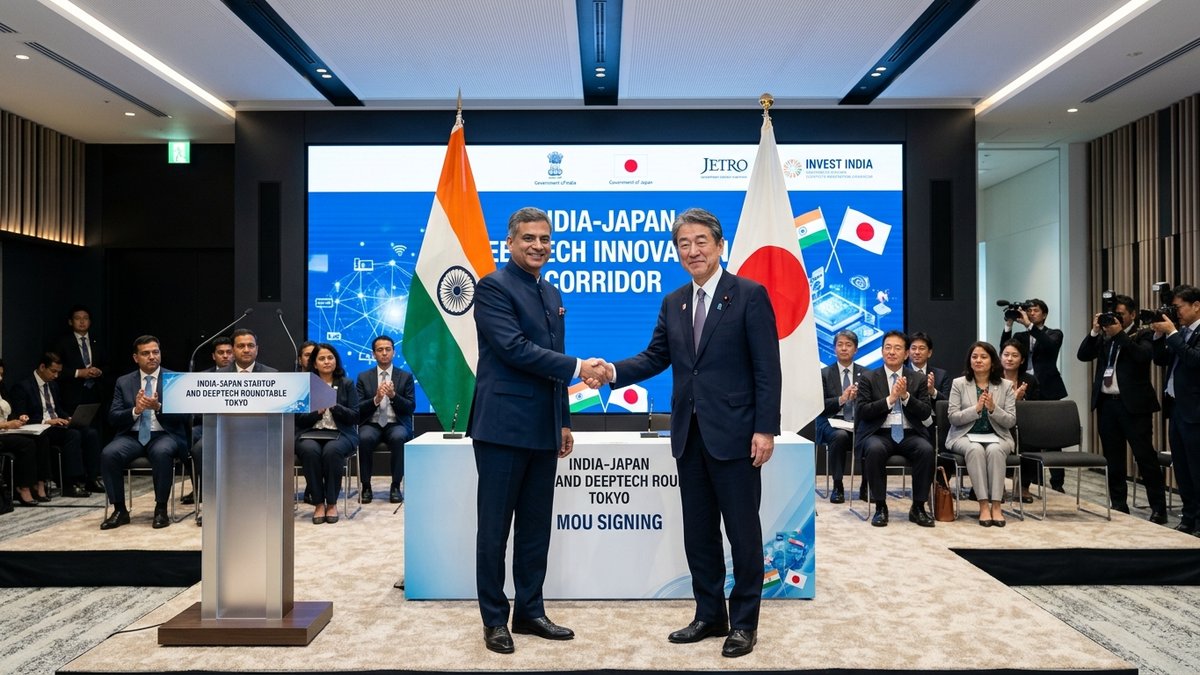
Commerce Minister Piyush Goyal unveils a 4-pillar bilateral framework in Tokyo, proposing a $1 billion Fund of Funds to channel patient Japanese capital into Indian deeptech startups.
Executive Key Takeaways
- Commerce Minister Piyush Goyal unveils a 4-pillar bilateral framework in Tokyo, proposing a $1 billion Fund of Funds to channel patient Japanese capital into Indian deeptech startups.
- India and Japan share an unshakeable bond founded on shared democratic values, mutual trust, and technological ambition, declared Commerce and Industry Minister Piyush Goyal in Tokyo. By combining India’s youthful demographic dividend, vast market scale, and software prowess with Japan’s legendary precision engineering and patient capital, we are creating a resilient technology axis that will power global growth for decades to come.
- Key Benchmark: **Capital Horizon** — Rapid seed and Series A risk capital
TOKYO — In a momentous development for Asian technological sovereignty and international venture capital, India and Japan have significantly deepened their strategic economic partnership, anchored by a proposed $1 billion Fund of Funds dedicated specifically to deeptech startups, advanced manufacturing, and sovereign innovation.
The landmark announcement was made by Union Minister of Commerce and Industry Piyush Goyal during the high-powered India-Japan Startup Roundtable held in Tokyo in late August 2026. Addressing an influential audience of Japanese corporate titans, sovereign wealth managers, venture capitalists, and startup founders, Minister Goyal proposed a comprehensive Four-Pillar Framework designed to structurally integrate India’s vast engineering talent and scale with Japan’s world-renowned precision manufacturing and long-term institutional capital.
The proposed $1 billion deeptech vehicle directly addresses the critical need for "patient capital" required to commercialize high-moat hardware, quantum computing, robotics, and advanced semiconductor packaging. This initiative intersects with national semiconductor expansions explored in India Approves ₹731 Crore Quantum & AI University in Amaravati: MeitY Backs 8.5-Acre Deeptech Research Hub and builds upon sovereign policy momentum documented in India’s Deeptech Ecosystem Gains Policy and Funding Momentum: Capital Pivots to Semiconductors, Quantum, and Hard Tech.
The Four-Pillar Architecture: Merging Indian Scale with Japanese Precision
Unlike consumer internet and software-as-a-service (SaaS) businesses—which often achieve commercialization within 24 to 36 months—deeptech startups tackling quantum sensors, industrial humanoid robotics, clean hydrogen electrolysis, and silicon photonics require extensive multi-year research horizons before generating positive unit economics.
Western venture capital has historically struggled with this extended gestational period due to 10-year fund lifecycles demanding rapid liquidity exits. Conversely, Japan’s institutional investment ecosystem possesses the world's most disciplined, patient long-term capital, but frequently encounters domestic demographic constraints and a shortage of software engineering scale.
Minister Goyal’s Four-Pillar Framework directly unites these complementary geopolitical strengths:
1. Japan-India Deep-Tech Capital Corridor: Establishing a dedicated sovereign and private capital channel, headlined by a second $1 billion Fund of Funds co-managed by India’s DPIIT/SIDBI and Japanese institutional allocators, ensuring uninterrupted late-stage growth capital for hard-tech ventures.
2. Two-Way Academic and Laboratory Innovation Bridge: Creating formal technology-transfer agreements linking premier Indian institutions (IIT Madras, IIT Bombay, IISc Bengaluru) with elite Japanese universities and research institutes (University of Tokyo, Kyoto University, RIKEN).
3. Manufacturing and Precision Technology Integration: Pairing Indian software algorithms, embedded AI firmware, and rapid prototyping with Japanese precision tooling, optical fabrication, and zero-defect manufacturing standards.
4. Institutional Startup Pitching & Commercial Matchmaking Platforms: Formalizing continuous quarterly interaction forums between Indian founders, Japanese trading houses (Sogo Shosha), and global conglomerates like SoftBank, Sony, Mitsubishi, and Toyota.
"India and Japan share an unshakeable bond founded on shared democratic values, mutual trust, and technological ambition,"declared Commerce and Industry Minister Piyush Goyal in Tokyo. "By combining India’s youthful demographic dividend, vast market scale, and software prowess with Japan’s legendary precision engineering and patient capital, we are creating a resilient technology axis that will power global growth for decades to come."
Synergy Matrix: India’s Ecosystem Capabilities vs. Japan’s Complementary Strengths
The analytical matrix below details the strategic complementarity that makes the India-Japan deeptech alliance uniquely powerful:
| Strategic Dimension | Indian Ecosystem Strength | Japanese Ecosystem Strength | Combined Bilateral Synergy |
|---|---|---|---|
| Capital Horizon | Rapid seed and Series A risk capital | Vast institutional "patient capital" (15+ year horizon) | Seamless capital continuity from early lab prototype to public market IPO |
| Talent & R&D | 1.5M engineers graduated annually; deep AI/software talent | Master craftsmanship (Monozukuri), precision metallurgy, & optics | Co-designed hardware products with world-leading firmware and build quality |
| Market Scale | 1.4B population; world's fastest-growing digital economy | Global corporate distribution networks across G7 nations | Immediate domestic validation in India followed by seamless deployment across OECD markets |
| Supply Chain Security | Plentiful critical minerals, massive land parcels, & clean power | Dominance in semiconductor lithography tools & chemical substrates | Creation of an unassailable, trusted Quad supply chain immune to geopolitical choke points |
| Regulatory Support | Fast-track National Deep Tech Startup Policy & PLI incentives | Japan Ministry of Economy, Trade and Industry (METI) overseas subsidies | Dual-sovereign derisking through paired government grants and tax credits |
Proven Track Record: From Exploratory Pitching to Commercial Execution
The proposed $1 billion fund builds upon a solid foundation of concrete bilateral milestones. Over the past 24 months, joint India-Japan startup initiatives organized by DPIIT and JETRO (Japan External Trade Organization) have introduced 65 Indian deeptech startups to more than 100 Japanese corporate conglomerates.
These curated interactions have already generated more than 30 formal commercial partnerships and joint ventures across critical industries:
- Indian autonomous robotics companies deploying automated warehouse inspection systems for Japanese logistics giants.
- Indian semiconductor design firms co-developing power management chips with Japanese automotive tier-1 suppliers.
- Collaborative research in green ammonia and hydrogen storage technologies between Indian renewable energy developers and Japanese utility consortiums.
As the global technological landscape fragments into competing spheres of influence, the institutionalization of the India-Japan Deeptech Corridor establishes an enduring economic bridge. It ensures that both nations not only maintain technological leadership in critical sectors, but actively shape the standards of 21st-century industry.