A powerful convergence of government incentives, National Deep Tech Startup Policy (NDTSP) rollouts, and institutional VC allocations accelerates India’s transition into high-moat hardware.
Executive Key Takeaways
- A powerful convergence of government incentives, National Deep Tech Startup Policy (NDTSP) rollouts, and institutional VC allocations accelerates India’s transition into high-moat hardware.
- India is moving from the age of service-delivery arbitrage to the era of sovereign scientific defensibility, observed senior partners at leading venture funds. Ten years ago, an Indian startup was valued on gross merchandise value (GMV) or customer acquisition cost (CAC). Today, the most resilient valuations are commanded by founders who own fundamental silicon IP, quantum patents, and advanced manufacturing patents.
- Key Benchmark: **Intellectual Property Moat** — Minimal (Generic open-source code & marketing)
NEW DELHI & BENGALURU — In what venture capitalists are describing as the most profound structural shift in the country's startup landscape, India’s deeptech ecosystem is experiencing unprecedented policy and funding momentum as both government agencies and private institutional investors aggressively reallocate capital toward hard tech.
Bolstered by the operational rollout of the National Deep Tech Startup Policy (NDTSP), the expanding ₹10,372 crore IndiaAI Mission, and the second phase of the India Semiconductor Mission (ISM), early-stage funding rounds for deeptech ventures have defied broader global venture capital sluggishness. Seed and Series A investments in semiconductor chip design, quantum cryptography, advanced robotics, satellite infrastructure, and synthetic biology have surged over 45% year-on-year.
The shift reflects the maturation of India's startup ecosystem, transitioning from asset-light consumer aggregator apps to defensible industrial intellectual property, as examined in Deeptech Draws Growing Investor Attention: Why Global and Domestic VCs Are Shifting to Hard Tech and aerospace manufacturing breakthroughs celebrated in InspeCity Raises ₹100 Crore to Build In-Orbit Satellite Servicing.
Dismantling the 'Hardware Valley of Death'
Historically, Indian venture capital was notoriously averse to hard technology. Building a hardware or semiconductor startup requires substantial upfront capital, specialized cleanroom access, and multi-year gestation cycles before revenue realization—creating what founders called the "Deeptech Valley of Death."
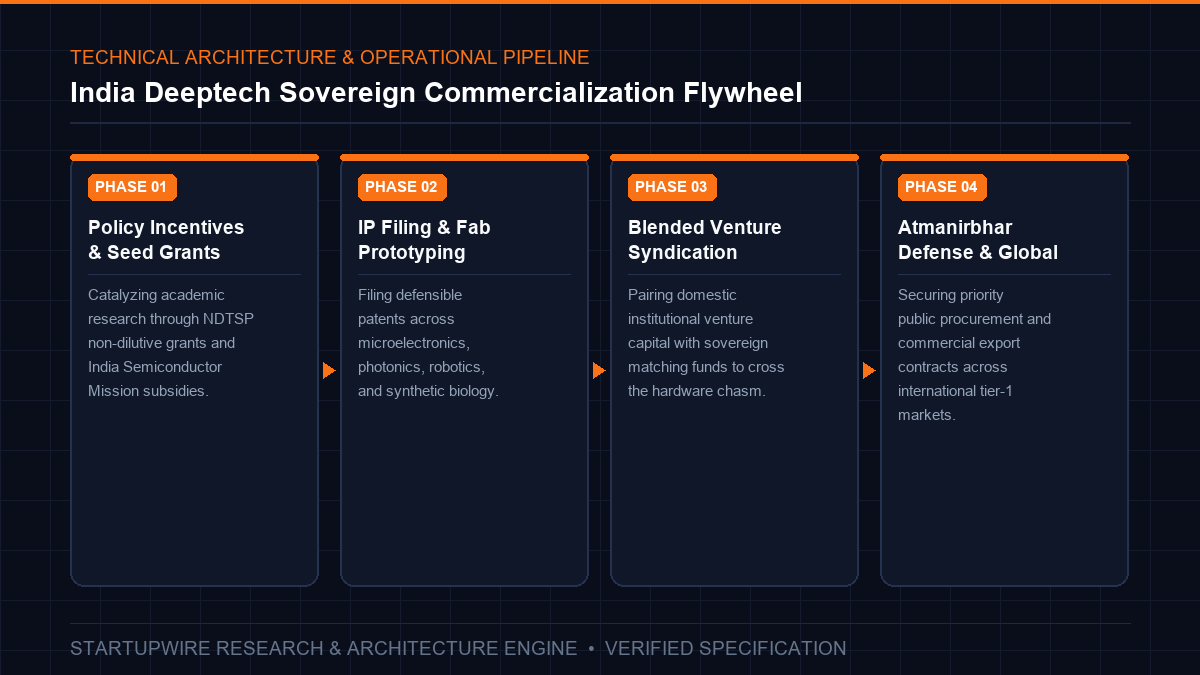
The NDTSP has systematically targeted these bottlenecks through concrete policy levers:
- Long-Term Patient Capital Pools: Creating dedicated Fund of Funds mechanisms with 12- to 15-year fund lifecycles, matching private venture commitments rupee-for-rupee.
- Fast-Track IP and Patent Prosecution: Slashing international and domestic patent processing times from 48 months down to less than 12 months for qualified deeptech startups.
- Sovereign Procurement Mandates (Make-in-India): Mandating that state-owned enterprises, defense agencies, and telecommunications operators reserve up to 25% of strategic tenders for qualified domestic deeptech startups.
"India is moving from the age of service-delivery arbitrage to the era of sovereign scientific defensibility,"observed senior partners at leading venture funds. "Ten years ago, an Indian startup was valued on gross merchandise value (GMV) or customer acquisition cost (CAC). Today, the most resilient valuations are commanded by founders who own fundamental silicon IP, quantum patents, and advanced manufacturing patents."
Comparative Sector Metrics: Consumer Tech vs. Indian Deeptech (2026)
The comparative breakdown below illustrates why institutional capital is pivoting from consumer software to hard technology:
| Sector Dimension | Consumer Tech & E-Commerce (2018–2023) | Sovereign Deeptech & Hard Tech (2026) | Strategic Investor Value |
|---|---|---|---|
| Intellectual Property Moat | Minimal (Generic open-source code & marketing) | High (Defensible patents & proprietary physics) | Virtually impossible for competitors to copy |
| Gross Margin Profile | 15% – 25% (eroded by aggressive discount subsidies) | 50% – 70% (high-value engineering products) | Resilient unit economics and pricing power |
| Government Procurement | Zero (frequently facing regulatory scrutiny) | High (Direct off-take by Defense, MeitY, ISRO) | Secured anchor enterprise revenues |
| Valuation Multiple Multiple | Volatile (subject to consumer sentiment swings) | Stable (valued on technical milestones & IP) | Insulated from macro retail liquidity shocks |
| Global Export Potential | Restricted to localized Indian domestic market | Global (exportable to 70+ manufacturing nations) | Immediate access to international USD revenue |
The Road Ahead for Indian Deeptech
With dedicated regional hubs emerging across Andhra Pradesh, Tamil Nadu, Karnataka, and Uttar Pradesh, India’s deeptech startup density is now the third highest globally, trailing only the United States and China.
As national infrastructure initiatives unlock domestic manufacturing corridors, as highlighted in India’s Deeptech Race Shifts From Software to Satellites and Advanced Engineering, the ongoing convergence of state support and private capital is establishing India as the undisputed manufacturing and deeptech capital of the Global South.