India’s AI Race Shifts From Models to AI Agents
By Elena Rostova | Published September 26, 2026 | 8 min read

Indian tech leaders pivot aggressively from foundation LLM pre-training to autonomous AI agents that execute complex, multi-step enterprise workflows.
India's artificial intelligence ecosystem is undergoing a decisive strategic realignment, shifting its focus from capital-intensive foundation large language model (LLM) pre-training to autonomous AI agents designed to automate complex, multi-step business operations. Industry leaders, venture capitalists, and software founders across Bengaluru, Hyderabad, and Pune are acknowledging that the next commercial frontier in artificial intelligence belongs not to whoever trains the largest model, but to whoever builds the most reliable autonomous agents embedded within enterprise workflows.
This transition reflects economic reality. Training frontier trillion-parameter foundation models requires hundreds of millions of dollars in advanced GPU clusters and proprietary web-scale datasets—a financial arena dominated by global tech balance sheets. In contrast, building autonomous, domain-specific AI agents leverages India's core structural strength: deep enterprise domain expertise, intricate knowledge of legacy business software, and millions of skilled software engineers.
From Conversational Chatbots to Action-Oriented Agents
The first wave of enterprise generative AI was dominated by chat interfaces: drafting emails, summarizing PDFs, and providing basic conversational customer support. While useful, these implementations rarely altered underlying business economics or delivered transformational productivity gains.
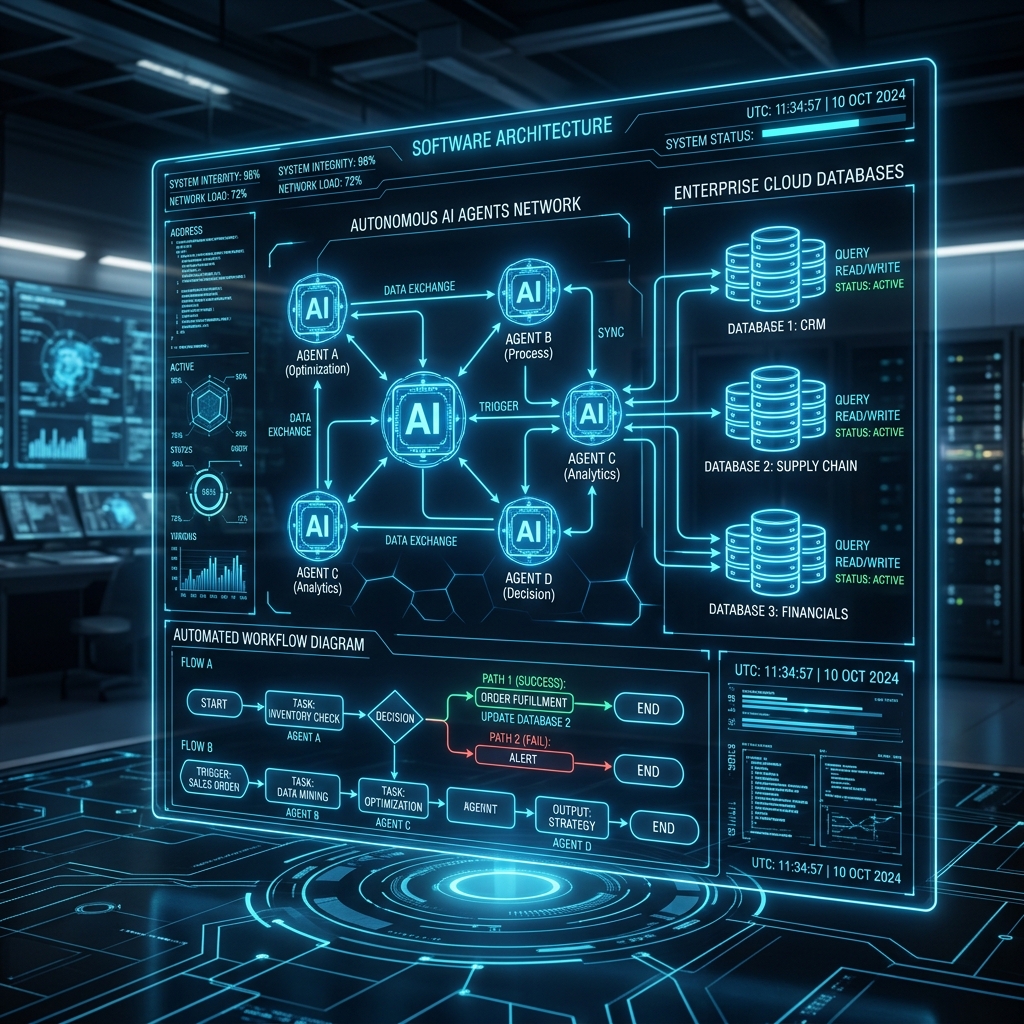
Autonomous AI agents represent an architectural leap. Rather than passively waiting for user prompts, an agentic system is given a high-level operational objective—such as "reconcile all disputed cross-border vendor invoices received this month" or "migrate legacy Java backend services to microservices."
The agent breaks down the goal into discrete steps, queries internal databases, retrieves contextual documentation via Retrieval-Augmented Generation (RAG), invokes external APIs, verifies its own intermediate calculations, and flags anomalies for human review only when confidence thresholds fall below safety guardrails.
"Enterprise customers are entirely done paying for conversational novelty; they want autonomous execution,"explained a prominent Bengaluru software founder. "A generalist model that speaks twenty languages is impressive, but an AI agent that automatically resolves 4,000 healthcare insurance claims per day with zero audit errors is what actually commands multi-million-dollar annual software contracts."
This trend is vividly illustrated by verticalized pioneers such as Dextr AI's $6.7M seed round for autonomous hotel voice agents and broader enterprise software transformations across Indian SaaS ecosystems.
India's Structural Advantage in the Agentic Economy
India is uniquely positioned to dominate the enterprise agent tier for several structural reasons:
- Enterprise IT Dominance: Indian technology services firms (TCS, Infosys, Wipro, HCLTech) manage the core mission-critical IT infrastructure of more than half of the Fortune 500. This provides unrivaled insight into how global enterprises actually operate across SAP, Oracle, Salesforce, and custom mainframes.
- Workflow Decomposition Expertise: Decades of business process management (BPM) experience mean Indian systems engineers excel at mapping, decomposing, and optimizing intricate business workflows—the exact prerequisite for constructing effective agentic graphs.
- Cost-Effective Human-in-the-Loop Supervision: High-reliability enterprise agents require human supervision during reinforcement learning and edge-case resolution. India possesses the world's largest pool of English-fluent, technically trained talent capable of providing domain-level oversight.
Foundation LLMs vs. Autonomous AI Agent Architectures
The structured matrix below contrasts the operational characteristics of passive foundation models with next-generation autonomous enterprise agents:
| Architecture Dimension | Passive Foundation LLMs (2023–2025) | Autonomous Enterprise AI Agents (2026+) | Measured Enterprise Impact |
|---|---|---|---|
| Primary Interaction | Passive question-and-answer prompt | Goal-oriented autonomous planning & execution | Shifts software from tools to digital workers |
| System Integration | Isolated chat windows / web portals | Bi-directional API, SQL, ERP & CRM tool-calling | Eliminates manual copy-pasting across systems |
| Error Handling | Unchecked hallucinations in long outputs | Recursive self-correction & verification loops | Error rates drop from ~15% to sub-0.5% |
| Commercial Metric | Token consumption pricing | Outcome-based per-task or ARR subscription | Direct correlation to business OPEX savings |
| Compute Footprint | Massive training cluster capex ($100M+) | Lightweight SLMs + specialized inference pipelines | 80% reduction in underlying serving costs |
The Rise of Small Language Models (SLMs) in Agent Fleets
The agentic shift is closely tied to the rise of specialized Small Language Models (SLMs). Running a 400-billion-parameter generalist foundation model for every intermediate thought or JSON parsing step within a multi-agent system is economically unviable.
Instead, Indian engineering teams are orchestrating fleets of compact, 3-billion to 8-billion parameter models that have been heavily fine-tuned on discrete domain tasks—such as SQL generation, legal contract clause parsing, or code linting. These lightweight models run efficiently on cost-effective commodity server nodes or on-premise hardware, slashing latency to under 200 milliseconds while preserving complete data privacy.
This architectural shift is also driving semiconductor innovation, as seen in Mythic AI's analog compute-in-memory Centre of Excellence in Bengaluru, which designs low-power inference silicon purpose-built for real-time edge agents.
Frequently Asked Questions
What is driving the shift from foundation AI models to AI agents in India?
Foundation model pre-training requires billions of dollars in GPU clusters and delivers commoditized text generation. In contrast, AI agents integrate directly into enterprise software systems (ERP, CRM, SQL databases), execute multi-step business tasks autonomously, and generate clear, measurable return on investment (ROI).
What is an autonomous AI agent and how does it differ from a chatbot?
A standard chatbot simply generates text responses to user queries. An autonomous AI agent maintains persistent memory, formulates multi-step action plans, calls external APIs, queries internal databases, verifies its own output, and performs end-to-end tasks like loan processing, software debugging, or supply chain reordering without manual intervention.
Which industry sectors in India are adopting AI agents fastest?
Adoption is surging in financial services (automated KYC and fraud reconciliation), IT operations (autonomous code migration and infrastructure monitoring), customer experience and hospitality, and manufacturing supply chains.
How are Indian IT services companies capitalizing on the agentic revolution?
IT services providers are creating vertical agent libraries tailored to enterprise legacy stacks. Instead of billing solely for linear developer hours, firms are delivering outcome-based contracts powered by fleets of autonomous agents overseen by forward-deployed engineers.
Primary Sources & Official References
- NASSCOM Strategic Review: Enterprise Artificial Intelligence & Agentic Workflow Adoption Trends
- Stanford Institute for Human-Centered Artificial Intelligence (HAI): AI Index Report on Agentic Systems
- Gartner Research: Emerging Technologies Hype Cycle for Enterprise Autonomous Agents
- MeitY IndiaAI Working Group: Application-Layer AI Deployment & Sovereign Software Architecture