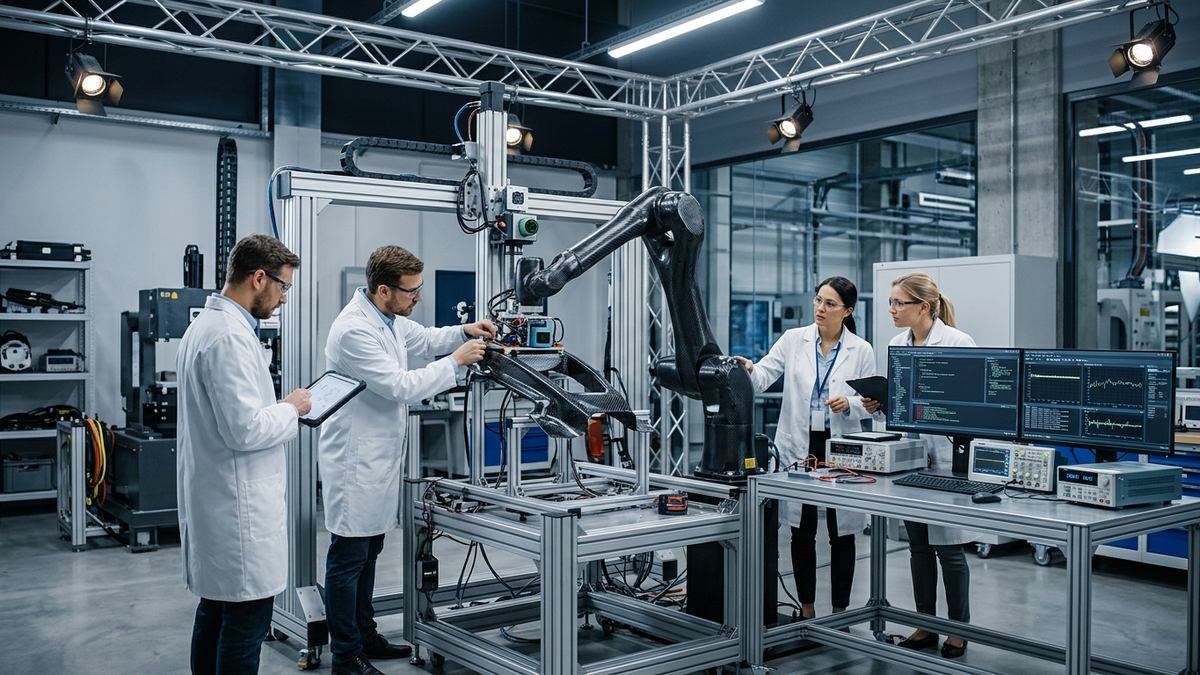
L&T Technology Services unveils an engineering acceleration platform to bridge the deeptech valley of death, enabling lab-stage startups to achieve enterprise commercial scale.
Executive Key Takeaways
- L&T Technology Services unveils an engineering acceleration platform to bridge the deeptech valley of death, enabling lab-stage startups to achieve enterprise commercial scale.
- Scientific breakthroughs in incubators often fail not because the underlying physics is flawed, but because industrial qualification and enterprise testing are prohibitively capital-intensive, stated senior engineering executives at LTTS. Our platform democratizes access to multimillion-dollar laboratory infrastructure, giving Indian deeptech founders the industrial credibility needed to secure global enterprise contracts.
- Key Benchmark: **TRL 4: Lab Validation** — Fragile benchtop components fail in field conditions
MUMBAI & BENGALURU — Pure-play engineering research and development (ER&D) services leader L&T Technology Services (LTTS) has launched a dedicated acceleration and validation platform designed to help early-stage deeptech startups transition from laboratory proof-of-concepts to commercial industrial deployment. The comprehensive program addresses the notorious "Valley of Death" in hardware and scientific commercialization by providing promising startups with direct access to LTTS's world-class testing laboratories, 5G industrial testbeds, environmental simulation chambers, and deep-domain global enterprise client networks.
Targeting high-barrier technology sectors including industrial robotics, clean energy, medical devices, automotive electronics, and aerospace components, the LTTS platform bridges the immense gap between university lab prototypes and mission-critical production readiness.
This industrial acceleration initiative complements software ecosystem transitions highlighted in The Agentic Shift in Indian IT and aligns with capital deployment models explored in RBI Operationalises Pre-Sanctioned Credit on UPI.
Crossing the Deeptech Valley of Death: Why Lab Innovations Stumble
India possesses a prolific ecosystem of academic institutions, incubation centers, and scientific researchers producing world-class patents in nanotechnology, advanced robotics, synthetic materials, and edge sensor systems. However, an estimated 85% of deeptech startups fail before achieving commercial revenue—a casualty of the formidable Technology Readiness Level (TRL) bottleneck.
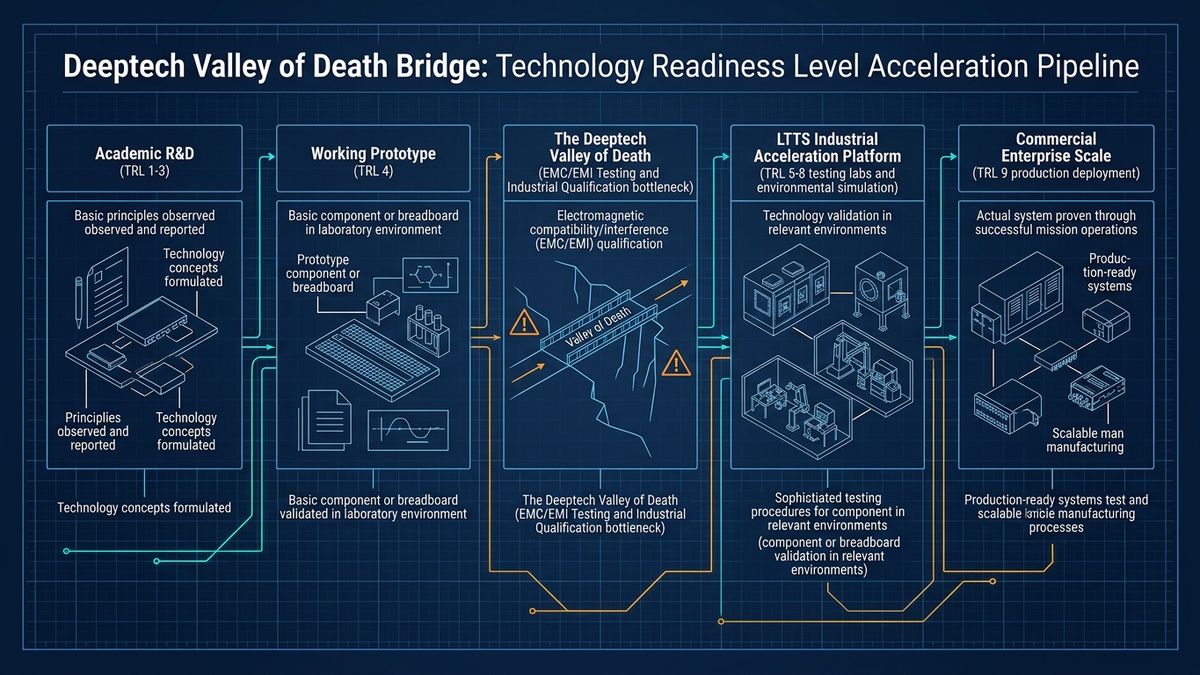
While software startups can ship a minimum viable product (MVP) with minimal capital expenditure using cloud servers, deeptech ventures face rigorous engineering hurdles:
- Prohibitive Testing & Certification Costs: Electromagnetic compatibility (EMC/EMI), vibration resistance, thermal cycling, and safety certifications can easily cost millions of rupees per iteration.
- Lack of Industrial Domain Expertise: Academic researchers often lack the industrial design and Design-for-Manufacturability (DFM) expertise required to turn fragile benchtop prototypes into rugged industrial products.
- Enterprise Access Barriers: Conservative Tier-1 industrial buyers, aerospace contractors, and hospital networks rarely take risks on unproven early-stage startups without institutional validation.
"Scientific breakthroughs in incubators often fail not because the underlying physics is flawed, but because industrial qualification and enterprise testing are prohibitively capital-intensive,"stated senior engineering executives at LTTS. "Our platform democratizes access to multimillion-dollar laboratory infrastructure, giving Indian deeptech founders the industrial credibility needed to secure global enterprise contracts."
Deeptech Acceleration Matrix: Prototype to Commercial Production
The table below outlines how the LTTS platform accelerates startups across critical Technology Readiness Levels (TRLs) compared to traditional standalone journeys:
| Technology Readiness Level (TRL) | Traditional Startup Bottleneck | LTTS Acceleration Intervention | Commercial Milestone Achieved |
|---|---|---|---|
| TRL 4: Lab Validation | Fragile benchtop components fail in field conditions | Design-for-Manufacturability (DFM) engineering review | Production-viable component bill-of-materials (BOM) |
| TRL 5: Simulated Environment | Inability to afford environmental & thermal test chambers | Full access to LTTS climatic, vibration, & drop test labs | Documented survival across extreme temperature ranges |
| TRL 6: Operational Prototype | Electromagnetic interference (EMI) failures delay pilots | Anechoic chambers and pre-compliance RF testing | Compliance with global CE, FCC, and BIS standards |
| TRL 7: System Demonstration | Lack of industrial integration testing environments | Private 5G industrial testbeds and robotic cells | Real-world factory floor operational validation |
| TRL 8: Qualified Production | Factory tooling and low-volume assembly bottlenecks | Integration with Larsen & Toubro manufacturing lines | Pilot production run of 100 – 1,000 industrial units |
| TRL 9: Commercial Deployment | Lengthy 18-month enterprise procurement cycles | Co-selling to LTTS’s 50+ Fortune 500 enterprise clients | Signed commercial master services agreements (MSAs) |
State-of-the-Art Infrastructure and Enterprise Co-Innovation
Participating deeptech startups gain hands-on access to LTTS's specialized engineering centers across Bengaluru, Vadodara, and Chennai:
1. 5G and Industrial IoT Testbeds: Validating real-time edge telemetry, ultra-reliable low-latency communication (URLLC), and industrial wireless protocols for smart factories.
2. Medical Device Verification Suites: Cleanroom verification, bio-compatibility assessments, and software lifecycle testing adhering to ISO 13485 and US FDA 510(k) standards.
3. Automotive & EV Power Labs: Hardware-in-the-Loop (HIL) simulation racks for battery management systems (BMS), motor inverters, and functional safety (ISO 26262).
4. Propulsion and Avionics Testing: High-precision vibration dynamometers and sensor calibration rigs designed for drone delivery systems and aerospace subsystems.
Fueling India's Deeptech Sovereign Ambitions
The launch of the LTTS platform coincides with ambitious national initiatives—including the National Deep Tech Startup Policy (NDTSP) and the Anusandhan National Research Foundation (ANRF)—aimed at positioning India as a global scientific and industrial powerhouse.
By aligning the operational scale and engineering pedigree of Larsen & Toubro with the agility of domestic deeptech innovators, the platform provides the missing industrial link needed to transform intellectual property into commercially viable, export-grade technology that powers the future of global industry.