India's $250 billion IT services and SaaS industry is shifting from passive code autocomplete assistants to autonomous multi-agent software engineering systems that plan, refactor, and deploy code independently.
Executive Key Takeaways
- India's $250 billion IT services and SaaS industry is shifting from passive code autocomplete assistants to autonomous multi-agent software engineering systems that plan, refactor, and deploy code independently.
- The unit of leverage in software engineering has changed permanently, stated engineering leaders at leading enterprise GCCs. Instead of measuring output in lines of code written by junior developers, we are measuring developer productivity by the number of autonomous agent pipelines an architect can supervise.
- Key Benchmark: **Task Scope** — Single function / in-line snippet
BENGALURU — Across India's vast software engineering hubs from Whitefield to HITEC City, the corporate enterprise debate over generative artificial intelligence has moved beyond simple copilots and chat autocomplete assistants. Indian IT giants—including Tata Consultancy Services (TCS), Infosys, and Wipro—alongside frontier B2B SaaS startups, are rapidly deploying autonomous multi-agent AI engineering swarms to take over full lifecycle software development.
Rather than relying on human engineers to manually prompt code snippets line by line, these agentic architectures—powered by state-of-the-art reasoning models and deterministic tool execution sandboxes—ingest Jira issue tickets, inspect whole-codebase AST graphs, generate comprehensive pull requests, execute regression test suites, and deploy production builds with minimal supervisory gating.
This evolution builds on enterprise strategies previously examined in DXC Tests How AI Can Transform India’s IT Services Model and the community scaling highlighted in Sarvam AI Launches Champions Program to Grow India’s AI Community.
Architectural Evolution: Single Prompt Copilots vs. Autonomous Agent Swarms
First-generation generative AI tools functioned essentially as glorified autocomplete engines. In contrast, modern agentic systems operate as recursive goal-seeking graphs with specialized micro-agents:
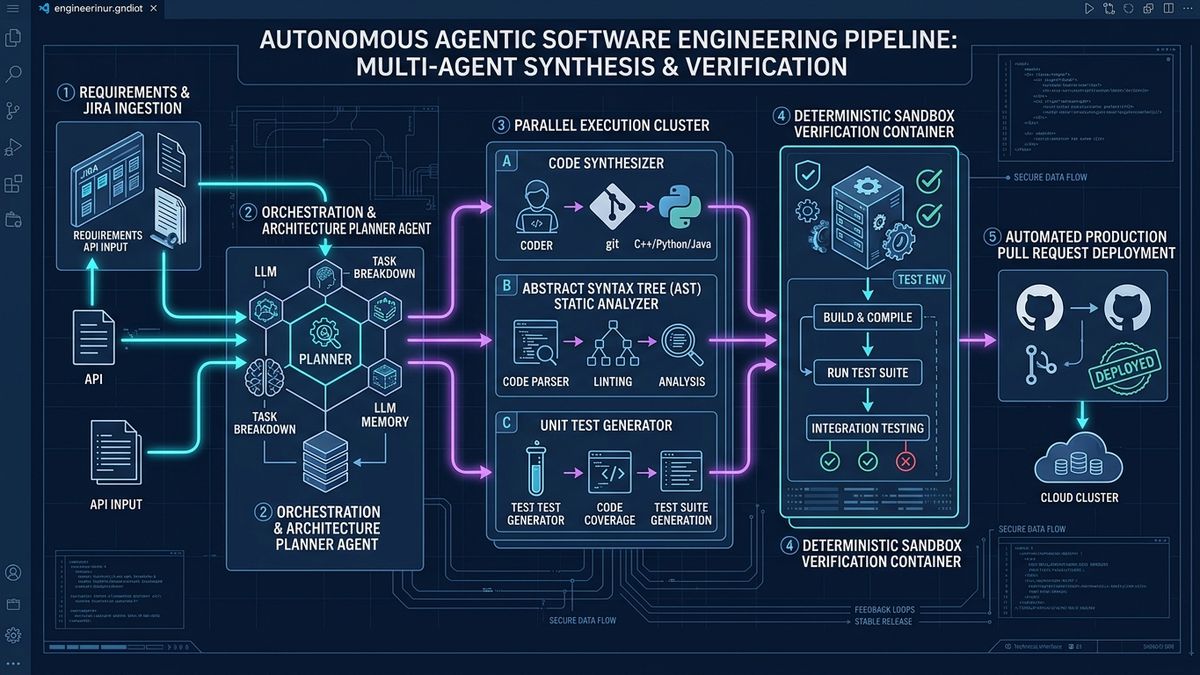
1. Strategic Intent Decomposition: A planner agent parses complex product specifications, maps cross-file dependencies, and produces a structured DAG execution graph.
2. Contextual AST Manipulation: Code agents read, refactor, and write across multiple repositories while respecting architectural invariants, type definitions, and schema contracts.
3. Deterministic Sandbox Verification: The agent suite spawns ephemeral Docker containers, compiles the application, runs end-to-end integration tests, and reviews compiler warnings, recursively fixing bugs until the suite is green.
"The unit of leverage in software engineering has changed permanently,"stated engineering leaders at leading enterprise GCCs. "Instead of measuring output in lines of code written by junior developers, we are measuring developer productivity by the number of autonomous agent pipelines an architect can supervise."
Operational Benchmarks: Copilot vs. Autonomous Multi-Agent Systems
The comparative metrics below highlight real-world enterprise performance across Fortune 500 legacy modernization and SaaS migration pipelines:
| Development Metric | Developer Copilot (2023–2024) | Autonomous Agent Swarms (2026) | Performance Improvement |
|---|---|---|---|
| Task Scope | Single function / in-line snippet | Multi-file PR & End-to-End Module | 12x Higher Scope Complexity |
| Legacy Code Migration (e.g. COBOL to Java) | 4–6 Weeks per Microservice | 3–5 Days per Microservice | 80% Reduction in Cycle Time |
| Test Suite Synthesis & Coverage | Manual prompt-dependent | 100% Edge-Case AST Auto-Generated | 45% Increase in Code Coverage |
| Bug Remediation & Self-Correction | Requires Human Debugging | Automated Test-Loop Self-Correction | 70% Less Human Intervention |
| Developer Role | Active typist and prompter | Strategic reviewer & systems validator | High-Order Architectural Focus |
Impact on Indian IT Billing and Staffing Models
This technological transition is forcing a fundamental rethink of the Indian IT services industry's traditional Time-and-Material (T&M) revenue model. Because agentic pipelines compress 100-hour engineering refactoring tasks into two hours of compute, global enterprise clients are demanding outcome-based pricing contracts.
- Reskilling Over 1 Million Engineers: TCS, Infosys, and HCLTech have institutionalized mandatory certifications in agent orchestration, model fine-tuning, and deterministic guardrail verification.
- The Rise of "Super-Engineers": High-performing engineering pods of 5 developers now manage workloads that previously required 25–30 offshore engineers, driving software profit margins significantly higher for firms that master the transition.
As enterprise software development shifts from manual coding to algorithmic orchestration, India's deep talent pool is uniquely positioned to lead the deployment of trustworthy, mission-critical autonomous agents for global software infrastructure.