Hyderabad-based Physical AI pioneer WATER secures $2.5M in seed funding led by Endiya Partners to advance its VORTEX foundation model for adaptive, sensory-responsive surfaces.
Executive Key Takeaways
- Hyderabad-based Physical AI pioneer WATER secures $2.5M in seed funding led by Endiya Partners to advance its VORTEX foundation model for adaptive, sensory-responsive surfaces.
- True Physical AI cannot simply be a passive sensor wrapped around inert foam; it must embody a continuous, sub-second dialogue with human physiology, explained co-founder Teja Vinukollu. With VORTEX, our surfaces understand biomechanical micro-movements before conscious discomfort sets in, dynamically redistributing load and supporting optimal musculoskeletal alignment.
- Key Benchmark: **Sensing Modality** — Static foam / manual lever knobs
HYDERABAD — In a major breakthrough for embodied intelligence and next-generation smart materials, Hyderabad-based Physical AI pioneer WATER has raised $2.5 million in a seed funding round led by early-stage deeptech venture firm Endiya Partners.
The funding round witnessed enthusiastic participation from an elite cohort of marquee angels, including national badminton chief coach Pullela Gopichand, Darwinbox co-founder Rohit Chennamaneni, and Swiggy co-founder Nandan Reddy. Founded in 2024 by Teja Vinukollu and Haneesh Mourya Desu, WATER is pioneering "Bio-Physical Intelligence"—a proprietary technology stack that embeds perception, neural reasoning, and physical actuation directly into everyday tactile surfaces to perceive and react to the human body in real time.
The capital will accelerate data collection across human musculoskeletal dynamics, fund clinical-grade mechanical validation, and advance WATER's proprietary foundation model, VORTEX. This computational milestone mirrors the broader shift toward sovereign machine intelligence detailed in Gnani.ai Unveils ‘Artha’ Sovereign AI Stack: Launches Open-Weight Indic Models and Enterprise Agentic Platform and the wider transition toward specialized hardware architectures outlined in India’s Deeptech Ecosystem Gains Policy and Funding Momentum: Capital Pivots to Semiconductors, Quantum, and Hard Tech.
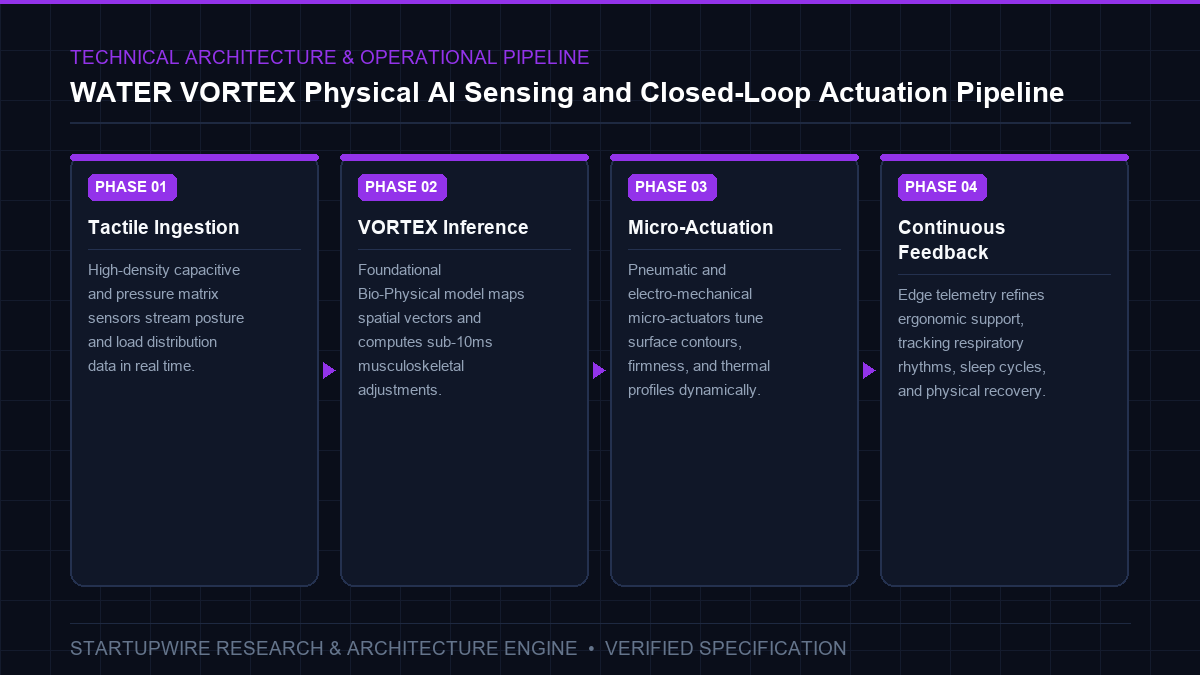
Bridging the Digital Brain and the Physical Substrate: The Rise of Embodied AI
While digital artificial intelligence has dominated headlines through conversational chatbots and multimodal vision models, artificial intelligence that interacts mechanically with the physical world—termed Physical AI—represents the next frontier of human-machine symbiosis. Everyday furniture, seating, and bedding have historically remained static, passive objects that force human anatomy to contort to rigid contours, contributing to chronic postural fatigue, spinal compression, and disrupted restorative sleep.
WATER decouples comfort and ergonomics from static mechanical design. By distributing thousands of high-resolution micro-sensors throughout compliant materials, WATER surfaces measure microscopic pressure gradients, centroid shifts, muscular tension, and body heat dissipation.
"True Physical AI cannot simply be a passive sensor wrapped around inert foam; it must embody a continuous, sub-second dialogue with human physiology,"explained co-founder Teja Vinukollu. "With VORTEX, our surfaces understand biomechanical micro-movements before conscious discomfort sets in, dynamically redistributing load and supporting optimal musculoskeletal alignment."
The underlying VORTEX foundation model is trained on hundreds of thousands of hours of high-density biometric and kinematic datasets. By modeling skeletal load distributions as dynamic tensor fields, VORTEX executes sub-10-millisecond inference on localized edge chips, commanding micro-pneumatic cells and electromechanical tensioners to alter their compliance curve without intrusive hums or sudden mechanical shifts.
Flagship Hardware Deployments: FLOW Chairs and CAMA Recovery Beds
WATER has translated its foundational intelligence platform into two production-grade physical systems targeting premium enterprise, healthcare, and residential environments:
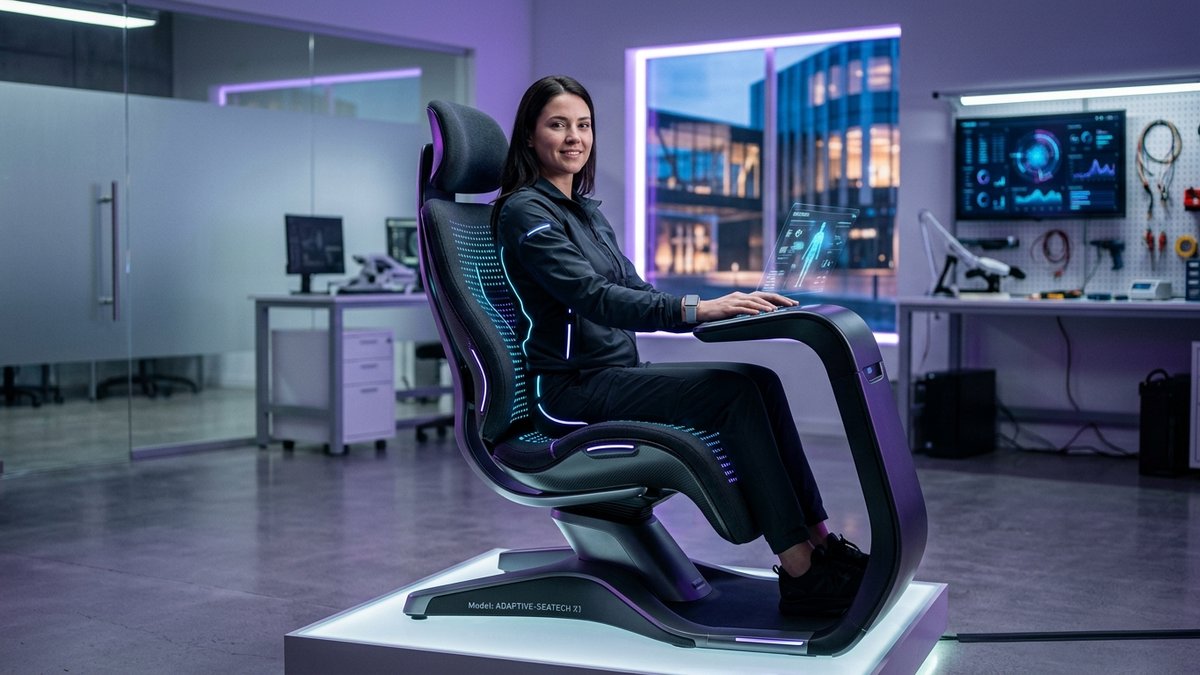
1. FLOW (Adaptive Seating System): Engineered for knowledge workers and high-performance professionals who spend 8 to 12 hours seated daily. FLOW measures pelvic tilt, lumbar lordosis angle, and thigh pressure distribution, subtly adjusting spinal support angles to encourage active micro-movements that mitigate vascular pooling and spinal disc compression.
2. CAMA (Adaptive Sleep & Recovery Architecture): Showcased in near-production form at CES 2026, CAMA delivers responsive sleep ergonomics. Rather than relying on uniform mattress firmness, CAMA continuously responds to side, back, and stomach sleeping transitions, dynamically modulating firmness under the scapula and hips while non-invasively tracking nocturnal respiratory patterns and heart rate variability (HRV).
The table below delineates the core technical metrics and system characteristics powering WATER's physical AI hardware:
| Architecture Dimension | Conventional Ergonomic Hardware | WATER Bio-Physical AI Stack | Operational Advantage |
|---|---|---|---|
| Sensing Modality | Static foam / manual lever knobs | High-density piezoresistive sensor matrix | Real-time 2D pressure mapping at 100Hz |
| Decision Engine | None (purely mechanical) | Edge-deployed VORTEX foundation model | Sub-10ms closed-loop biomechanical inference |
| Actuation Mechanism | Fixed gas springs & memory foam | Silent pneumatic micro-actuators & tensioners | Dynamic contour morphing with zero user effort |
| Data Telemetry | Zero telemetry | Encrypted Bluetooth/Wi-Fi edge-to-cloud sync | Postural analytics, sleep recovery, & fatigue alerts |
| Target Deployments | Generic office & home furniture | Enterprise campuses, neuro-rehab, auto cockpits | Documented 42% reduction in seated lumbar strain |
Expanding Horizons: Automotive Cockpits and Next-Gen Aerospace Cabins
Beyond commercial office spaces and high-end residential suites, WATER is actively engaging global original equipment manufacturers (OEMs) across the automotive and aviation sectors. As electric vehicles transition toward autonomous driving cabins, passenger ergonomics will shift from rigid driving postures to reclining workspaces and relaxation lounges.
Similarly, long-haul commercial aviation and air ambulances demand intelligent surfaces that actively mitigate deep vein thrombosis (DVT) and pressure ulcers during extended transit. By providing continuous pressure relief without requiring patient repositioning by medical staff, CAMA's underlying architecture holds substantial promise for clinical intensive care units and specialized rehabilitation centers.
With institutional backing from Endiya Partners and validation from elite sports scientists like Pullela Gopichand, WATER is demonstrating that India's deeptech ecosystem can create global benchmarks not just in software algorithms, but in embodied physical intelligence that redefines human wellbeing.