Samsung Expands Indian Engineering Footprint to Architect the Next Generation of Galaxy AI
By Priya Sundaram | Published August 10, 2026 | 5 min read
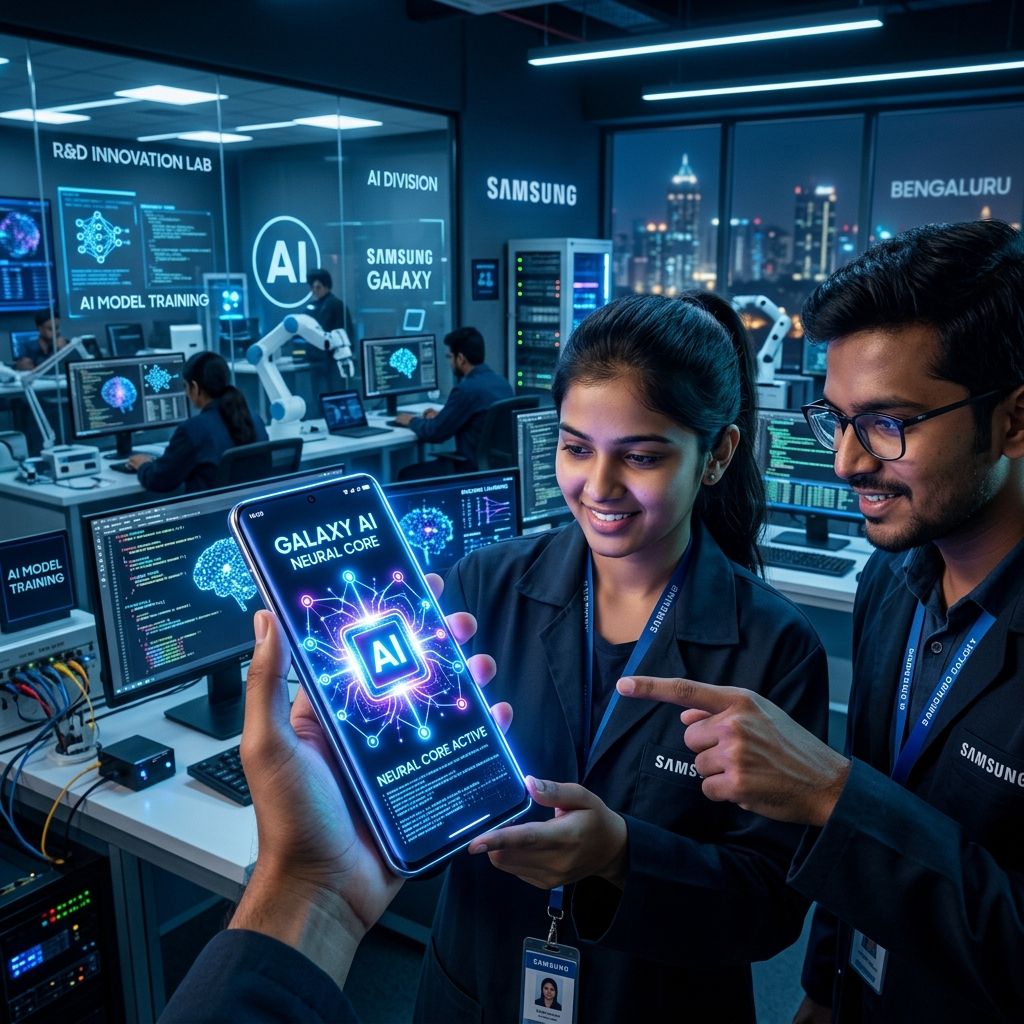
Samsung highlights the expanding role of its Indian engineering hubs in Bengaluru and Noida in shaping core multimodal features for future Galaxy AI devices.
Global electronics leader Samsung has revealed that its Indian engineering teams located at Samsung R&D Institute India - Bengaluru (SRI-B) and Samsung R&D Institute India - Noida (SRI-N) are playing an increasingly central role in engineering the next generation of Galaxy AI.
Indian R&D centers—which together form Samsung’s largest software research hub outside of South Korea—are leading key developments in on-device generative AI, real-time voice translation, multi-modal context understanding, and intelligent camera image processing.
Intent-First Engineering Mandate and Local Innovation
As artificial intelligence moves from cloud servers directly onto mobile chipsets, Samsung's Indian engineers are designing optimized neural processing routines that execute locally on hardware while conserving battery consumption.
Key breakthroughs pioneered by the Indian R&D team include the multi-language expansion of Live Translate (adding support for Hindi, Tamil, Telugu, and Marathi), AI-driven real-time call summarization, and advanced generative photo editing tools embedded in Galaxy flagship devices.
"Our Indian engineering talent is not just executing global mandates—they are actively conceptualizing and building core capabilities of Galaxy AI that power smartphones for hundreds of millions of users worldwide."
"— Dr. Mohan Rao Goli, Corporate Vice President & CTO at SRI-Bengaluru"
Engineering Domain & Feature Contribution Matrix
The table below outlines the specific Galaxy AI software modules engineered by Samsung's Indian R&D facilities:
| R&D Center | Engineering Domain | Primary AI Technologies | Key Galaxy AI Features Developed |
|---|---|---|---|
| SRI-Bengaluru | On-Device Language & Voice AI | Small Language Models (SLMs), Speech-to-Text (STT), Neural Translation | Live Translate for Indic languages, Interpreter mode, Audio Transcript Assist |
| SRI-Bengaluru | Vision AI & Multi-Modal Processing | Neural Object Detection, Image Segmentation, Diffusion Models | Generative Edit, Object Eraser 2.0, AI Nightography processing |
| SRI-Noida | Mobile Security & Data Privacy | Knox Vault integration, On-device encryption, PII redaction | Private AI Processing Guard, secure local key management |
| SRI-Bengaluru | Health & Wearable AI | Sensor Fusion, Biosignal processing, Neural Pattern Recognition | Energy Score algorithms, personalized sleep coaching for Galaxy Watch |
Strengthening India's Role in Global Tech R&D
Samsung’s deep investment in Indian engineering reflects a broader trend of multinational tech giants locating strategic R&D centers in the country. This expansion closely mirrors local innovation momentum, such as B2B software expansion and AI infrastructure growth across Indian tech corridors.
Key Focus Areas for Next-Gen Galaxy AI
Looking ahead, Samsung’s Indian R&D teams are working on three primary innovation fronts for upcoming flagship releases:
1. Context-Aware Agentic Assistants: On-device AI models capable of predicting user intent across multiple apps without sending sensitive user data to external servers.
2. Zero-Latency Neural Translation: Expanding real-time bidirectional translation to 12 additional regional dialects across South Asia and Southeast Asia.
3. Computational Photography & Sensor Fusion: Leveraging micro-neural networks to synthesize multi-frame RAW exposures in challenging low-light environments.
With over 5,000 engineers and researchers combined in Bengaluru and Noida, Samsung continues to elevate India's status as a powerhouse for global mobile AI development.