Sarvam AI signs a 5-year MoU with Ministry of Defence's HQ Integrated Defence Staff to deliver sovereign AI and compressed sensor-to-shooter telemetry for armed forces.
Executive Key Takeaways
- Sarvam AI signed a strategic five-year Memorandum of Understanding with the Ministry of Defence's Headquarters Integrated Defence Staff (HQ IDS).
- The agreement deploys sovereign foundation models and agentic workflows across all three service branches—Indian Army, Indian Navy, and Indian Air Force.
- Projects are executed through Chanakya, Sarvam's firewalled national security division, guaranteeing 100% domestic compute, zero foreign data exposure, and strict human-in-the-loop oversight.
Indian frontier artificial intelligence venture Sarvam AI has entered into a landmark five-year Memorandum of Understanding (MoU) with the Ministry of Defence's Headquarters Integrated Defence Staff (HQ IDS). The institutional agreement establishes an expansive umbrella framework to conceptualize, evaluate, and operationalize sovereign artificial intelligence capabilities across the Indian Army, Indian Navy, Indian Air Force, and tri-service theater commands.
The strategic alliance signals a decisive commitment by India's military leadership to integrate native foundational models, autonomous agentic workflows, and predictive analytics into frontline decision-making architectures. By relying on domestically engineered models rather than adapted commercial software, India joins an elite tier of nations establishing fully sovereign defense AI architectures.
Compressing the Sensor-to-Shooter Loop in Modern Multi-Domain Theaters
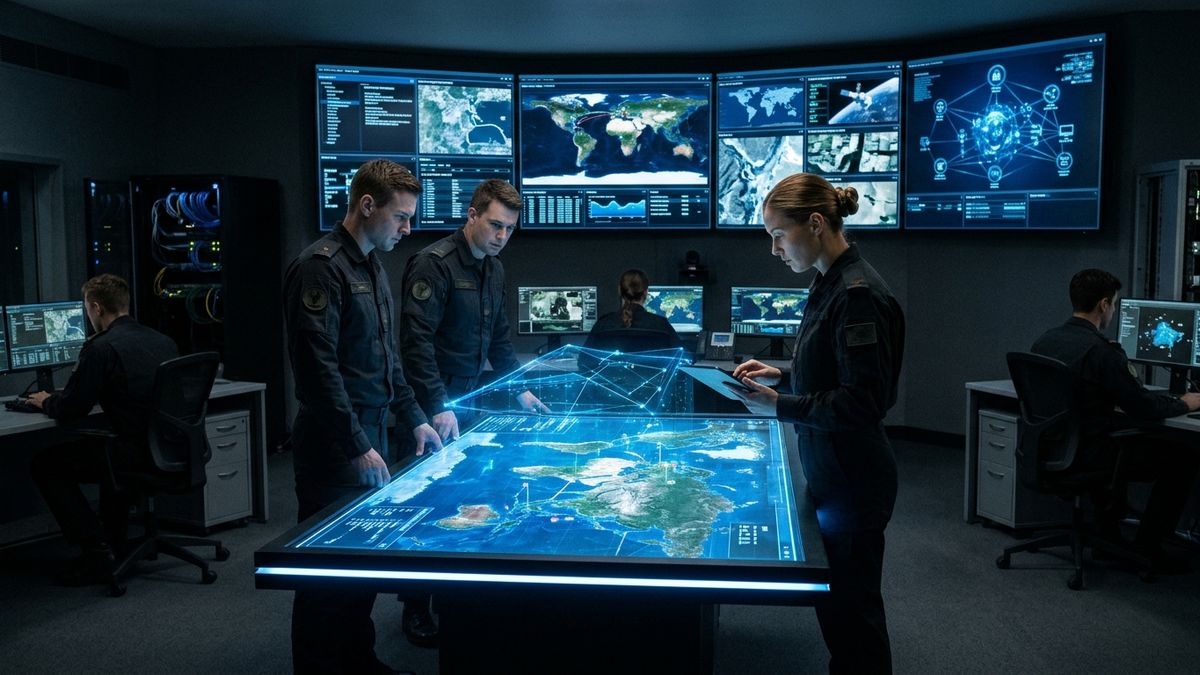
Modern military operations across land, sea, air, cyberspace, and electromagnetic spectrums generate unprecedented volumes of tactical telemetry. Unmanned aerial vehicles (UAVs), satellite synthetic aperture radar (SAR), thermal perimeter optics, and electronic signal monitors continuously transmit terabytes of raw data that can overwhelm manual human intelligence analysts.
The primary operational mandate of the Sarvam-HQ IDS alliance is compressing the critical "sensor-to-shooter loop"—the elapsed duration between identifying a potential adversary asset and disseminating verified situational intelligence to field commanders. Sarvam's multi-modal foundation models will ingest disparate sensor feeds simultaneously, executing real-time cross-sensor correlation to eliminate false positives and highlight high-priority tactical anomalies.
"Modern battlefield dominance will not be determined solely by kinetic firepower, but by the speed, accuracy, and sovereignty of the algorithmic decision layer,"stated senior defense planning officials. "Partnering with Indian deeptech pioneers like Sarvam AI guarantees that our tactical doctrines, training corpora, and strategic telemetry remain safeguarded behind unbreakable domestic firewalls."
This institutional alliance reflects a broader national strategy of deploying sovereign high-performance computing, mirroring private-sector deep-tech investments such as BioStack's federated data architectures and telecom-grade private automation deployments.
The Chanakya Protocol: Air-Gapped Sovereign Security
To address the stringent operational security requirements of the Indian armed forces, all defense-grade workflows are executed exclusively through Chanakya, Sarvam AI's dedicated national security division.
The Chanakya architecture enforces strict non-negotiable operational boundaries:
- Complete Air-Gapped Deployments: Algorithms, inference runtimes, and vector stores are deployed within isolated, physical hardware enclaves disconnected from the public internet and foreign commercial APIs.
- Sovereign Infrastructure Guarantees: All training corpora, domain adaptation weights, and operational telemetry reside strictly on Indian sovereign computing clusters and tactical edge appliances.
- Deterministic Human-in-the-Loop Oversight: Sarvam's military models function strictly as advisory decision-support systems. Every lethal engagement, targeting authorization, and strategic asset reassignment requires explicit human verification and affirmative chain-of-command authorization.
- Zero Foreign Cloud Dependencies: The entire model software stack—including tokenizers, embedding layers, and transformer attention heads—is developed domestically, eliminating vulnerabilities linked to offshore supply chain backdoors.
Defense AI Architecture: Commercial Cloud vs Sovereign Chanakya Stack
The comparative matrix below outlines the critical distinctions between standard commercial AI offerings and the sovereign military stack established under the MoU:
| Strategic Parameter | Commercial Enterprise AI | Sovereign Chanakya Defence AI | Operational Impact |
|---|---|---|---|
| Compute Location | Multi-tenant commercial public clouds | Classified domestic servers & tactical edge nodes | Zero exposure to foreign surveillance or embargoes |
| Data Ingestion | Public web scraping & commercial logs | Encrypted tactical radar, optical, and COMINT feeds | Domain-adapted precision for contested combat environments |
| Network Dependency | Persistent high-bandwidth internet | Functional in disconnected, intermittent (DDIL) nodes | Resilient operation in heavily jammed electronic warfare zones |
| Language Capability | Western-centric multilingual models | Deep Indic dialect and military phonetics mapping | Seamless tactical communication across multi-lingual regiments |
| Governance Standard | Commercial terms of service | Official Secrets Act & Armed Forces Doctrine | Total institutional alignment with sovereign defense priorities |
Cross-Branch Interoperability and Multilingual Tactical Telemetry
A key structural advantage of the HQ IDS partnership is the creation of a unified AI fabric spanning all three military services. Historically, individual service branches often procured isolated technological solutions that lacked native interoperability, leading to friction in joint theater command operations.
Under the unified framework:
- Unified Common Operating Picture (COP): Naval maritime reconnaissance aircraft, Army ground radar outposts, and Air Force airborne early warning and control (AEW&C) planes feed into a shared cognitive layer that builds a continuous, synchronized operational map.
- Dialect and Accent Normalization: Sarvam's renowned leadership in Indic natural language processing enables tactical voice models to parse regional accents, technical military abbreviations, and high-noise radio chatter in real time, translating spoken commands instantly across regiments.
- Predictive Logistics & Readiness: Machine learning models analyze component wear, flight hours, and maintenance logs across armored fighting vehicles and fighter squadrons, forecasting equipment failures before they manifest during active deployments.
Establishing Long-Term Sovereign Strategic Independence
In an era of intensifying geopolitical competition, software and artificial intelligence have emerged as instruments of state power. Nations that rely on foreign foundational models face severe vulnerabilities during diplomatic crises, including potential remote kill switches, telemetry interception, and sudden service cancellations.
By entering into a multi-year partnership with Sarvam AI, India's Ministry of Defence establishes structural self-reliance (Aatmanirbharta) across the algorithmic backbone of its armed forces, ensuring that India's military intelligence platforms remain sovereign, resilient, and technologically preeminent.
Frequently Asked Questions
What is the scope of Sarvam AI's partnership with the Ministry of Defence?
The five-year MoU establishes an institutional framework for deploying sovereign AI across the Indian Army, Navy, Air Force, and joint military commands for intelligence analysis, operational planning, and target acquisition.
What is Chanakya and what role does it play in the agreement?
Chanakya is Sarvam AI's specialized, firewalled national security and defense division that manages classified military deployments under air-gapped protocols with zero public cloud exposure.
How does the military AI deployment protect data sovereignty?
All foundational models and data processing run exclusively on Indian sovereign cloud and tactical edge compute infrastructure, ensuring sensitive operational telemetry never traverses foreign networks.
What is the 'sensor-to-shooter loop' mentioned in the tactical objectives?
The sensor-to-shooter loop refers to the elapsed time between detecting an operational target with sensors and authorizing an engagement. Sarvam's AI models compress this timeline by fusing optical, radar, and acoustic telemetry in real time.
Primary Sources & Official References
- Headquarters Integrated Defence Staff (HQ IDS): Tri-Service Strategic Technology Cooperation MoU
- Ministry of Defence (MoD): Defence AI Roadmap and Self-Reliance Directives
- Sarvam AI: Chanakya National Security Architecture Briefing
- Centre for Joint Warfare Studies (CENJOWS): Sovereign Foundation Models in Modern Electronic Warfare