Skyfall AI, co-founded by Maluuba founder Sam Pasupalak, has unveiled SKY-001, a spatial world model delivering 51x–125x faster CAD synthesis and physical constraint reasoning.
Executive Key Takeaways
- Skyfall AI has unveiled SKY-001, a specialized spatial world model engineered specifically for CAD, BIM, and complex physical constraint verification.
- Co-founded by former Maluuba co-founder Sam Pasupalak, the startup reports 51x to 125x faster execution and roughly $0.005 per sample inference costs compared to general frontier LLMs.
- The architecture relies on a Hierarchical Composer and a Construction World Model to synthesize multi-component engineering assemblies directly in spatial coordinates without hallucination.
Frontier artificial intelligence startup Skyfall AI has officially unveiled SKY-001, a groundbreaking spatial world model engineered specifically for mechanical design, Computer-Aided Design (CAD), and high-precision physical engineering. Co-founded by Indian technologist Sam Pasupalak—who previously co-founded deep learning venture Maluuba before its acquisition by Microsoft—Skyfall AI addresses a glaring blind spot in modern artificial intelligence: the inability of text-based Large Language Models (LLMs) to reliably grasp three-dimensional geometry, rigid physical constraints, and interconnected mechanical assemblies.
Rather than relying on iterative textual reasoning loops that frequently generate unbuildable mechanical parts or hallucinated geometric vertices, SKY-001 plans directly inside the visual and spatial domain. By mapping parametric design constraints into continuous spatial representations, the model achieves unprecedented execution speeds—outperforming general frontier systems by 51x to 125x while slashing operational compute costs to approximately $0.005 per generated sample.
Spatial Cognition vs. Monolithic LLMs: Why Generalist Models Fail at Physical Geometry
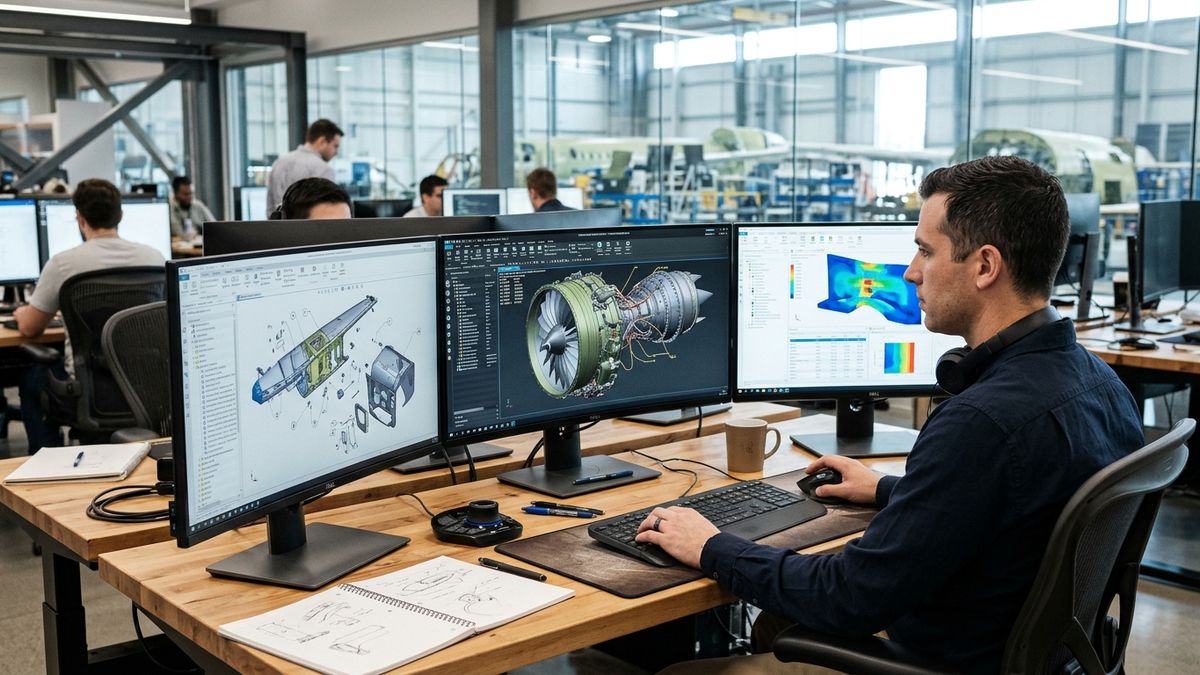
Over the past three years, foundation models have mastered natural language prose, software code generation, and visual image styling. However, deploying frontier LLMs in precision engineering disciplines—such as aerospace turbomachinery design, automotive chassis tooling, or multi-layer printed circuit board (PCB) routing—has consistently encountered severe architectural bottlenecks:
- Tokenization Disconnect: LLMs discretize text into tokens. Physical engineering, however, exists in non-discrete, continuous three-dimensional coordinate spaces governed by Navier-Stokes fluid mechanics, thermodynamic gradients, and strict geometric tolerances.
- Assembly Hallucination: When tasked with multi-part mechanical assemblies, conventional LLMs fail to maintain joint kinematics, part-interference checks, and stress distribution boundaries across hundreds of mating components.
- Prohibitive Latency and Costs: Attempting to force generalist models to iteratively debug CAD code strings requires dozens of expensive reasoning queries, costing upwards of $0.75 per sample while taking several minutes per revision.
Skyfall AI resolves these fundamental limitations by departing from text-centric autoregression. SKY-001 treats engineering design as an embodied, spatial world modeling task, evaluating physical plausibility before generating manufacturing instructions.
"Generalist language models view the physical world through the narrow keyhole of natural language text tokens,"explained engineering researchers at Skyfall AI. "True engineering design requires spatial intuition—the innate capacity to understand how geometric volumes mate, how forces transfer across surfaces, and how physical matter assembles in the real world. SKY-001 establishes that continuous spatial foundation."
The rapid emergence of specialized physical and spatial models mirrors the deeptech hardware acceleration previously examined in /post/samsung-semiconductor-and-iisc-establish-quantum-research-lab.
Two-Tier System Architecture: Hierarchical Composer and Construction World Model
At the technical core of SKY-001 is a modular, two-stage neural architecture engineered to balance macro-structural coherence with sub-millimeter component precision:
1. The Hierarchical Composer
The Hierarchical Composer accepts natural language engineering requirements, performance specifications, and boundary envelopes. It recursively decomposes the target design into a hierarchical graph of functional assemblies, sub-assemblies, and individual constituent components. Rather than generating low-level polygon meshes in a single unconstrained pass, the composer solves topological relationships, material allocations, and interface kinematics at the macro layer.
2. The Construction World Model
Once the structural hierarchy is established, the Construction World Model synthesizes the exact parametric construction sequence. It simulates the physical manufacturing process—such as CNC milling toolpaths, additive manufacturing layer orientation, or injection mold draft angles—ensuring that every synthesized geometry complies with real-world fabrication tolerances.
The table below contrasts the performance and operational benchmarks of SKY-001 against mainstream generalist frontier models:
| Performance Benchmark | Traditional Frontier LLM (e.g. GPT-6 Astra) | Skyfall AI SKY-001 World Model | Operational Advantage |
|---|---|---|---|
| Operational Domain | Discrete Text Tokens / Code Syntax | Continuous Spatial / Geometric Coordinates | Zero Spatial Hallucinations |
| Inference Latency | 45 – 180 seconds per iteration | 0.8 – 2.4 seconds per iteration | 51x to 125x Speedup |
| Sample Compute Cost | ~$0.750 per evaluated design | ~$0.005 per evaluated design | 99.3% Cost Reduction |
| Kinematic Assembly Checks | Manual post-processing required | Native real-time collision & joint verification | Automated Structural Validation |
| Export Formats | Raw Python / OpenSCAD code strings | Direct STEP, IGES, Parasolid, and IFC | Seamless CAD Integration |
Industrial Deployment Vectors: From Aerospace Tooling to Microelectronics
Skyfall AI is positioning SKY-001 across high-value industrial sectors where engineering turnaround times represent multi-million-dollar bottlenecks:
- Aerospace & Defense: Rapid exploration of lightweight generative bracketry, internal cooling channels for rocket engine nozzles, and aerodynamic fairing optimizations.
- Civil Infrastructure & BIM: Automated conversion of 2D architectural schematics into fully compliant, multi-discipline Building Information Models with integrated HVAC and electrical routing.
- Printed Circuit Boards (PCBs): High-speed multi-layer trace routing adhering to signal integrity rules, electromagnetic interference (EMI) shielding, and thermal dissipation thresholds.
- Automotive Tooling: Rapid generation of stamped die tooling, jig assemblies, and assembly line robotic fixture definitions.
This structural focus on automated engineering workflows builds upon the enterprise automation momentum covered in /post/rapidcanvas-raises-29-million-in-series-b and /post/shamrock-ai-raises-5-million.
Verification and Open Industrial Benchmarks
While Skyfall AI's internal metrics indicate dramatic speedups and cost efficiencies, the startup is preparing to release open standardized benchmarks to allow independent mechanical engineering laboratories and aerospace manufacturers to validate SKY-001 on standard NIST CAD test suites.
As enterprise deeptech shifts from conversational interfaces toward embodied physical intelligence, SKY-001 marks a decisive transition toward software that understands the real, physical world.
Frequently Asked Questions
What is Skyfall AI and what makes SKY-001 fundamentally different from standard LLMs?
Skyfall AI is an artificial intelligence startup co-founded by Sam Pasupalak, whose previous AI venture Maluuba was acquired by Microsoft. Unlike general-purpose Large Language Models that treat engineering problems as text token prediction, SKY-001 is a spatial world model that operates directly within continuous geometric coordinate spaces, understanding physics, tolerances, and multi-part volumetric relationships.
What key engineering industries can utilize SKY-001?
SKY-001 is purpose-built for Computer-Aided Design (CAD), Building Information Modeling (BIM), printed circuit board (PCB) layout routing, aerospace structural component modeling, and computational molecular/protein design.
What are the core architectural components of SKY-001?
The model features a two-tiered architecture: the Hierarchical Composer, which decomposes high-level design specifications into functional geometric sub-assemblies, and the Construction World Model, which executes the exact physical fabrication and assembly sequencing adhering to material constraints.
How does SKY-001 compare on compute efficiency and inference cost?
In internal engineering benchmarks against general frontier models like OpenAI GPT-6 Astra, SKY-001 achieved execution speeds between 51x and 125x faster, reducing cost per generated sample from $0.75 down to approximately $0.005.
Primary Sources & Official References
- Skyfall AI Technical Whitepaper: Spatial World Models for High-Fidelity Engineering Synthesis
- IEEE Computer Society: Computational Geometry and Generative Modeling in Parametric CAD
- American Institute of Aeronautics and Astronautics (AIAA): Machine Learning in Structural Aerospace Design
- Association for Computing Machinery (ACM): Hierarchical Decompositions in Generative Assembly Systems