VerifAIX Raises $5M for Chip Verification: Indian Semiconductor Startup Accelerates AI-Powered Silicon Verification for Next-Gen ASICs
By Aarav Sharma | Published September 16, 2026 | 8 min read
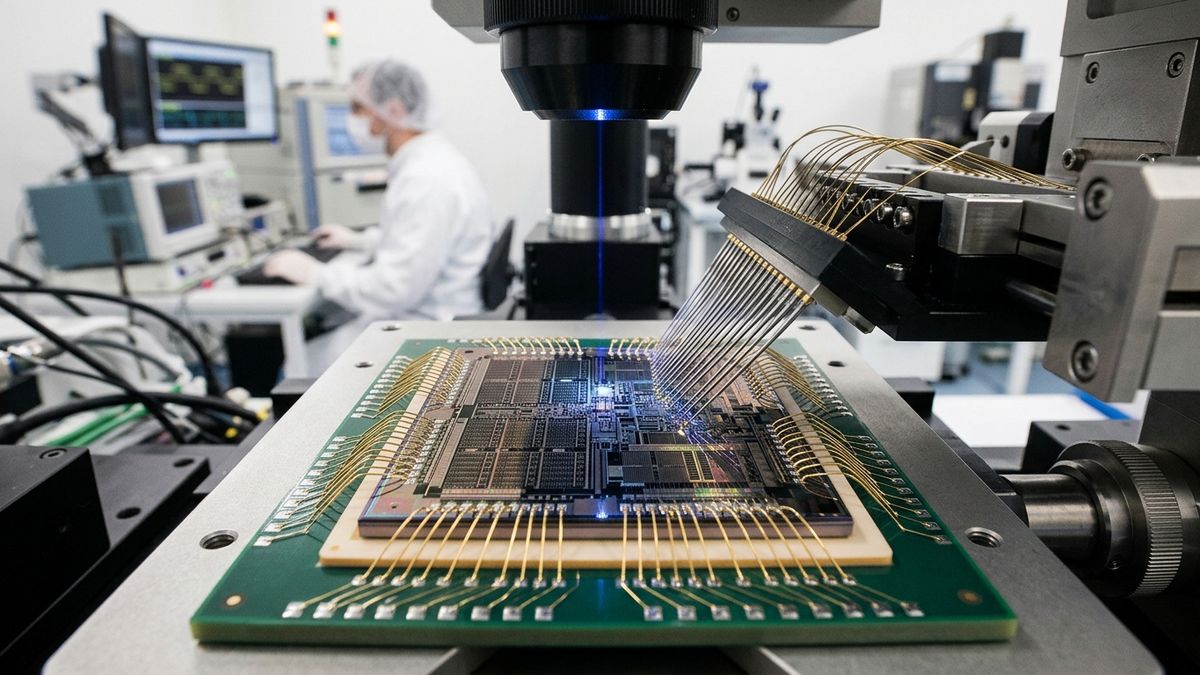
Bengaluru semiconductor startup VerifAIX raises $5M in seed funding to pioneer AI-driven design verification and automated defect validation for complex silicon microchips.
Indian semiconductor deeptech venture VerifAIX has officially announced the successful closing of a $5 million seed financing round led by prominent deeptech venture capital funds and prominent semiconductor industry angels. The capital infusion will be deployed to accelerate research and development and scale commercial deployment of VerifAIX’s proprietary artificial intelligence-powered electronic design automation (EDA) verification platform, engineered to solve the escalating verification crisis in leading-edge application-specific integrated circuits (ASICs), neural accelerators, and heterogeneous chiplet architectures.
As global semiconductor architectures shrink toward sub-3nm nodes and pack tens of billions of transistors into 2.5D and 3D stacked dies, verifying that a chip design behaves precisely as intended before committing to physical tape-out has become the most expensive and time-consuming bottleneck in microelectronics. A single undetected logic bug escaping to physical silicon can result in multi-million-dollar re-spins, catastrophic product delays, and severe financial penalties. VerifAIX utilizes domain-trained reinforcement learning models and formal verification algorithms to autonomously identify elusive corner-case bugs in fraction of traditional simulation time.
The Semiconductor Verification Crisis: Why Silicon Design Needs AI
In modern semiconductor design cycles, verification engineers outnumber design engineers by a ratio of more than two to one, with verification activities consuming upwards of 60% to 70% of total engineering budgets. The traditional verification pipeline—built around SystemVerilog, Universal Verification Methodology (UVM), and pseudo-random testbench simulations—is buckling under the weight of modern architectural complexity:
1. State-Space Explosion: Modern multi-core processors and AI NPUs contain an effectively infinite combination of operational states, cache coherency transitions, and asynchronous clock domains that manual testbenches cannot comprehensively cover.
2. Prolonged Simulation Run-Times: Running comprehensive regression test suites on complex SoC designs can require weeks of continuous compute on high-performance server farms, delaying tape-out schedules.
3. Severe Shortage of Verification Talent: The global semiconductor industry faces a severe deficit of senior verification engineers capable of writing complex formal verification assertions and debug scripts.
VerifAIX solves this structural dilemma by introducing autonomous AI verification agents. Rather than relying on human engineers to manually craft millions of directed test vectors, VerifAIX's neural verification engine intelligently analyzes register-transfer level (RTL) code, predicts potential fault domains, and generates targeted, constrained-random stimulus to achieve verification closure rapidly.
This investment arrives amid a resurgent wave of venture capital flowing into Indian deeptech hardware, as highlighted in our weekly funding analysis showing Indian startup funding hitting $392M across hardware and spacetech.
"Verification is the existential guardian of the semiconductor industry. When tape-out costs for advanced silicon exceed $50 million, you cannot afford a single undetected race condition or memory deadlock,"stated the founding team of VerifAIX. "By infusing generative AI and formal mathematical reasoning into the verification loop, VerifAIX empowers engineering teams to achieve 100% coverage closure in weeks rather than months, slashing time-to-market for complex AI silicon."
Architecture of the VerifAIX Intelligent Verification Platform
The VerifAIX software suite integrates directly into existing commercial EDA workflows, functioning seamlessly with standard industry toolchains:
* Autonomous Testbench Synthesis: Translates high-level architectural specifications and natural language design documents into fully synthesizable, UVM-compliant verification testbenches.
* RL-Driven Corner-Case Exploration: Employs deep reinforcement learning agents that actively search for unvisited state spaces, corner cases, and protocol violations that conventional random generators overlook.
* Automated Root-Cause Diagnostic Engine: When a functional bug or timing violation is detected, the platform automatically traces the error through clock trees and signal paths, pinpointing the exact offending line of RTL code.
* Multi-Die Chiplet Interconnect Verification: Specialized formal algorithms designed to verify ultra-dense die-to-die interfaces (UCIe and BoW) across multi-chiplet packaging modules.
These verification advancements dovetail with the physical validation workflows examined in our report on how Teradyne expands automated semiconductor test systems in Bengaluru.
Comparative Matrix: VerifAIX vs. Traditional Silicon Verification
The structured matrix below contrasts conventional UVM verification methodologies with VerifAIX’s AI-powered automated verification platform:
| Operational Dimension | Traditional Verification (UVM/Simulation) | VerifAIX AI-Driven Platform | Verified Engineering Impact |
|---|---|---|---|
| Testbench Creation | Manual authoring taking 3–6 months | Autonomous synthesis in under 48 hours | 80% reduction in upfront testbench setup time |
| Coverage Closure | Pseudo-random simulation with manual tweaking | Directed reinforcement learning search | Reaches 98%+ functional coverage 3.5x faster |
| Corner-Case Discovery | Often undetected until hardware emulation | Systematically navigates rare state boundaries | Pre-tape-out elimination of catastrophic silicon bugs |
| Root-Cause Analysis | Manual waveform inspection taking days | Automated neural back-tracing to RTL code | Bug triage completed in minutes rather than days |
| Compute Consumption | Thousands of CPU hours on regression farms | Optimized, targeted vector execution | 60% reduction in simulation server farm compute |
Boosting the India Semiconductor Mission (ISM)
India has historically served as the global backend for VLSI engineering, housing over 20,000 chip design engineers working for multinational semiconductor giants. However, the nation historically lacked indigenous EDA software vendors capable of capturing high-margin global intellectual property revenues.
VerifAIX represents a crucial milestone in the maturation of India's fabless semiconductor ecosystem. With its $5 million seed round, the startup is expanding its engineering laboratory in Bengaluru and establishing customer validation pilots with leading automotive chip designers and AI accelerator developers in India, North America, and Europe.
By combining algorithmic artificial intelligence with microelectronic precision, VerifAIX is proving that Indian deeptech startups can innovate at the foundational layer of global semiconductor computing.