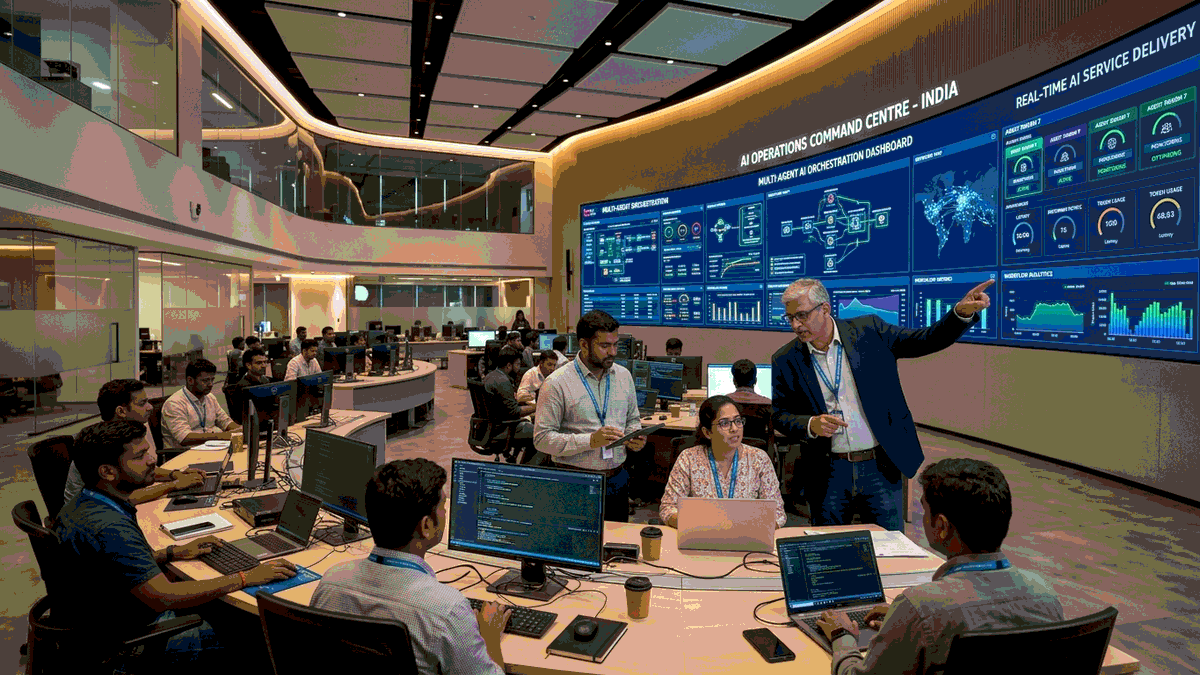
AI Race Reshapes Indian Campus Hiring: Tech Majors and Startups Mandate Agentic Engineering Skills
By Elena Rostova | Published August 14, 2026 | 7 min read
Global tech firms and Indian startups overhaul college recruitment, prioritizing autonomous agentic orchestration, LLM fine-tuning, and systems architecture over legacy rote coding.
The rapid acceleration of generative artificial intelligence and autonomous coding agents has triggered a sweeping transformation across Indian university campus placements. Global tech giants, Global Capability Centres (GCCs), and high-growth startups are overhauling their engineering recruitment pipelines, abandoning legacy rote syntax tests and competitive LeetCode-style puzzles in favour of agentic orchestration, system architecture design, LLM fine-tuning, and AI-assisted code verification.
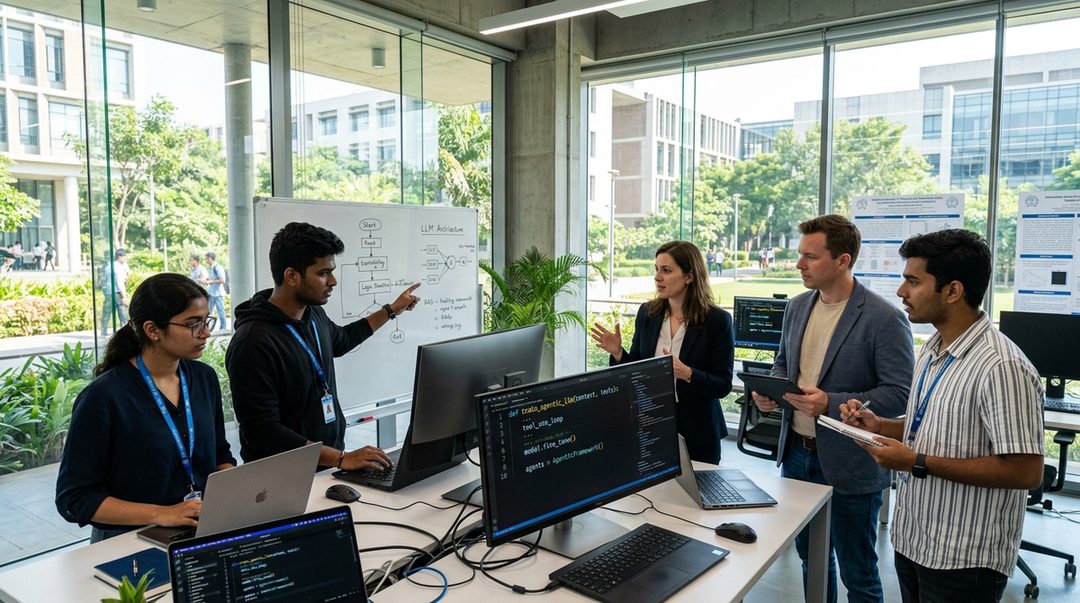
At premier institutions including the Indian Institutes of Technology (IITs), National Institutes of Technology (NITs), and leading private engineering universities, recruitment panels are demanding graduates who can orchestrate multi-agent software systems, write robust integration tests, and debug complex production microservices alongside AI coding copilots.
The End of Rote Coding: Shifting Evaluation Metrics
For decades, campus recruitment in India relied heavily on timed algorithmic challenges and basic data structures (DSA) assessments. However, with modern models like Gemini 3.7 Flash and Claude 3.7 effortlessly solving standard algorithmic benchmarks, the ability to write boilerplate algorithms from memory has lost its commercial differentiation.
Instead, recruiters are placing candidates in live developer environments equipped with AI coding agents. Candidates are assessed on how effectively they guide the AI, craft precise context prompts, critique generated pull requests, detect subtle concurrency bugs, and architect secure database schemas.
"We no longer hire junior engineers to write raw boilerplate loops that AI can generate in two seconds,"said Radhika Gupta, Head of Talent Acquisition at a leading global cloud enterprise in Bengaluru. "We evaluate engineering judgment: Can the student reason about distributed systems? Can they verify AI-written code for security vulnerabilities? Can they design modular APIs that autonomous agents can reliably call? The definition of technical literacy has fundamentally shifted."
This hiring paradigm shift directly relates to the broader industry dynamics explored in our investigative analysis on how AI disrupts traditional IT services hiring models and why engineering fundamentals matter more than ever in the age of AI coding.
Campus Placement Transformation: Legacy vs 2026 Evaluation Matrix
The fundamental evolution in technical hiring standards across Indian engineering campuses is captured in the comparative table below:
| Recruitment Dimension | Traditional Placement Model (Pre-2025) | Modern AI-First Placement Model (2026) | Primary Skill Tested |
|---|---|---|---|
| Initial Screening Round | Automated LeetCode / HackerRank DSA tests | Multi-file repository debugging with AI copilots | Code comprehension & system diagnostics |
| System Design Interview | Abstract whiteboard architectural diagrams | Live microservice decomposition with API contracts | Scalability, caching, and rate limiting logic |
| Technical Assessment | Writing algorithms from memory without IDEs | Directing autonomous agentic CLI tools & PR review | Prompt framing, prompt caching, and test coverage |
| Specialized Elective Premium | General Web Dev / Android Dev | RAG pipelines, fine-tuning, embeddings, and vector DBs | Applied Generative AI implementation |
| Fresh Graduate Salary Bands | ₹8 LPA – ₹16 LPA (Standard Software Eng) | ₹22 LPA – ₹45 LPA (AI Systems Engineer) | Premium for end-to-end full-stack agent architects |
Curriculum Overhaul Across Engineering Universities
In response to industry demand, engineering faculties across the country are rapidly updating academic curricula. Courses that previously spent entire semesters on basic syntax are being replaced with modules on distributed systems architecture, database sharding, applied machine learning, and cybersecurity auditing.
Furthermore, universities are establishing collaborative AI innovation labs in partnership with industry leaders—mirroring programs like IIM Calcutta's Google AI initiative—where undergraduates build real-world open-source applications and commercial prototypes before their final placement season.
The Rise of the 'Super-Productive' Junior Engineer
Rather than reducing total engineering employment, the AI transformation is creating a new tier of '10x junior engineers.' Graduates who master AI orchestration tools can deliver feature velocity previously expected only of senior staff engineers with 5+ years of experience.
As Indian engineering education aligns with global AI workforce requirements, India’s talent ecosystem is transitioning from delivering low-cost IT maintenance to engineering the foundational software and intelligent agents powering global technology enterprises.