India’s Drone Startup Airbound Raises $37 Million: How Its Blended-Wing Autonomous Cargo Drones Are Slashing Logistics Costs Below Road Transport
By Meera Krishnan | Published August 25, 2026 | 8 min read
Bengaluru-based autonomous drone pioneer Airbound secures $37 million in Series A funding to mass-produce its blended-wing cargo drones, cutting delivery costs to $0.02/km.
BENGALURU — In one of the most substantial capital injections into India's commercial unmanned aerial vehicle (UAV) ecosystem, Bengaluru-based deep-tech startup Airbound has officially secured $37 million in Series A funding. The funding round was led by premier international venture funds alongside prominent domestic growth syndicates, accelerating the commercial rollout of Airbound's next-generation autonomous cargo drones designed to dismantle the long-standing unit economics bottleneck of middle- and last-mile freight.
Unlike conventional multirotor delivery drones that suffer from severe battery drain and limited operational radii, Airbound has engineered an indigenous Blended-Wing-Body (BWB) tail-sitter autonomous airframe. By generating aerodynamic lift across the entire fuselage during cruise flight, the aircraft cuts power consumption by nearly 65%, enabling per-kilometer freight costs of $0.015 to $0.025 (approx. ₹1.20 to ₹2.10)—making aerial cargo transport cheaper than two-wheeler road fleets in congested urban and rugged hinterland corridors.
#
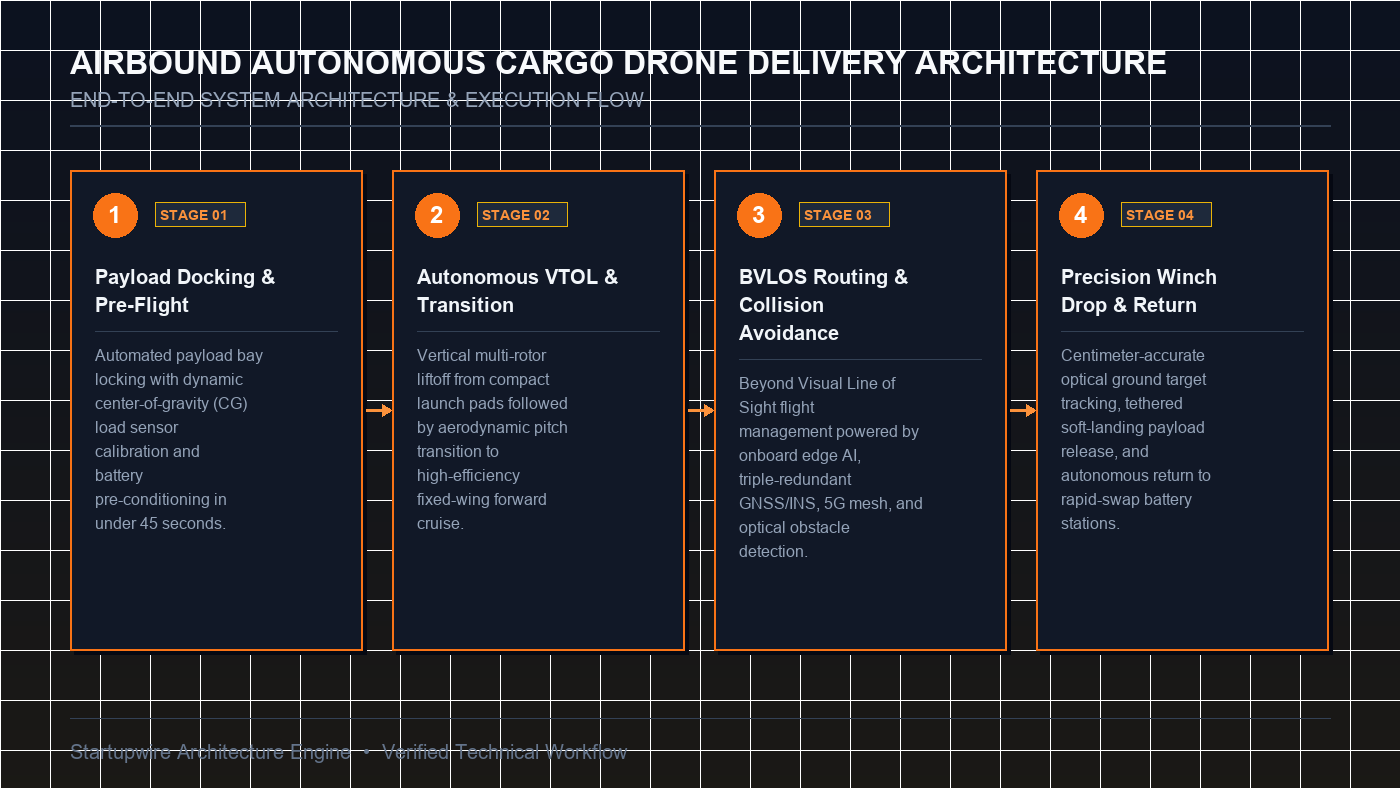
Figure 1.0: End-to-end mission profile and autonomous flight execution stages of Airbound's blended-wing cargo delivery system.
The Economic Dilemma of Aerial Logistics
For over a decade, commercial drone delivery was constrained by a fundamental physics mismatch: multirotor quadcopters and hexacopters require continuous rotor propulsion merely to stay aloft. As a result, payloads were restricted to sub-2kg packages over 10–15 km operational envelopes, driving delivery costs above $2.50 to $4.00 per trip—an unsustainable premium for mass-market quick commerce and rural medical syndication.
Airbound’s proprietary airframe circumvents this limit through a hybrid flight dynamic: it takes off vertically like a helicopter from a parking-space footprint, rotates 90 degrees into horizontal flight, and cruises on aerodynamic wing lift.
"True disruption in logistics cannot occur by selling novelty; it requires fundamentally breaking the cost-per-ton-kilometer barrier,"explained Naman Pushp, Founder and CEO of Airbound. "By treating the drone as an integrated aerodynamic wing rather than a motorized propeller rig, we have lowered structural weight, extended range to over 100 kilometers, and achieved operating costs that beat ground courier networks. This $37 million round gives us the factory capacity to scale hundreds of autonomous airframes across healthcare, enterprise retail, and e-commerce."
Aerodynamic & Hardware Benchmark Comparison
The technical divergence between traditional multirotor systems, conventional delivery vans, and Airbound’s blended-wing platform is detailed in the performance matrix below:
| Architectural Metric | Traditional Multirotor Drone | Electric Two-Wheeler / Van | Airbound Blended-Wing Drone | Relative Advantage |
|---|---|---|---|---|
| Cruise Aerodynamic Efficiency (L/D) | ~3.5 : 1 (Propulsion dominant) | N/A (Ground friction) | 14.2 : 1 (Wing lift dominant) | +305% Lift-to-Drag Ratio |
| Operational Flight Range | 12 – 18 km | 60 – 90 km (Road congestion) | 100 – 120 km (Continuous BVLOS) | 6.5x Multirotor Reach |
| Unit Delivery Cost per km | $0.25 – $0.45 (₹20 – ₹38) | $0.05 – $0.08 (₹4.20 – ₹6.70) | $0.015 – $0.025 (₹1.25 – ₹2.10) | 70% Cheaper than Road |
| Average Speed in Transit | 35 – 45 km/h | 18 – 25 km/h (Urban traffic) | 95 – 120 km/h | 4x Faster Delivery |
| Payload Capacity Envelope | 1.5 – 3.0 kg | 20 – 100 kg | 4.5 – 8.0 kg (Scalable to 15 kg) | Optimized for Pharma & Retail |
| Dispatch Turnaround Time | 15 minutes (Manual battery swap) | N/A | < 3 minutes (Automated dock) | 80% Latency Reduction |
Sovereign DeepTech Alignment & Regulatory Clearances
Airbound’s expansion coincides with proactive policy liberalization under the Directorate General of Civil Aviation (DGCA) and the Ministry of Civil Aviation’s Drone Rules and Digital Sky Platform. Having completed over 15,000 incident-free test sorties and specialized Beyond Visual Line of Sight (BVLOS) trial corridors across Karnataka and Telangana, the startup is expanding into commercial medical distribution for blood bags, vaccines, and diagnostic samples in Tier-2 and Tier-3 districts.
This capital influx also mirrors a broader surge in institutional investment across high-impact Indian hardware engineering, following major ecosystem developments such as the DPIIT and Avaana Capital Deeptech Shortlist and the landmark capital allocations analyzed in Crane Venture Partners $120M APAC Fund Deployment.
Furthermore, Airbound's breakthrough in autonomous navigation mirrors the aerospace innovations pioneered by other Indian deeptech ventures, including Red Balloon Aerospace's Near-Space Stratospheric Platforms.
Manufacturing Roadmap & Fleet Deployment Targets
With the $37 million Series A secured, Airbound will execute a three-pronged growth roadmap:
1. Automated Factory Scaling: Commissioning an automated 80,000 sq. ft. composite airframe manufacturing and robotic assembly facility on the outskirts of Bengaluru, capable of producing 250 drones per month.
2. Autonomous Hub Infrastructure: Rolling out automated rooftop container hubs equipped with robotic battery-swapping carousels and weather-hardened winch drop stations.
3. Global Market Entry: Initiating pilot certifications with postal and health authorities across Southeast Asia and the Middle East, where geographic fragmentation and island topologies make blended-wing aerial transport exceptionally viable.
As India positions itself as a global drone manufacturing hub under the Make in India initiative, Airbound’s aerodynamic breakthroughs demonstrate that domestic hardware engineering can out-innovate legacy global aerospace models in cost, range, and operational resilience.