Red Balloon Aerospace Builds India’s Near-Space Future: The Vijayawada Startup Taking Stratospheric Balloons Beyond Rocketry
By Karthik Ramaswamy | Published August 21, 2026 | 8 min read
Vijayawada-based Red Balloon Aerospace pioneers near-space stratospheric balloons and airships, putting India among five global nations with super-pressure flight capability.
VIJAYAWADA — When observers discuss India’s booming private space sector, they usually picture roaring rocket engines lifting off from coastal launch pads at Sriharikota. But twenty to thirty kilometers above the Earth—in the freezing, razor-thin air of the stratosphere known as "near-space"—a different kind of aerospace revolution is quietly taking flight.
In this atmospheric corridor, conventional drones cannot generate enough aerodynamic lift to stay aloft, while Low Earth Orbit (LEO) satellites zip past at 27,000 kilometers per hour, able to observe a specific geographic coordinate for only a few fleeting minutes at a time.
Operating out of Vijayawada, Andhra Pradesh, aerospace startup Red Balloon Aerospace is building sovereign near-space infrastructure. Founded in 2025 by former Skyroot Aerospace executives Dr. CVS Kiran (CEO) and Sireesh Pallikonda (COO), the startup is proving that autonomous stratospheric balloons and airships can deliver continuous, satellite-grade Earth observation, defense surveillance, and telecommunications at a tiny fraction of rocket launch costs.
Unlocking the "Tower in the Sky": Why Near-Space Matters
The near-space region (spanning altitudes from 10 km to 160 km) has historically remained an engineering graveyard due to extreme environmental conditions: temperatures dropping to -80°C, near-vacuum atmospheric pressures, and intense ultraviolet radiation.
However, platforms capable of persistent stratospheric flight offer immense operational advantages:
- Zero-Latency High-Resolution Optical & Radar Imaging: Floating just 25 km above ground, optical sensors achieve sub-decimeter spatial resolution without needing massive, multi-million-dollar space telescopes.
- Persistent Geostationary Dwell Time: While satellites orbit rapidly, a super-pressure stratospheric balloon can maintain position over a disaster area, agricultural belt, or border corridor for weeks at a time.
- 100% Payload Recovery & Sensor Reusability: Unlike orbital satellites that burn up upon atmospheric re-entry, stratospheric platforms can be commanded to descend to designated recovery zones, allowing sensors to be upgraded and redeployed within hours.
Mission SANA: India Joins an Elite Five-Nation Club
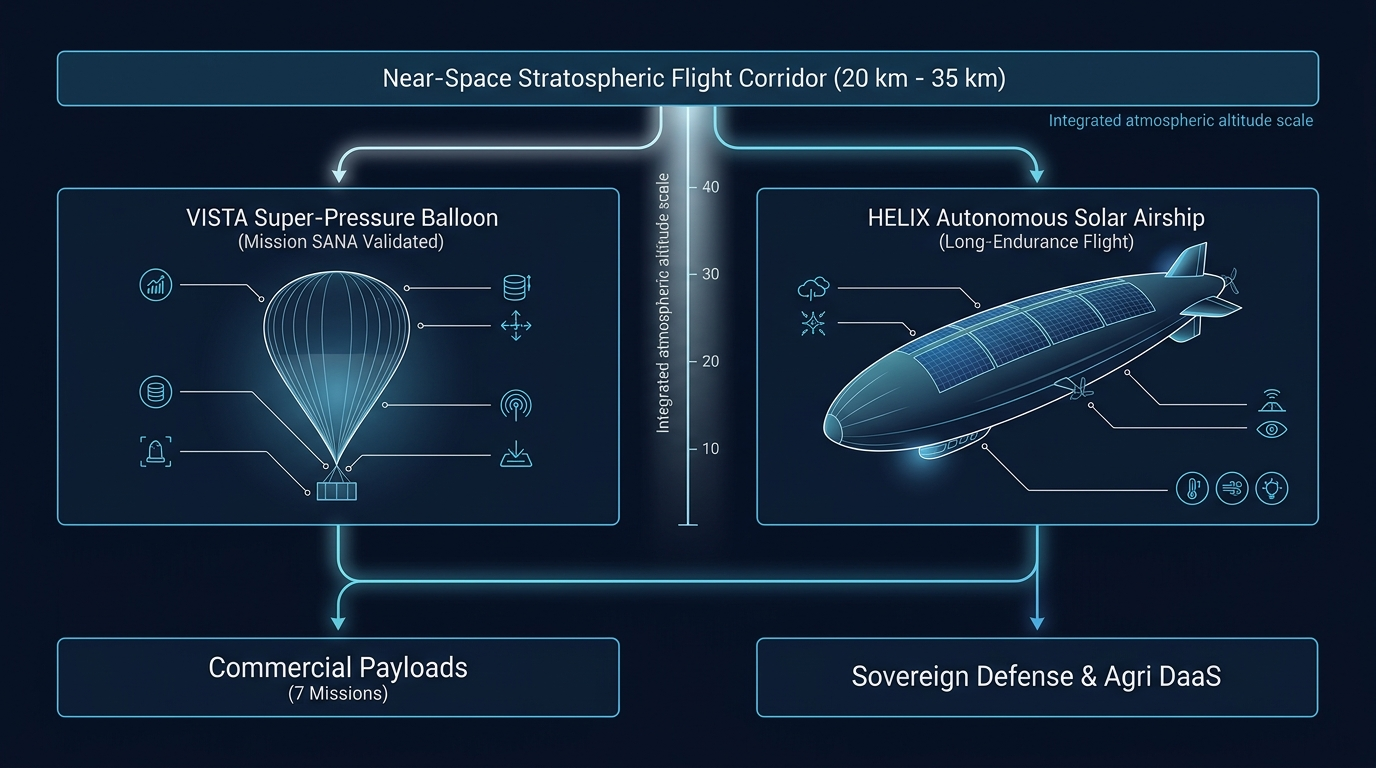
In May 2026, Red Balloon Aerospace conducted Mission SANA, launching its flagship VISTA super-pressure stratospheric balloon from the Indira Gandhi Stadium in Vijayawada. The balloon climbed into the stratosphere, establishing a stable float altitude of approximately 25 kilometers while carrying seven active commercial payloads from domestic and international partners.
The success of Mission SANA marked an extraordinary technological milestone: India became one of only five nations in the world—alongside the United States, France, Japan, and China—possessing indigenous, fully operational super-pressure stratospheric balloon capabilities.
The comparison table below highlights the operational trade-offs between near-space platforms, high-altitude drones, and orbital satellites:
| Operational Parameter | High-Altitude Drones (HALE) | Red Balloon Near-Space (VISTA/HELIX) | Low Earth Orbit Satellites (LEO) |
|---|---|---|---|
| Operating Altitude | 12 km – 18 km | 20 km – 35 km (Near-Space) | 400 km – 800 km |
| Loiter Duration / Dwell | 24 – 48 hours | Weeks to Months (Continuous) | 5 – 10 minutes per orbital pass |
| Payload Capacity | 20 kg – 60 kg | 100 kg – 350 kg | 50 kg – 2,000 kg |
| Deployment Cost per Mission | $250,000 – $500,000 | <$35,000 per flight | $3,000,000 – $15,000,000 |
| Payload Recovery | Reusable | 100% Safe Ground Recovery | Unrecoverable / Atmospheric Re-entry Burn |
The Materials Breakthrough: Surviving the Stratosphere
To achieve super-pressure flight, Red Balloon had to build its material science value chain entirely in-house:
1. Multi-Layer Ultra-Resilient Polymers: Developed proprietary composite films that maintain structural integrity and internal gas pressure despite 120-degree diurnal temperature swings (from -80°C at night to +40°C in unfiltered sunlight).
2. HELIX Autonomous Airship Roadmap: Currently in advanced engineering testing, HELIX combines solar-harvesting photovoltaic films with electric propulsion, allowing the airship to autonomously navigate against stratospheric jet streams.
3. ALTIS Tethered Aerostat: Engineered as a persistent perimeter security and communications relay platform for coastal ports and sensitive defense installations.
"Near-space is not a competitor to rocketry; it is the vital connective tissue that bridges civil aviation and orbital satellites,"explained Dr. CVS Kiran, CEO of Red Balloon Aerospace. "By mastering super-pressure stratospheric navigation, we can provide defense agencies, agricultural monitors, and telecommunications providers with continuous, high-resolution coverage at a price point that makes persistent monitoring economically viable."
Catalyzing India’s Dual-Use SpaceTech Economy
Red Balloon Aerospace’s breakthroughs illustrate the accelerating commercial maturity of India’s private aerospace sector under the regulatory framework of IN-SPACe (Indian National Space Promotion and Authorization Centre) and the iDEX (Innovations for Defence Excellence) defense procurement pipeline.
As explored in our deep-dives into India's SpaceTech Horizon & Orbital Commercialization and Techno Defence’s miniature cryocooler breakthroughs, private deeptech ventures are building sovereign, dual-use capabilities that safeguard national security while unlocking recurring commercial revenue.
Discover emerging aerospace innovators on the Startupwire VC Radar and explore verified space tech companies on the Ecosystem Directory.