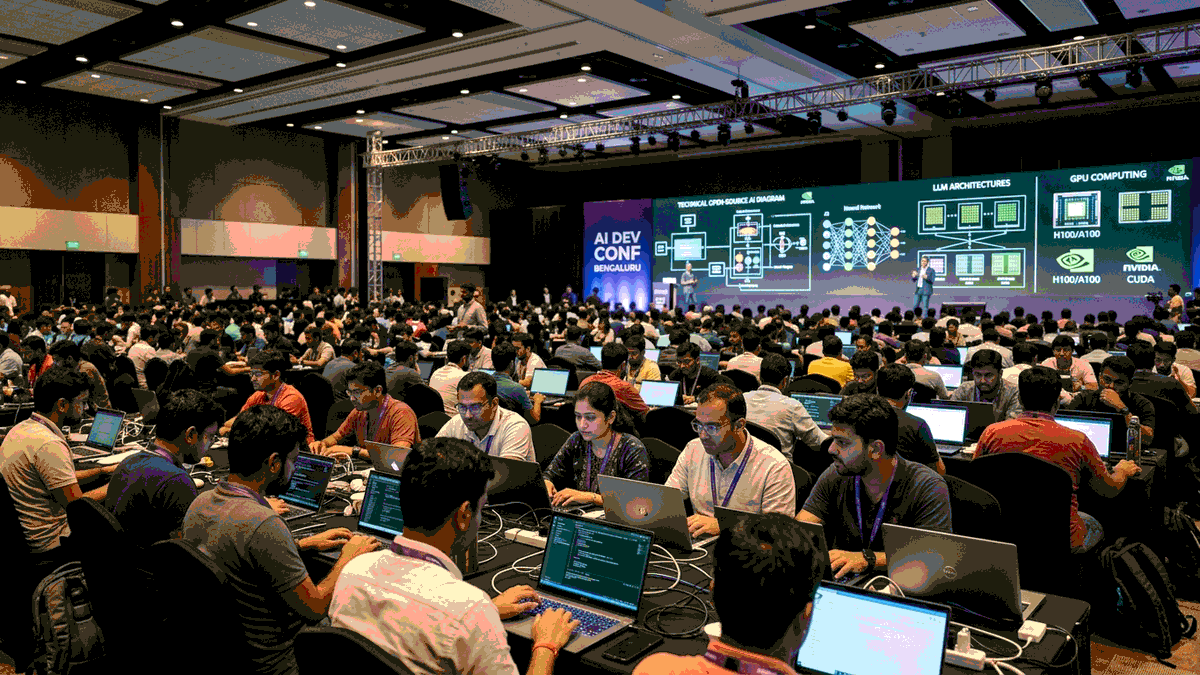
At AMD AI DevDay India in Bengaluru, over 380 developers and AI researchers assembled to explore agentic workflows, open ROCm architectures, LLM fine-tuning, and hardware-accelerated coding agents.
Executive Key Takeaways
- At AMD AI DevDay India in Bengaluru, over 380 developers and AI researchers assembled to explore agentic workflows, open ROCm architectures, LLM fine-tuning, and hardware-accelerated coding agents.
- Developers are the true engine of technological transformation; hardware only delivers real-world value when the developer ecosystem has frictionless, transparent access to write code directly to the silicon, declared Deepak Agarwal, Corporate Vice President of Silicon Design Engineering at AMD, in his opening keynote address. India possesses the highest concentration of high-velocity AI talent in the world. By equipping Indian engineers with open software tools, transparent compilers, and direct cloud compute credits, we are democratizing frontier AI development.
- Key Benchmark: **Compiler & Kernel Source** — Closed-source, proprietary binaries
BENGALURU — Demonstrating its deepening commitment to dismantling proprietary artificial intelligence software moats, AMD convened over 380 premier AI developers, ML researchers, and startup founders at AMD AI DevDay India in Bengaluru.
Held at the Taj West End, the high-density technical conference served as an immersive showcase for AMD’s rapidly maturing open-source AI ecosystem, anchored by the ROCm (Radeon Open Compute) software stack. Attendees participated in intensive architectural deep-dives and hands-on GPU labs spanning autonomous agentic workflows, reinforcement learning from human feedback (RLHF), LLM parameter-efficient fine-tuning (PEFT), and edge inference compilation.
The initiative expands upon developer upskilling trends analyzed in India’s AI Learning Boom Accelerates as Engineering Students and IT Professionals Race to Secure GenAI Skills and connects directly to open-weight ecosystem momentum captured in Gnani.ai Unveils ‘Artha’ Sovereign AI Stack: Launches Open-Weight Indic Models and Enterprise Agentic Platform.
Shattering the Proprietary CUDA Monopoly: The Imperative of Open Hardware Standards
For nearly a decade, the enterprise AI computing sector was dominated by a single closed software ecosystem: NVIDIA’s CUDA. Proprietary API locks, high licensing overheads, and constrained hardware allocations created severe supply bottlenecks for early-stage startups, university labs, and enterprise IT budgets.
AMD’s counter-strategy focuses on building an unencumbered, fully open-source AI software substrate. By contributing directly to open-source foundation libraries like PyTorch, vLLM, Triton, and Hugging Face Transformers, AMD is ensuring that developers can write machine learning code once and deploy seamlessly across diverse silicon architectures without proprietary vendor lock-in.
"Developers are the true engine of technological transformation; hardware only delivers real-world value when the developer ecosystem has frictionless, transparent access to write code directly to the silicon,"declared Deepak Agarwal, Corporate Vice President of Silicon Design Engineering at AMD, in his opening keynote address. "India possesses the highest concentration of high-velocity AI talent in the world. By equipping Indian engineers with open software tools, transparent compilers, and direct cloud compute credits, we are democratizing frontier AI development."
Highlights from Technical Sessions: Hands-On Labs and Agentic Frameworks
The conference program was bifurcated into theoretical systems architecture and hands-on laboratory tracks:
- Agentic AI & Coding Agents: Architectural patterns for multi-agent reasoning, continuous code synthesis, and deterministic tool-use pipelines leveraging frameworks like AutoGen and LangGraph compiled natively on AMD hardware.
- Scaling Reinforcement Learning: Guest sessions led by machine learning research leads from Hugging Face exploring memory-efficient RL algorithms for alignment, mathematical reasoning, and domain specialization in open foundation models.
- High-Throughput Inference with vLLM: Demonstrations showing how AMD ROCm-optimized vLLM kernels deliver industry-leading token throughput, continuous batching, and KV-cache compression on AMD Instinct MI300X accelerators.
- Robotic Autonomy & Shared Human-Robot Control: Industrial engineering presentations from Siemens showcasing real-time edge vision models and collaborative robotics control running on AMD embedded processors.
The table below contrasts the open AMD AI developer stack against legacy proprietary architectures:
| Architectural Vector | Legacy Proprietary AI Ecosystem | AMD Open ROCm Developer Ecosystem | Developer & Business Impact |
|---|---|---|---|
| Compiler & Kernel Source | Closed-source, proprietary binaries | 100% Open-source ROCm repository on GitHub | Developers can inspect, modify, and optimize low-level compute kernels |
| Framework Integration | Upstream proprietary patches | Day-0 native support in PyTorch, Triton, vLLM | Zero code refactoring required when switching target hardware |
| Ecosystem Portability | Hard vendor lock-in to single silicon family | Cross-architecture support (APUs, GPUs, FPGAs) | Write once, scale seamlessly from developer laptops to 100K-GPU clusters |
| Compute Access Program | Strict enterprise vetting and long waitlists | AMD AI Developer Program with free cloud credits | Lowers entry barrier for Indian student innovators and bootstrap founders |
| Memory Bandwidth & Capacity | Segmented memory capacities across tiers | Unified high-capacity HBM3 architectures | Run full 70B parameter models without complex multi-node sharding |
Expanding the AMD AI Developer Program in India
To sustain developer momentum beyond the single-day summit, AMD announced the expansion of its AMD AI Developer Program tailored specifically for the Indian ecosystem. The initiative provides vetted startups, academic research laboratories, and open-source contributors with:
1. Subsidized Cloud GPU Credits: Direct on-demand access to AMD Instinct MI300X clusters hosted via premier sovereign cloud partners.
2. Dedicated ROCm Engineering Support: Direct Slack and GitHub community channels with AMD kernel compiler engineers to optimize custom CUDA-to-HIP kernel conversions.
3. Hardware Seeding for Academic Labs: Distributing enterprise-grade Ryzen AI workstations and acceleration kits to premier Indian institutes of technology (IITs) and research centres.
By placing open, highly performant tools directly into the hands of India's developer community, AMD is laying the groundwork for an inclusive, multi-vendor AI future where algorithmic innovation is limited only by human creativity rather than proprietary hardware walls.