IBM announces plans to deploy India's first on-premises utility-scale quantum computer in Amaravati by early 2027, accelerating sovereign quantum research.
Executive Key Takeaways
- IBM will deploy India's first physical on-premises utility-scale quantum computer in Amaravati, Andhra Pradesh, with commissioning scheduled for early 2027.
- The installation will be anchored by IBM Quantum System One featuring utility-scale superconducting processors operating at cryogenic dilution temperatures.
- The hub will integrate with the National Quantum Mission (NQM) to support sovereign research in cryptography, advanced materials discovery, and financial risk modeling.
IBM has officially formalized plans to deploy India's first on-premises quantum computer in Amaravati, Andhra Pradesh, by early 2027, marking a monumental watershed in the nation's high-performance and deeptech computing ambitions. The deployment brings IBM's flagship Quantum System One cryogenic computing architecture directly onto Indian soil, providing domestic researchers, academic institutions, defense laboratories, and enterprise developers with physical, low-latency access to utility-scale quantum processing units (QPUs).
The landmark initiative cements Amaravati's emerging reputation as a strategic technological capital and provides India with sovereign computing infrastructure capable of executing quantum circuits beyond the reach of classical brute-force supercomputing simulations. By eliminating reliance on transatlantic cloud queues for quantum workloads, the project directly anchors the Government of India's ₹6,003 crore National Quantum Mission (NQM).
Bridging the Classical-to-Quantum Frontier in Amaravati
Quantum computing leverages the fundamental principles of quantum mechanics—superposition, entanglement, and interference—to evaluate complex mathematical problem spaces exponentially faster than classical binary architectures. While classical supercomputers calculate outcomes sequentially using binary bits (zeros and ones), quantum processors manipulate qubits that exist in continuous probability amplitudes.
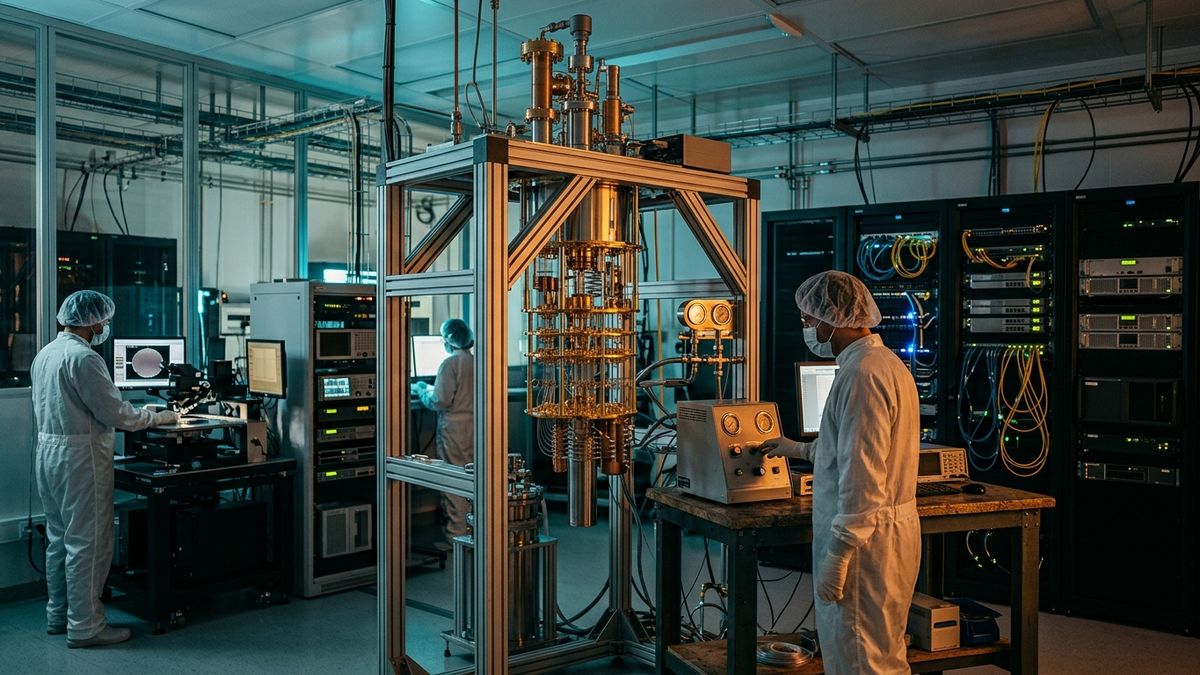
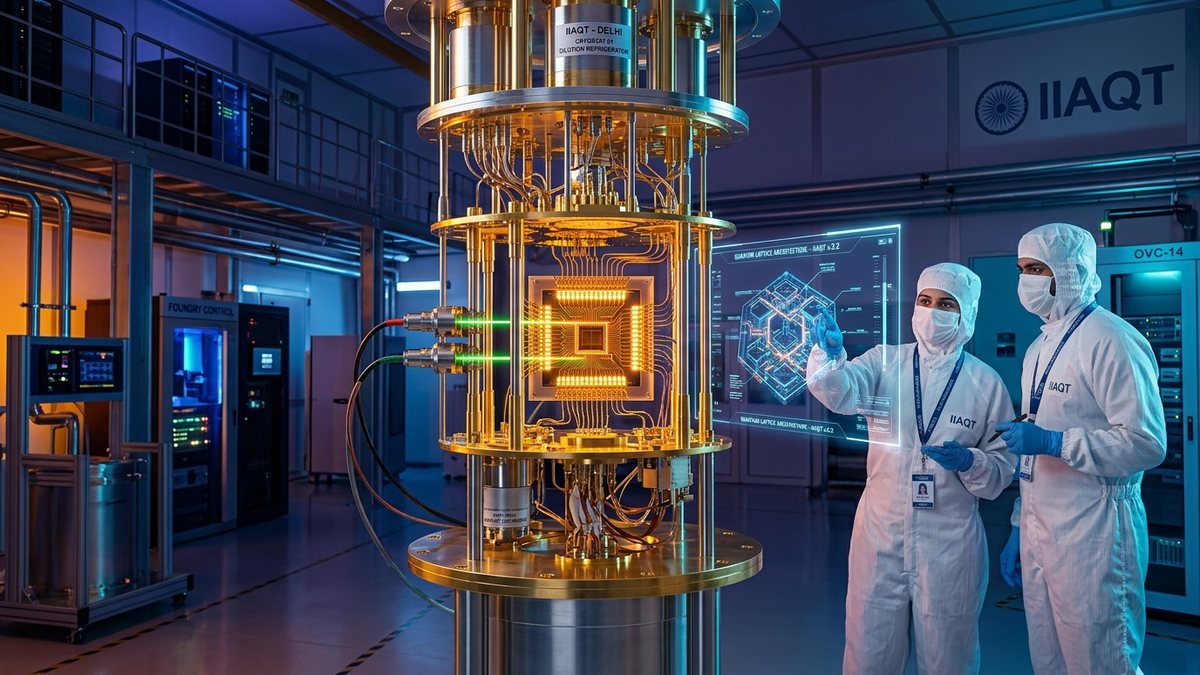
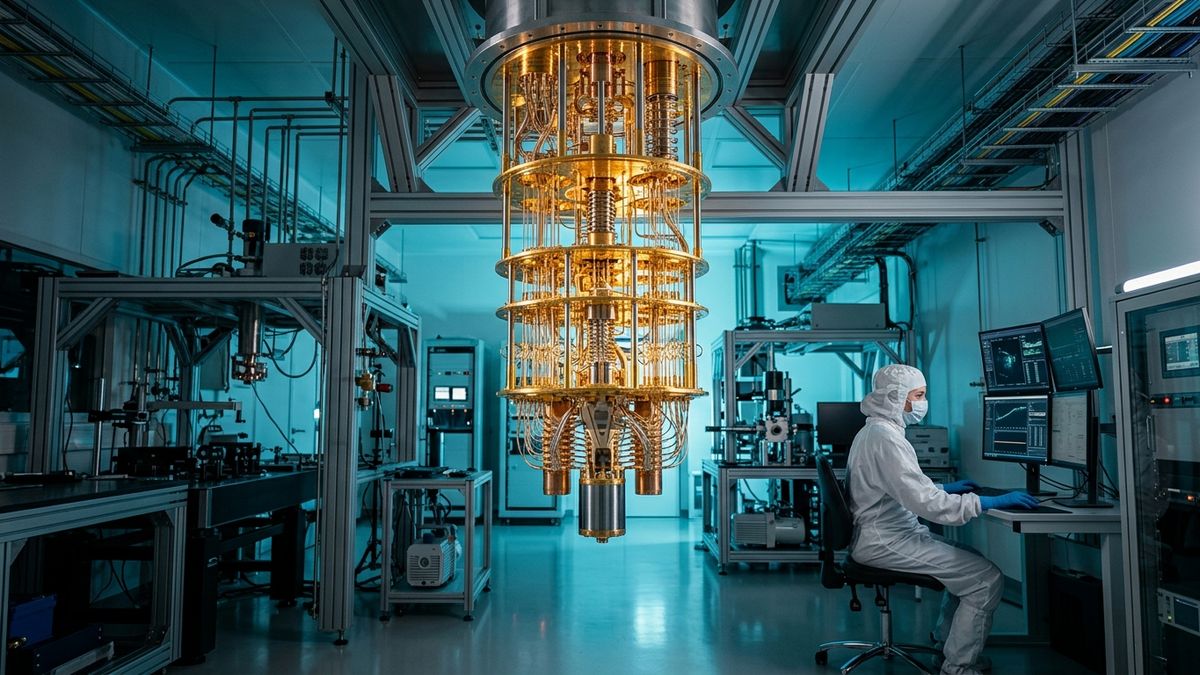
The Amaravati facility will house an IBM Quantum System One enclosed in a hermetically sealed, nine-foot-tall borosilicate glass chamber. Within this casing, a multistage helium dilution refrigerator systematically cools the superconducting processor down to 15 millikelvin (-273.135 degrees Celsius)—colder than outer space—suppressing thermal vibrations and thermal noise to maintain delicate quantum coherence states.
"Deploying utility-scale quantum hardware in Amaravati is not merely an infrastructure installation; it represents a sovereign leap for India's scientific and industrial ecosystem,"said senior technology delegates involved in the project. "By coupling on-premises cryogenic quantum processors with classical high-performance computing clusters, Indian scientists and enterprise engineers can solve simulation challenges that were previously mathematically intractable."
Strategic Alignment with India's National Quantum Mission
The timing of the Amaravati deployment aligns directly with milestones established under India's National Quantum Mission (NQM), approved by the Union Cabinet to develop 50 to 1,000 physical qubit systems over an eight-year horizon. While indigenous laboratories at TIFR, IISc Bengaluru, and IIT Madras work on native superconducting and trapped-ion hardware, the IBM Amaravati center gives the domestic ecosystem immediate access to mature, commercial-grade quantum compilers, pulse-level control software, and active error-mitigation pipelines.
Researchers will utilize IBM's Qiskit open-source quantum software development framework to build algorithms directly optimized for the physical topology of the Amaravati QPU. Furthermore, the facility will serve as a regional training ground, educating thousands of graduate researchers and software engineers in quantum circuit synthesis, noise suppression techniques, and hybrid quantum-classical algorithms.
This hardware deployment complements nationwide developments in advanced digital infrastructure, such as the direct-to-chip data center cooling architectures analyzed in our report on /post/india-deploys-high-density-liquid-cooling-for-30-mw-of-ai-capacity, creating a unified sovereign high-performance computing fabric across southern India.
Key Technical Specifications & Classical Comparison
The structured matrix below contrasts the operational parameters of classical supercomputing with the upcoming Amaravati IBM Quantum System One:
| Architectural Metric | Classical HPC Cluster | Cloud-Based Quantum Emulators | Amaravati IBM Quantum System One |
|---|---|---|---|
| Computational Unit | Binary Bit (0 or 1) | Simulated Software Matrix | Superconducting Qubit |
| Processor Operating Temp | Air/Liquid Cooled (20°C to 45°C) | Ambient Server Room | 15 Millikelvin Cryogenic Chandelier |
| Problem Complexity Scaling | Polynomial / Exponential Time | Memory-Constrained Emulation | Direct Hilbert Space Circuit Execution |
| Noise & Error Model | Deterministic Parity Check | Exact Arithmetic Simulation | Quantum Error Mitigation (M3, TREX, ZNE) |
| Data Latency | Low Local Bus Latency | High Cross-Border Cloud Latency | Low-Latency Sovereign On-Premises Bus |
| Target Workloads | Vectorized Fluid Dynamics & CFD | Small-Scale Toy Proof-of-Concepts | Materials Synthesis, Molecular Binding, Optimization |
High-Impact Enterprise & Scientific Use Cases
The availability of local quantum computing hardware will catalyze breakthroughs across several high-priority sectors in the Indian economy:
- Next-Generation Battery & Materials Chemistry: Simulating electron correlation in complex lithium-sulfur and sodium-ion molecular matrices to accelerate domestic electric vehicle battery lifecycles without requiring years of physical trial-and-error synthesis.
- Pharmaceutical Lead Discovery: Modeling intricate protein-ligand binding affinities at atomic resolutions to slash pre-clinical drug candidate discovery timelines for domestic pharmaceutical majors.
- Financial Risk Modeling & Portfolio Optimization: Executing quantum Monte Carlo simulations and non-linear arbitrage calculations for financial institutions and sovereign funds, optimizing liquidity management under extreme market stress conditions.
- Post-Quantum Cryptography (PQC) Validation: Validating lattice-based cryptographic algorithms and quantum-resistant encryption protocols across critical national infrastructure, banking systems, and defense telecommunications networks.
Similar to how frontier language models are reshaping software delivery—as highlighted in /post/hcltech-partners-with-anthropic-to-build-agentic-ai-solutions—quantum-classical hybrid computing will transform how Indian enterprise teams build next-generation algorithmic IP.
Roadmap to 2027 Commissioning
The implementation roadmap spans three synchronized phases over the next 24 months. Phase 1 entails constructing the specialized high-stability vibration-isolated cleanroom facility in Amaravati, equipped with uninterrupted helium gas recovery systems and clean power feeds. Phase 2 covers the physical assembly of the cryogenic dilution chiller, microwave signal generators, and coaxial cable harnesses. Phase 3 focuses on QPU calibration, Qiskit Runtime integration, and pilot research deployment with premier academic and industrial partners.
By bringing one of the world's most advanced computational instruments to Andhra Pradesh, IBM and Indian leadership are establishing a foundational asset that will anchor the country's deeptech competitiveness for decades to come.
Frequently Asked Questions
What is IBM deploying in Amaravati and when will it be operational?
IBM is deploying India's first on-premises utility-scale Quantum System One hardware in Amaravati, Andhra Pradesh, with commercial and academic commissioning targeted for early 2027.
How will Indian researchers and companies access the Amaravati quantum computer?
The installation will offer both physical on-site access for sovereign research teams and secure hybrid cloud access via IBM Quantum Runtime, enabling cross-institution collaboration across India.
How does this deployment align with India's National Quantum Mission (NQM)?
The National Quantum Mission targets domestic quantum hardware fabrication and algorithmic capabilities. The Amaravati facility serves as a flagship anchor hub, providing researchers immediate access to 100+ qubit systems while indigenous hardware programs mature.
What are the primary industry applications for utility-scale quantum systems?
Primary enterprise use cases include simulating molecular bonds for drug and battery chemistry, optimizing distributed logistics pipelines, quantitative portfolio risk analytics, and designing post-quantum cryptographic primitives.
Primary Sources & Official References
- IBM Quantum Hardware Roadmap & System One Architectural Specifications: Official technical whitepaper on cryogenic hardware design and utility-scale quantum processors.
- Department of Science and Technology (DST): National Quantum Mission Implementation Guidelines and Sovereign R&D Milestones.
- Government of Andhra Pradesh: Amaravati Digital Infrastructure and Advanced Technology Hub Policy Filings.
- Ministry of Electronics and Information Technology (MeitY): Sovereign Computing and High Performance Computing Infrastructure Directives 2026.