ByteAsk Raises $1M for AI Coding Agents
By Karthik Ramaswamy | Published September 24, 2026 | 8 min read
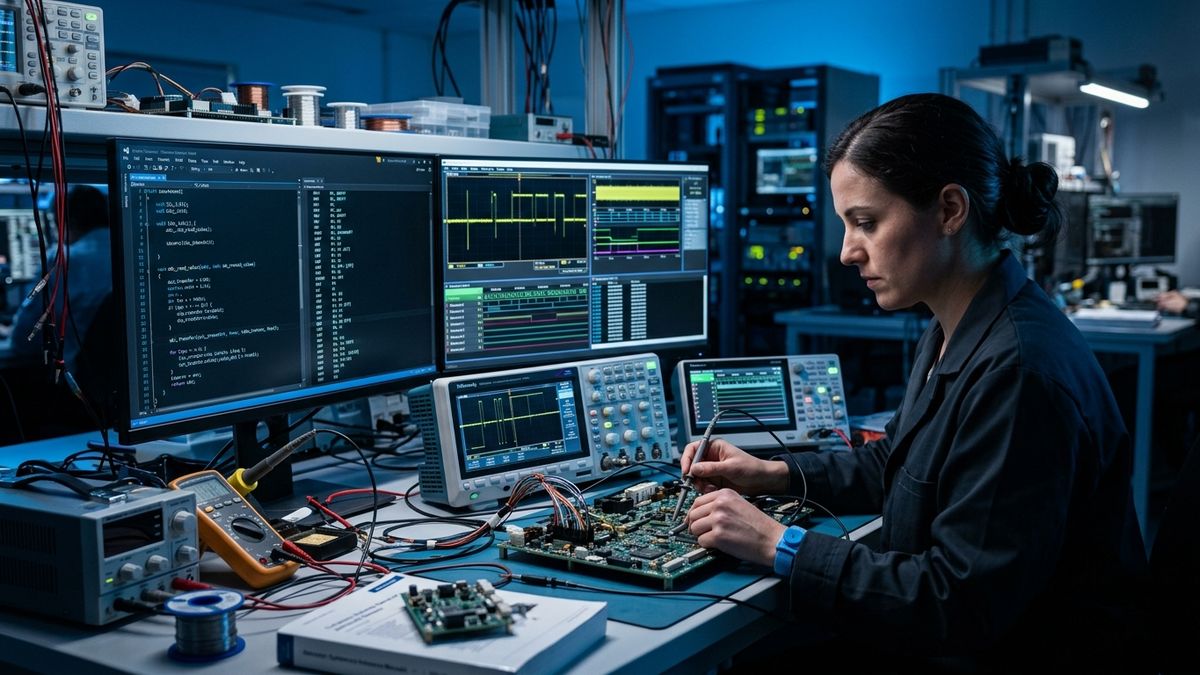
ByteAsk secures $1 million from Y Combinator and Entrepreneur First to build deterministic C/C++ AI coding agents for aerospace, automotive, and robotics.
Deeptech artificial intelligence startup ByteAsk has secured $1 million in seed funding from premier global accelerators Y Combinator and Entrepreneur First (EF) to build deterministic, safety-critical AI coding agents specifically engineered for C and C++ developers. By targeting mission-critical industries—including aerospace, autonomous automotive systems, industrial robotics, and semiconductor device firmware—ByteAsk is pioneering an entirely new category of developer tooling where code correctness is a matter of life and death.
While the broader tech market has been inundated with general-purpose AI coding assistants like GitHub Copilot and Cursor, these tools are predominantly optimized for high-level, interpreted languages such as Python, JavaScript, and TypeScript. In those environments, an occasional logical hallucination or runtime null-pointer exception causes a non-fatal web error.
In embedded C and C++, however, a single unhandled memory leak, buffer overflow, or race condition can crash an aircraft flight control system, disable automotive anti-lock braking algorithms, or brick expensive semiconductor silicon wafers.
The Systems Engineering Chasm in Generative AI
Low-level systems programming in C and C++ represents the foundational bedrock of global infrastructure. Operating system kernels, telecom basestations, flight management computers, missile guidance electronics, and microcontroller firmware all depend on C and C++.
Yet, automated software generation has largely bypassed this domain due to three immense engineering hurdles:
- Strict Determinism and Zero Hallucination Tolerance: Embedded systems governed by standards like DO-178C (avionics) or ISO 26262 (automotive ASIL-D) do not permit probabilistic output. Every function must execute within guaranteed time boundaries and bounded memory constraints.
- Hardware-Software Coupling: C/C++ code interacts directly with physical registers, interrupt service routines (ISRs), and custom peripheral interfaces. Code cannot be verified in a vacuum without modeling the underlying microcontroller architecture (e.g., ARM Cortex-M, RISC-V, Infineon AURIX).
- Mandatory Compliance Standards: Safety-critical codebases must comply with rigorous static analysis guidelines, notably MISRA C:2012, MISRA C++:2023, and CERT C rules.
ByteAsk’s breakthrough lies in combining LLM reasoning with mathematical formal methods and hardware-in-the-loop emulation, effectively bridging this chasm.
"General-purpose LLM code assistants treat software development as a creative autocomplete exercise,"explained systems engineering researchers. "ByteAsk treats code synthesis as a formal mathematical proof. In aerospace and automotive engineering, that distinction is the difference between mission success and catastrophe."
This systems-level capability directly complements broader deeptech efforts in domestic hardware, such as Tata Electronics' rapid build-out of India's semiconductor ecosystem.
Inside the ByteAsk Deterministic Agentic Stack
ByteAsk does not simply generate raw code text. Instead, it operates a multi-phase verification pipeline that wraps generative neural models inside deterministic mathematical guardrails:
- 1. Natural Language to Formal Specification: The developer specifies requirements or bug descriptions. ByteAsk translates the prompt into formal logical assertions and state-machine transitions.
- 2. Symbolic AST Parsing & Constrained Generation: Code generation is constrained by grammar-aware decoders that prevent syntactically invalid constructs or banned keyword usages.
- 3. Automated MISRA & Static Analysis Linter: Every generated snippet is instantly compiled and evaluated against over 170 MISRA C/C++ guidelines, flagging pointer arithmetic violations, type conversions, and potential stack overflows.
- 4. Emulated Hardware Sandbox Execution: Generated routines are deployed into high-speed virtual micro-architectures (QEMU/custom ARM/RISC-V emulators) to confirm timing constraints, register states, and interrupt behaviors before presenting the code to the engineer.
Comparative Feature Matrix: ByteAsk vs. General AI Assistants
The structured table below contrasts ByteAsk's deterministic architecture against standard commercial AI coding tools:
| Capability Dimension | Standard AI Assistants (Copilot / Cursor) | ByteAsk Deterministic Systems Agent | Safety-Critical Impact |
|---|---|---|---|
| Primary Language Focus | Python, JavaScript, Go, HTML/CSS | Embedded C, Modern C++ (11/14/17/20), Rust | Deep specialization in systems code |
| Safety Standard Verification | None; generic linting recommendations | Automated MISRA C/C++, AUTOSAR, CERT C checking | Ready for DO-178C & ISO 26262 audits |
| Memory Safety & Pointer Checks | Probabilistic; frequently hallucinates unsafe pointers | Formal mathematical proofs of memory boundedness | Zero undefined behavior or buffer overflows |
| Execution Sandboxing | Browser or local generic Node/Python runtime | Hardware-in-the-loop virtual emulators (ARM/RISC-V) | Validates clock cycles & register writes |
| Hallucination Tolerance | Tolerated (developer manually debugs) | Zero tolerance (code rejected if proof fails) | Essential for life-critical deployments |
Commercial Traction and Expansion Roadmap
Following their graduation from Entrepreneur First and participation in Y Combinator, ByteAsk's founders have commenced private enterprise pilots with aerospace avionics suppliers, tier-1 automotive component manufacturers, and industrial robotics firms in Europe, North America, and India.
With $1 million in seed capital, ByteAsk is actively recruiting senior compilers engineers, formal verification specialists, and embedded systems veterans to expand support for custom DSPs (Digital Signal Processors) and emerging RISC-V automotive microcontrollers.
By bringing AI speed to the exacting rigor of aerospace and automotive engineering, ByteAsk is poised to unlock massive productivity gains for the engineers whose code keeps our physical world running safely.
Frequently Asked Questions
Why is code generation in C and C++ significantly harder for AI than Python or JavaScript?
Unlike high-level languages with automated garbage collection and runtime sandboxes, C and C++ require explicit manual memory management, precise pointer arithmetic, and direct hardware register access. A subtle bug like an uninitialized pointer or buffer overflow can lead to catastrophic hardware failure, vehicle crashes, or mission-ending aerospace system aborts.
How does ByteAsk prevent dangerous hallucinations in life-critical systems?
ByteAsk integrates neural language models with deterministic symbolic solvers, abstract syntax tree (AST) verifiers, and formal theorem provers. Every line of suggested code is automatically checked against rigorous static analysis rules (such as MISRA C/C++ and CERT C) and compiled in simulated hardware sandboxes before presentation to the engineer.
What role did Y Combinator and Entrepreneur First play in backing ByteAsk?
ByteAsk was incubated through Entrepreneur First (EF), where the founding engineers assembled, before being selected into Y Combinator's elite accelerator batch. The combined $1 million investment provides runway to expand systems engineering talent and sign enterprise design partnerships.
Which specific industries represent ByteAsk's primary target market?
The platform is purpose-built for embedded systems teams in commercial aerospace, autonomous automotive mobility (ASIL-D compliant ECUs), industrial robotics, medical device firmware, and semiconductor design companies developing low-level device drivers.
Primary Sources & Official References
- ByteAsk Systems: Technical Architecture Whitepaper on Deterministic Embedded Code Agents: Internal engineering document detailing formal methods integration with LLM decoders.
- Y Combinator: Summer 2026 DeepTech Batch Directory & Founder Disclosures: Official company listing and accelerator seed investment records.
- MISRA Consortium: Guidelines for the Use of the C Language in Critical Systems: Industry compliance rules for safety-critical C/C++ development.
- IEEE Computer Society: Safety-Critical Software Engineering & Neural Code Synthesis Review: Peer-reviewed analysis on verification requirements for AI code generators.