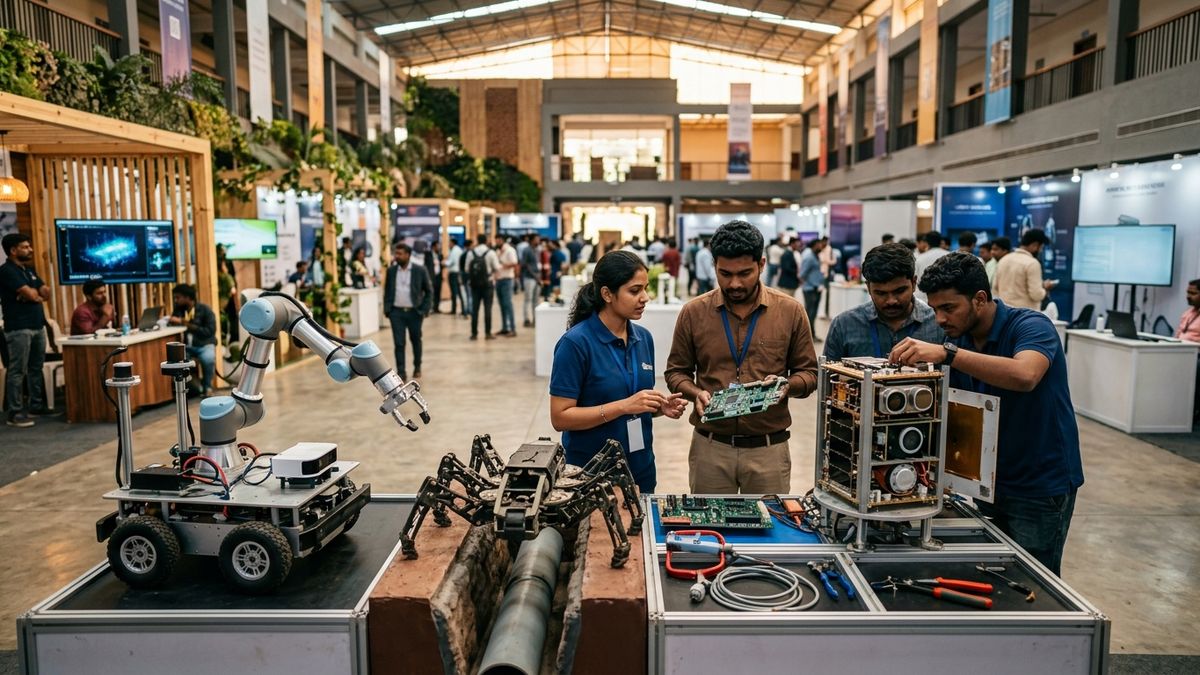
Deeptech automation startup Cosine Robots has secured ₹22.36 crore in capital to advance its embodied AI navigation stack, dexterous robotic manipulators, and indigenous smart factory hardware.
Executive Key Takeaways
- Cosine Robots has secured ₹22.36 crore in institutional funding to spearhead next-generation robotics R&D, edge perception firmware, and indigenous actuators.
- The company is expanding beyond basic material transport to deploy dexterous dual-arm manipulators and multi-modal embodied AI agents inside unstructured factory environments.
- R&D allocations will establish an advanced mechatronics calibration facility in Pune, targeting global export competitiveness against European and East Asian OEMs.
Indian deeptech automation venture Cosine Robots has closed ₹22.36 crore in fresh venture capital dedicated specifically to next-generation robotics innovation and embodied artificial intelligence research. While early factory automation depended heavily on imported mechanical kits and static, pre-programmed movement paths, Cosine Robots is using the capital to design indigenous vision-language-action (VLA) models, high-torque precision actuators, and autonomous mobile manipulation systems engineered in India for global industrial deployment.
Led by frontier technology venture syndicates and industrial hardware investors, the investment enables Cosine to expand its dedicated mechatronics R&D campus in Pune. The engineering roadmap centers on bridging the gap between pure software AI and complex physical dexterity—building industrial machines capable of perceiving unpredictable factory environments, navigating dynamic obstacles, and executing delicate assembly maneuvers safely alongside human workers.
From Rigid Factory Cages to Adaptive Embodied Intelligence
Traditional industrial robots are fundamentally blind and inflexible. Conventional six-axis robotic arms operate inside locked safety cages, endlessly repeating fixed millimeter coordinates; if a component shifts by two centimeters on a conveyor belt, the robot fails or damages the part.
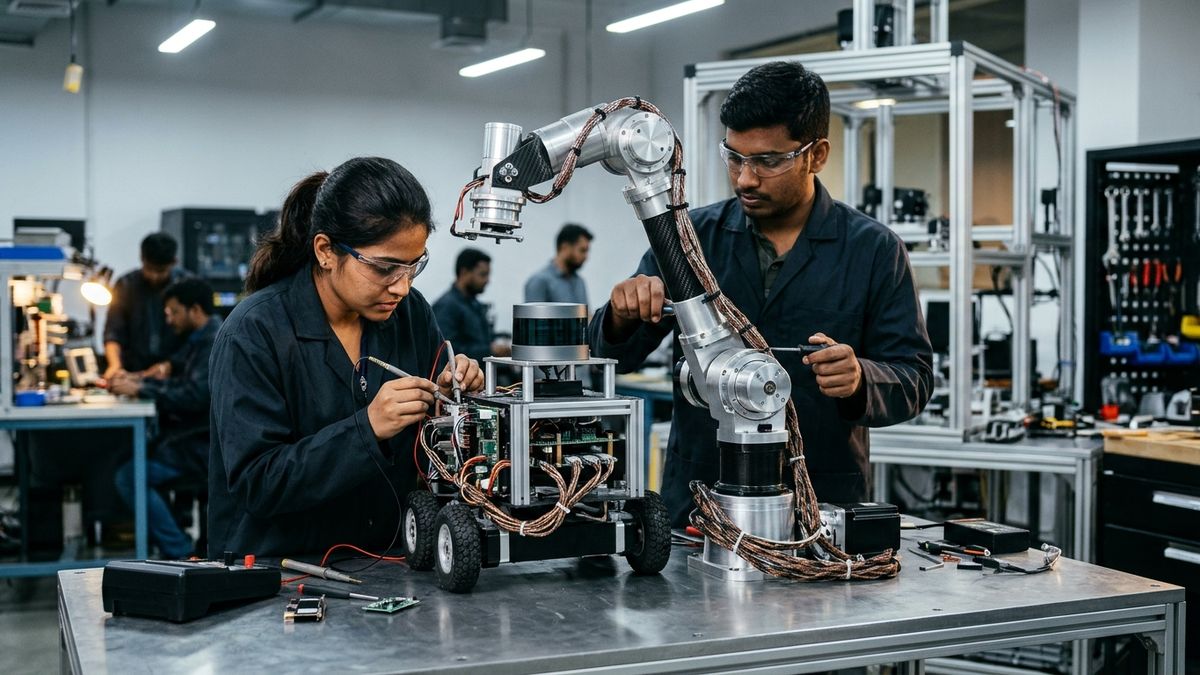
Cosine Robots is engineering a hardware-software architecture powered by embodied AI. By fusing solid-state 3D LiDAR, high-frequency tactile force-torque sensors at the end-effector, and onboard neural compute modules, Cosine's robotic platforms interpret real-world spatial geometry in real time. Rather than requiring expensive human re-programming for every product SKU change, factory technicians can demonstrate or issue natural commands while the robot adapts its kinematic path automatically.
This technological push accelerates India's physical AI momentum, building alongside domestic leaders such as Addverb Technologies' humanoid and quadruped robotics initiatives, Ottonomy's autonomous delivery robotics, and Venttup's AI-powered precision manufacturing.
Engineering Stack Comparison: Legacy Automation vs. Cosine Robotics Innovation
The matrix below highlights key hardware and cognitive advancements driving Cosine Robots' R&D pipeline:
| Robotics Engineering Stack | Conventional Industrial Automation | Imported Turnkey Robotics | Cosine Robots Embodied AI Stack |
|---|---|---|---|
| Perception & Spatial Awareness | Blind; depends on fixed optical jigs | 2D vision with static calibration | 3D Volumetric SLAM + Multi-modal Tactile Sensing |
| Programming & Task Re-tooling | Weeks of specialist PLC coding | Days of offline simulator scripting | Zero-shot neural generalization & rapid calibration |
| Drivetrain & Actuators | Imported bulky hydraulic/stepper motors | Expensive European/Japanese servos | Indigenous high-torque BLDC & cycloidal drives |
| Human-Robot Collaboration | Requires rigid physical steel cages | Limited speed zones on laser curtains | Active force-limiting skin & dynamic trajectory evasion |
| Fleet Coordination Latency | Centralized legacy warehouse server | Proprietary cloud gateway | Distributed edge mesh swarm orchestration |
| Supply Chain Localization | High reliance on foreign spare parts | 12 – 16 week international lead times | 85%+ indigenous mechanical & PCB fabrication |
"True robotics innovation does not happen by bolting open-source software onto imported hardware frames. By investing heavily into core mechatronics, domestic actuators, and embodied neural perception, we are building full-stack industrial intelligence that competes globally on both precision and unit economics."
Advancing Indigenous Mechatronics and Actuator Sovereignty
A major share of the ₹22.36 crore innovation fund is directed at resolving hardware supply chain bottlenecks. Precision robotic joints, harmonic gearboxes, and high-frequency servo controllers historically forced Indian robotics firms to import core components at steep currency markups.
Cosine Robots' innovation program targets three core milestones over the next 18 months:
- In-House Servo & Gearbox Prototyping: Establishing CNC precision machining and thermal testing benches to fabricate ultra-low-backlash actuators domestically.
- Vision-Language-Action (VLA) Edge Firmware: Compiling compact neural policies capable of running at 100 Hz control loops directly on ruggedized industrial GPUs without cloud connectivity.
- Cleanroom & Semiconductor Handling: Validating anti-static, ultra-low-particulate robotic platforms designed specifically for India's upcoming electronics assembly and OSAT packaging plants.
Through focused investment in core physics, actuators, and physical AI, Cosine Robots is strengthening India's emergence as a credible deep-tech robotics manufacturer.
Frequently Asked Questions
How will Cosine Robots deploy the ₹22.36 crore investment?
The capital is dedicated primarily to robotics R&D: advancing embodied AI vision-language-action models, manufacturing indigenous precision servo actuators, expanding mechatronics testing rigs in Pune, and scaling engineering talent.
What is embodied AI in industrial robotics?
Embodied AI integrates multi-modal neural networks with physical hardware actuators and depth sensors, enabling robots to dynamically understand 3D physical space, grasp unfamiliar objects, and adapt to changing factory tasks without rigid hardcoded programming.
Why is domestic actuator manufacturing important for Indian robotics?
Precision cycloidal gearboxes, servo motors, and motor controllers account for nearly 50% of a robot's bill of materials and have historically been imported. Indigenizing these components drastically lowers manufacturing cost and insulates Indian factories from geopolitical supply shocks.
Which sectors are adopting Cosine Robots' innovations?
Automotive assembly plants, semiconductor cleanroom handling, pharmaceutical packaging, and high-throughput e-commerce fulfillment centers are piloting Cosine's autonomous platforms.