Google Selects 4 Indian Startups for AI-for-Climate Accelerator: Terrastack, Varaha, Farmers for Forests, and Climitra Join Inaugural APAC Cohort
By Elena Rostova | Published September 15, 2026 | 8 min read
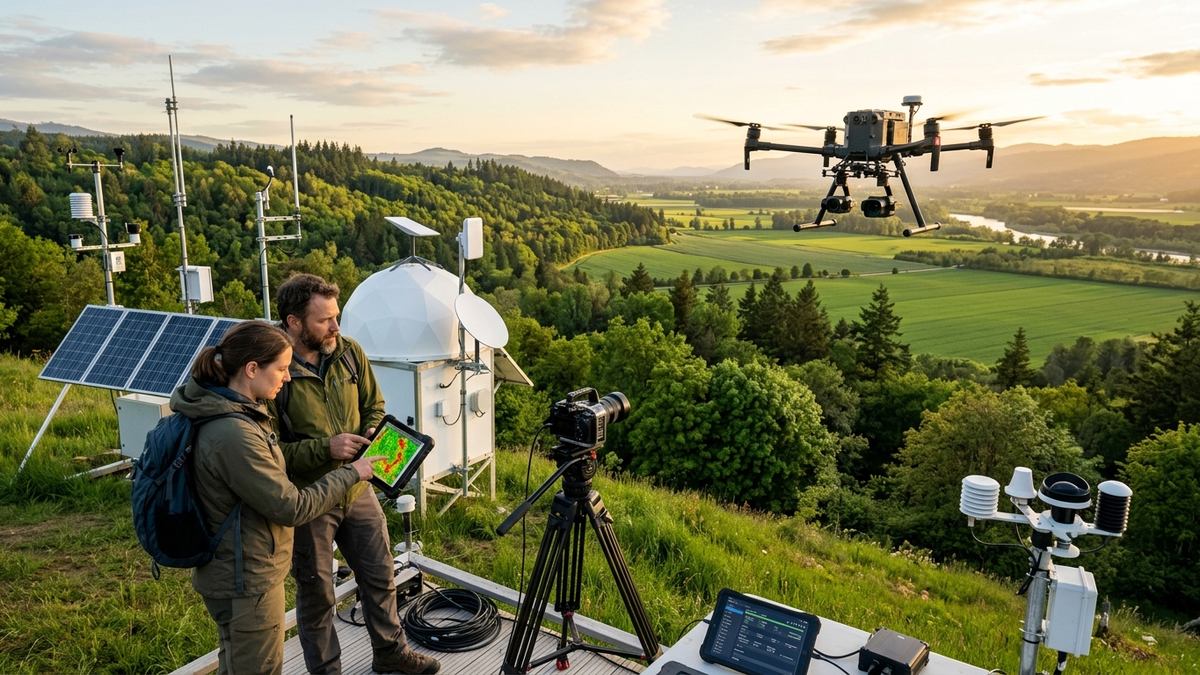
Google selects 4 pioneering Indian climate-tech ventures—Terrastack, Varaha, Farmers for Forests, and Climitra—for its inaugural APAC AI-for-Climate cohort, deploying satellite AI, drones, and biochar verification.
Google has officially selected four pioneering Indian climate-tech startups—Terrastack, Varaha Climate, Farmers for Forests (F4F), and Climitra Carbon—for its inaugural Asia-Pacific (APAC) AI-for-Climate accelerator program, spotlighting India's pivotal transition toward high-impact environmental deeptech. Part of a joint initiative spearheaded by Google DeepMind and Google for Startups, the three-month accelerator equips founders with frontier artificial intelligence models, dedicated Google Cloud high-performance computing clusters, Google Earth Engine geospatial tooling, and hands-on guidance from Google's global research scientists.
By converging synthetic aperture radar (SAR), multispectral satellite imagery, autonomous drone fleets, and predictive foundation models, these four Indian ventures are engineering scalable solutions to address severe ecological vulnerabilities, optimize nature-based carbon sequestration, and advance climate resilience across the Global South.
The Google APAC AI-for-Climate Mandate: Frontier AI for Ecological Action
The Asia-Pacific region stands at the center of the global climate challenge: while generating over half of worldwide industrial carbon emissions, it simultaneously bears disproportionate vulnerability to rising sea levels, severe monsoonal droughts, and agrarian topsoil erosion. Traditional environmental interventions often struggle with sparse ground-truth data, sluggish manual field auditing, and prohibitive verification expenses.
Google's AI-for-Climate accelerator was architected to overcome these friction points. Rather than treating artificial intelligence merely as an optimization layer for enterprise software, the cohort emphasizes sovereign ecological intelligence—training neural models on petabytes of orbital Earth observation data and localized environmental telemetry.
Founders in the program receive direct engineering support to fine-tune multimodal foundation models, integrate advanced atmospheric algorithms such as Google DeepMind's GraphCast weather forecasting engine, and process complex spatial datasets via Google Earth Engine. This programmatic backing directly aligns with national climate initiatives and international cooperation pacts, such as the orbital Earth observation frameworks examined in our report on how India and France deepen cooperation on the next space frontier.
"Accelerating scalable climate solutions demands the convergence of high-capacity compute, frontier neural architectures, and verified physical reality on the ground,"noted Google APAC leadership during the cohort launch. "The Indian startups selected for this inaugural cohort embody that convergence—deploying advanced drone computer vision, satellite radar, and biochar carbon tracking to solve systemic ecological bottlenecks."
Profiles of the 4 Selected Indian Climate-Tech Startups
The four Indian ventures selected represent complementary pillars of modern environmental engineering, spanning geospatial intelligence, carbon offset verification, drone-assisted forestry, and decentralized biochar deployment:
1. Terrastack: Geo-AI and Geospatial Foundation Models
Terrastack develops domain-adapted geospatial artificial intelligence (Geo-AI) platforms that convert raw Earth observation data into actionable climate intelligence. By fusing multi-temporal satellite imagery, radar scatterometry, and thermal sensors, Terrastack provides enterprise and public sector stakeholders with predictive risk analytics covering soil moisture deficits, wildfire vulnerability, and urban heat island dynamics. Through Google's accelerator, Terrastack is training neural segmentation architectures to identify localized micro-climate shifts and predict agrarian water stress weeks before visible crop wilting occurs.2. Varaha Climate: Large-Scale Industrial Biochar & Regenerative Agritech
Varaha has rapidly emerged as one of South Asia's foremost digital Measurement, Reporting, and Verification (dMRV) platforms for nature-based carbon removals. The startup partners with smallholder farming cooperatives across India, Southeast Asia, and Sub-Saharan Africa, incentivizing the adoption of regenerative agriculture, agroforestry, and biochar deployment. Varaha utilizes biogeochemical computer simulations and remote sensing pipelines to calculate net greenhouse gas mitigation with high precision, unlocking institutional carbon finance for rural farming households.3. Farmers for Forests (F4F): Drone Vision and Verified Afforestation
Farmers for Forests operates an innovative "pay-for-performance" conservation and afforestation model. Rather than relying on sporadic manual tree counting, F4F deploys autonomous multi-rotor drones equipped with multispectral sensors and computer vision models to track canopy volume, tree survival rates, and above-ground biomass accumulation over multi-year horizons. Their AI models analyze high-resolution aerial orthomosaics, enabling forest restoration projects to issue verified, audit-grade biodiversity and carbon credits.4. Climitra Carbon: Decentralized Biochar and Permanent Carbon Sinks
Climitra Carbon targets one of India's most persistent environmental issues: post-harvest crop residue burning. By deploying localized pyrolysis kilns that convert agricultural biomass (such as paddy straw and bagasse) into stable biochar, Climitra permanently locks carbon into the soil for hundreds of years. The company integrates Internet of Things (IoT) temperature and pyrolysis telemetry with satellite verification to generate high-durability carbon dioxide removal (CDR) certificates traded on global voluntary markets.Strategic Matrix: Indian Startups in Google AI-for-Climate Cohort
The structured matrix below outlines the technology stacks, ecological domains, and operational targets of the four Indian startups selected for the program:
| Startup Venture | Primary Technology Stack | Climate Vertical | Spatial & Sensing Modality | Strategic Deployment & Target Impact |
|---|---|---|---|---|
| Terrastack | Geo-AI, Spatial Foundation Models, Google Earth Engine | Land Intelligence & Climate Risk | Multispectral Satellite & Synthetic Aperture Radar (SAR) | Predictive drought mapping across 15M+ hectares of agrarian corridors |
| Varaha Climate | Biogeochemical Neural Models, dMRV Pipeline, Pyrolysis Telemetry | Regenerative Agriculture & Soil Carbon | Satellite Remote Sensing & Ground Sensor Calibration | Generating high-integrity carbon removals across 1.2M smallholder farmers |
| Farmers for Forests | Aerial Computer Vision, Drone Photogrammetry, Canopy Classification | Reforestation & Biodiversity Conservation | Autonomous Drone Lidar & Multispectral Aerial Imaging | Real-time canopy auditability and pay-for-conservation incentives |
| Climitra Carbon | IoT Pyrolysis Telemetry, Decentralized Ledger, Spectral Soil Mapping | Agricultural Waste-to-Biochar & Permanent CDR | High-Resolution Earth Observation & Thermographic IoT | Eliminating agricultural residue burning while sequestering 500k+ tonnes of CO2 |
Overcoming the MRV Bottleneck: Bridging Satellites and Autonomous Drones
For decades, voluntary carbon markets and reforestation programs were plagued by the "MRV Bottleneck"—the inability to continuously, accurately, and affordably measure, report, and verify carbon sequestration without human error or fraudulent double-counting. Traditional forestry audits required manual field surveys where inspectors sampled a fraction of a percent of planted trees, resulting in significant variance and diminished institutional investor trust.
The four Indian startups in Google's accelerator overcome this deficit by deploying a continuous multi-tier sensing stack:
* Macro-Scale Orbital Layer: Satellites like Sentinel-2, Landsat, and commercial constellations provide continuous optical and radar coverage across vast agricultural basins, tracking continental-scale vegetation indices (NDVI, EVI) and moisture fluctuations.
* Meso-Scale Aerial Drone Layer: Autonomous drones conduct targeted low-altitude flyovers, generating centimetre-scale 3D point clouds that accurately measure individual tree height, trunk diameter, and canopy density.
* Micro-Scale Terrestrial Ground Truth: IoT-enabled pyrolysis kilns, digital soil probes, and farmer mobile telemetry establish calibrated ground truth that continuously validates and refines the orbital AI models.
This integration of autonomous robotics, aerospace hardware, and neural inference mirrors the rapid expansion of India's physical deeptech clusters, as observed in our analysis of how Tamil Nadu emerges as a deep-tech powerhouse.
The Climate-Tech Investment Landscape and Institutional Horizon
The selection of four Indian startups for Google's flagship regional program reflects an accelerating structural rotation in venture capital and institutional funding. While global funding for generic consumer mobile software has cooled, climate-tech and environmental deeptech have seen sustained institutional resilience. Global sovereign wealth funds, corporate carbon buyers, and specialized venture capital funds are seeking high-durability, quantifiable removal solutions that withstand rigorous regulatory scrutiny.
Furthermore, state and central governments across India are actively dismantling regulatory friction points for climate ventures. Initiatives such as state-backed procurement programs—highlighted in our reporting on how Karnataka launches ₹25 Cr 'Government First' startup initiative—are increasingly opening municipal and agrarian pilot corridors to indigenous tech providers.
As Terrastack, Varaha, Farmers for Forests, and Climitra enter the three-month Google accelerator, they carry the opportunity not only to refine their neural architectures on Google's supercomputing clusters, but to establish India as the global benchmark for scalable, science-backed climate intelligence.