Armatrix Robotics wins 'Best on Campus' at ET Startup Awards 2026 for its 22-DoF snake-like robotic arms built to inspect confined, hazardous spaces across naval and heavy industrial sites.
Executive Key Takeaways
- Armatrix Robotics wins 'Best on Campus' at ET Startup Awards 2026 for its 22-DoF snake-like robotic arms built to inspect confined, hazardous spaces across naval and heavy industrial sites.
- Confined-space maintenance has remained one of the most perilous, expensive, and archaic blind spots in global industry, explained the Armatrix co-founders. By mastering hyper-redundant inverse kinematics and decoupled cable-drive actuation, Armatrix allows plant operators to send a robotic snake deep into a submarine bilge or chemical reactor, map interior defects in 3D, and execute ultrasonic non-destructive testing without a single human risking their life.
- Key Benchmark: **Human Fatality & Toxic Gas Risk** — Severe (Requires breathing apparatus & safety ropes)
KANPUR — In a resounding triumph for Indian academic deep-tech engineering, Armatrix Robotics, a pioneering robotics venture incubated at IIT Kanpur, has been awarded the coveted 'Best on Campus' honour at The Economic Times Startup Awards (ETSA 2026).
Founded in 2024 by three visionary IIT Kanpur graduates—Vishrant Dave, Prateesh Awasthi, and Ayush Ranjan—Armatrix has engineered a breakthrough class of hyper-redundant, snake-like continuous robotic manipulators designed to enter, navigate, and maintain highly confined and hazardous industrial environments that are structurally inaccessible or lethally dangerous for human workers.
The award jury, chaired by Wipro Executive Chairman Rishad Premji, praised Armatrix for transforming world-class academic research in kinematic mechanics into commercial industrial hardware. Having recently secured $2.1 million in seed funding from institutional deeptech funds including pi Ventures and GradCapital, Armatrix is already deploying commercial pilots across naval shipbuilding yards, nuclear power facilities, and petrochemical refineries.
This milestone reinforces the structural engineering capabilities of Indian academic incubators, complementing sovereign space hardware analyzed in InspeCity’s ₹100 Crore Space Servicing Round and hardware-in-the-loop aerospace breakthroughs covered in Airbound Raises $3.7 Million for Autonomous Blended-Wing Cargo Drones.
Overcoming the Physics of Confined-Space Industrial Inspection
Heavy industrial infrastructure—such as naval warship double-bottom hulls, thermal power plant boiler tubing, oil refinery storage tanks, and aircraft wing fuel cells—presents an existential maintenance crisis. Currently, inspecting these spaces requires either human technicians to squeeze into dark, toxic, oxygen-deprived compartments (a leading cause of industrial fatalities worldwide) or multimillion-dollar structural teardowns that take critical infrastructure offline for weeks.
Traditional industrial robotic arms (such as 6-axis articulated arms from FANUC or KUKA) are fundamentally incapable of operating in these spaces: they are bulky, rigid, require vast swing clearance, and cannot maneuver around complex interior obstacles.
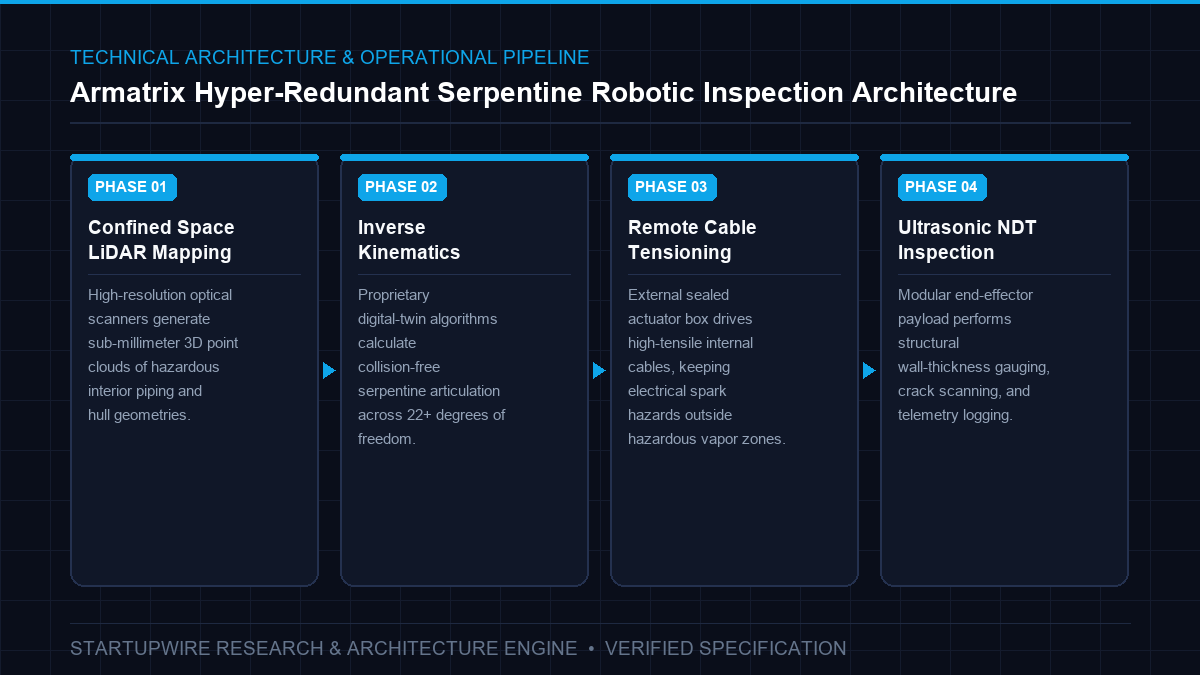
Armatrix solved this fundamental physical bottleneck through an ingenious decoupled mechanical architecture:
- Hyper-Redundant Articulation: The robotic arm spans 3 to 5 meters in length with an ultra-slender diameter of just 50 to 150 millimeters, incorporating over 22 independent degrees of freedom (DoF) that mimic the continuous biomechanical motion of a biological serpent.
- External Decoupled Actuator Box: Instead of placing electric motors and heat-generating electronics inside the robotic joints (which would create catastrophic explosion risks in volatile hydrocarbon atmospheres), Armatrix houses all motors, processors, and power systems in a hermetically sealed external base station.
- Tensioned Cable-Drive Transmission: High-tensile synthetic cables run through the interior of the articulated links, transmitting precision mechanical torque to each joint without exposing any live electrical circuits to hazardous gases.
"Confined-space maintenance has remained one of the most perilous, expensive, and archaic blind spots in global industry,"explained the Armatrix co-founders. "By mastering hyper-redundant inverse kinematics and decoupled cable-drive actuation, Armatrix allows plant operators to send a robotic snake deep into a submarine bilge or chemical reactor, map interior defects in 3D, and execute ultrasonic non-destructive testing without a single human risking their life."
Comparative Benchmark: Human Entry vs Rigid Robotics vs Armatrix Serpentine Systems
The operational and safety superiority of Armatrix’s hyper-redundant robotic technology over legacy inspection paradigms is detailed below:
| Operational Metric | Manual Human Confined Entry | Traditional Rigid Robotic Arms (KUKA/ABB) | Armatrix Snake-Like Robotic Platform |
|---|---|---|---|
| Human Fatality & Toxic Gas Risk | Severe (Requires breathing apparatus & safety ropes) | N/A (Cannot enter narrow openings < 500mm) | Absolute Zero Human Hazard (Operated Remotely) |
| Minimum Access Aperture | > 600 mm (Manhole diameter requirement) | Requires full panel disassembly (> 1,200 mm) | 50 – 150 mm (Can enter through standard inspection ports) |
| Degrees of Freedom (Kinematic Dexterity) | Limited human reach in prone crawl | 6 Degrees of Freedom (Rigid link constraints) | 22+ Continuous Hyper-Redundant Degrees of Freedom |
| Explosive Zone Safety (ATEX / HAZMAT) | Extreme ignition risk from equipment | Heavy, non-spark certified casings required | Intrinsically Safe (All motors sealed in external base) |
| Structural Teardown Downtime | 7 – 14 Days of plant shutdown for ventilation | Weeks of scaffolding & piping disassembly | Deployment in under 30 minutes with zero downtime |
| Inspection Data Integrity | Subjective human visual logs; high error rate | Limited sensor coverage | Sub-millimeter LiDAR & Ultrasonic Non-Destructive Testing (NDT) |
Digital Twin Navigation and AI-Driven Path Planning
Navigating a 5-meter snake arm with 22 articulation joints through a convoluted labyrinth of pipes cannot be accomplished with a simple manual joystick. Armatrix developed an autonomous path-planning engine powered by real-time spatial computing and digital twins.
As the robotic end-effector moves forward, miniature optical cameras and solid-state LiDAR sensors map the interior geometry in real time, building a 3D point cloud of the confined space. The company’s algorithmic solver computes the exact curvature of every preceding joint, ensuring that the body of the snake follows precisely in the trace of the head (a property known as follow-the-leader kinematics), preventing the arm from ever scraping or jamming against delicate interior walls.
With early commercial contracts signed across Indian defense shipbuilders and heavy manufacturing plants, Armatrix’s ETSA 'Best on Campus' recognition signals that India's premier engineering institutions have emerged as global leaders in commercial deeptech and mission-critical physical robotics.