IBM Expands Frontier Research With IIT Bombay and IISc Across Agentic AI, Indic LLMs and Quantum Computing
By Elena Rostova | Published October 2, 2026 | 8 min read
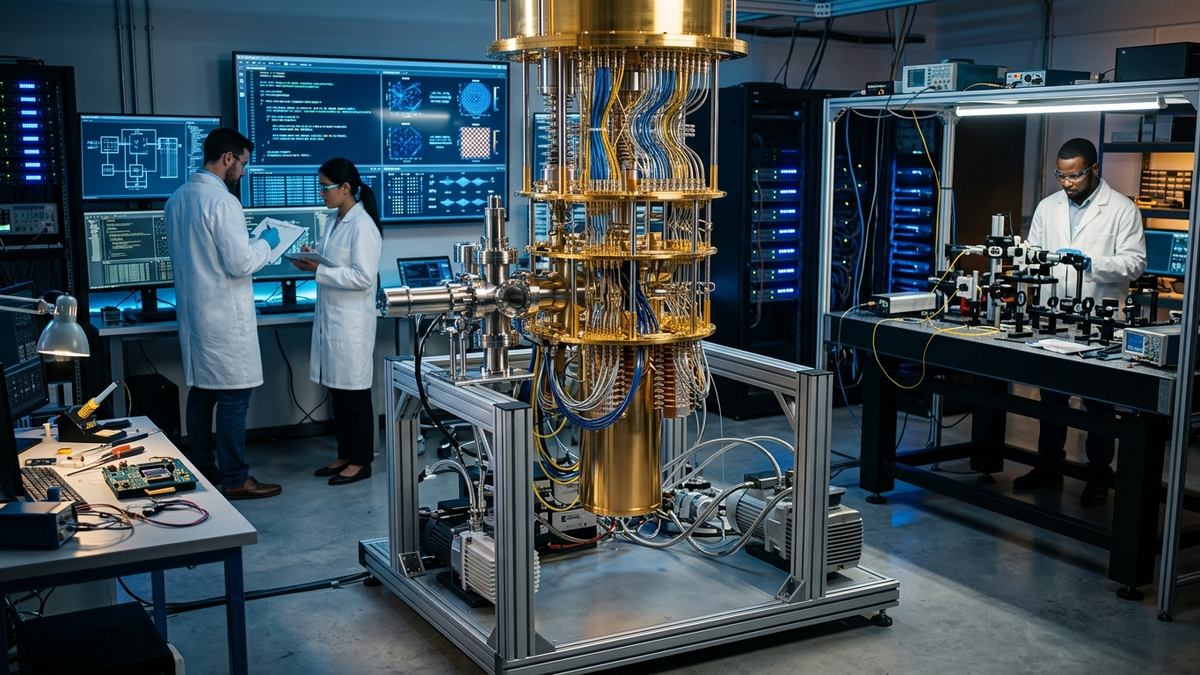
IBM expands multi-year research partnerships with IIT Bombay and IISc Bengaluru focusing on sovereign AI architectures, Indic foundation models, agentic systems, and quantum computing.
IBM has announced an expansive, multi-year expansion of its collaborative scientific research programs with two of India's premier academic and technological bastions—the Indian Institute of Technology (IIT) Bombay and the Indian Institute of Science (IISc) Bengaluru. The strategic research compact unites IBM's global research divisions with Indian faculty and doctoral fellows to tackle foundational scientific challenges across five frontier tracks: agentic AI architectures, sovereign Indic-language foundation models, AI infrastructure optimization, fault-tolerant quantum algorithms, and quantum utility benchmarking.
The expanded initiative provides Indian researchers with unprecedented access to IBM's state-of-the-art computational infrastructure, including cloud-based access to IBM's utility-scale quantum processors (such as the 127-qubit Eagle and 133-qubit Heron architectures) and the open-source Granite family of enterprise models. The alliance underscores India's evolving stature from a consumer of global software into an authoritative generator of fundamental computer science intellectual property.
Five Frontier Research Tracks: From Autonomous Agents to Quantum Utility
The collaborative roadmap is structured around five deeply interconnected technical tracks designed to address severe algorithmic and physical computational limitations:
- Agentic AI & Complex Reasoning: Investigating multi-agent orchestration frameworks where autonomous software agents decompose multi-step enterprise workflows, verify factual grounding, and interact safely with external software APIs and physical databases.
- Indic Foundation Models & Linguistic Equity: Tackling tokenization inefficiencies in low-resource Indian languages. Mainstream LLMs suffer from severe token fragmentation when processing Devanagari, Dravidian, and other regional scripts, driving up inference costs by up to 400%. The joint team is engineering vocabulary-efficient tokenizers and cross-lingual representation models.
- AI Infrastructure & Compiler Optimization: Co-designing hardware-software co-optimizations to reduce memory bandwidth bottlenecks during LLM serving, utilizing customized kernels and low-precision integer quantization techniques.
- Quantum Algorithmic Benchmarks: Developing novel quantum circuits for combinatorial optimization problems in logistics, financial portfolio balancing, and chemical molecular simulations.
- Quantum Error Mitigation & Noise Characterization: Deploying probabilistic error cancellation (PEC) and zero-noise extrapolation (ZNE) algorithms on near-term noisy intermediate-scale quantum (NISQ) systems to extract reliable computational results before full fault-tolerant error correction arrives.
Frontier Research Pipeline: IBM + IIT Bombay & IISc
[ Core Research ] ---> [ Indic LLMs / Agentic Systems ] ---> [ Sovereign AI Apps ]
         |
         +-----------> [ Quantum Circuits / Cryogenics ] -> [ National Quantum Mission ]
Matrix of Collaborative Research Tracks & Institutional Directives
The breakdown below outlines the operational focus, institutional leads, and targeted scientific milestones across the five research tracks:
| Research Domain | Academic Lead Institution | Primary Computing Resource | Milestone Deliverable |
|---|---|---|---|
| Agentic AI & Orchestration | IIT Bombay | IBM Watsonx & Granite LLMs | Multi-Step Reasoning & Self-Correction Engine |
| Indic Linguistic Models | IIT Bombay & IISc | Enterprise GPU Superclusters | High-Efficiency 22-Language Tokenizer Suite |
| Quantum Chemistry & Materials | IISc Bengaluru | IBM Heron 133-Qubit Processor | High-Precision Catalyst Simulation Algorithms |
| Quantum Error Mitigation | IISc Bengaluru | Qiskit Runtime Primitives | Utility-Scale Benchmarking Frameworks |
| Efficient AI Systems | IIT Bombay | Heterogeneous AI Acceleration Racks | Sub-4-Bit Model Serving Compiler Stacks |
"Sovereign technological leadership cannot be achieved through commercial software licensing alone; it requires fundamental scientific discovery at the atomic and mathematical levels,"stated senior leadership at IBM Research. "By deepening our relationships with IIT Bombay and IISc Bengaluru, we are accelerating the timeline toward practical quantum utility while ensuring that next-generation generative AI natively understands India's unique linguistic and socio-economic context."
Deepening Synergies With Sovereign Cloud and Vernacular AI
IBM's academic expansion complements its industrial sovereign infrastructure footprint in India. Recently, IBM partnered with domestic cloud giant Yotta to deploy enterprise AI pipelines, as reported in IBM and Yotta's launch of a sovereign agentic AI platform on Shakti Cloud. The research conducted at IIT Bombay and IISc will feed directly into open-source enterprise stacks deployed on sovereign domestic clouds.
Furthermore, the focus on vernacular intelligence mirrors the rapid venture momentum behind domestic language models, where startups like Arivihan raised funding to scale vernacular Indic AI tutoring. By addressing the mathematical foundation of Indic tokenization at the university level, IBM and its academic partners are solving the core bottleneck that has historically hampered regional AI adoption.
Catalyzing India's National Quantum Mission (NQM)
In quantum computing, the partnership serves as a vital accelerator for India's Rs 6,003-crore National Quantum Mission (NQM), overseen by the Department of Science and Technology. While India is actively building its domestic cryogenic and photonic testbeds, accessing IBM's commercial quantum fleet allows Indian researchers to run quantum algorithms on live hardware today.
This hands-on access is crucial for commercial quantum spin-outs and cybersecurity pioneers, such as QNu Labs raising Rs 200 crore to scale quantum key distribution and cryptographic defense. As India executes its broader frontier technology initiative backed by thousands of crores in public capital, the collaboration between IBM, IIT Bombay, and IISc provides the human capital, academic rigor, and experimental validation needed to secure India's position at the forefront of the quantum era.
Frequently Asked Questions
What is the primary focus of IBM's expanded collaboration with IIT Bombay and IISc?
The partnership focuses on advancing research in five frontier technological domains: agentic AI systems, sovereign Indic-language models, specialized AI infrastructure optimization, practical quantum computing algorithms, and quantum materials simulations.
What computing resources will researchers at IIT Bombay and IISc be able to access?
Researchers will access IBM's utility-scale quantum computing processors (including the 127-qubit Eagle and 133-qubit Heron systems via the cloud), high-performance AI computing clusters, and open-source enterprise Granite foundation models.
Why is Indic-language modeling a critical pillar of this research?
Most mainstream large language models are trained overwhelmingly on English and European tokens, leading to poor syntactic reasoning and high tokenization costs in low-resource Indic languages. The joint research creates specialized tokenizers and semantic alignment pipelines tailored for Indian linguistic diversity.
How does this research support India's National Quantum Mission (NQM)?
The collaboration directly aligns with the objectives of the National Quantum Mission by training doctoral researchers, designing quantum algorithms for indigenous industrial use cases, and advancing quantum error mitigation techniques.
Primary Sources & Official References
- IBM Research Global: Academic Collaboration & Frontier Computing Initiatives.
- Indian Institute of Technology Bombay (IIT Bombay): Department of Computer Science & Engineering Annual Report.
- Indian Institute of Science (IISc Bengaluru): Centre for Quantum Technologies and Artificial Intelligence.
- Department of Science and Technology (DST): National Quantum Mission Implementation Guidelines.